 Software DevelopmentSQL vs NoSQL Databases: Differences and How to ChooseHow SQL and NoSQL databases differ in data model, schema, scaling and consistency, where each one fits, and five questions to choose for your project.
CodeeoInsightsSoftware Development
Best HR Management Apps and How to Choose the Right One
A neutral look at popular HR management apps, including BambooHR, Workday, Rippling, Paycor and monday.com, plus a checklist for choosing the right one.
The best HR management app is the one that fits your company size, the countries you employ people in, and the HR work you most need to simplify. For small and midsize teams, focused HR platforms such as BambooHR are a common starting point; larger enterprises tend to look at suites such as Workday; and companies that want HR, payroll and IT in one place often consider Rippling. General work management tools like monday.com can handle HR workflows when your needs are simpler.
This guide explains what HR management apps do, compares well known options neutrally, and gives you a practical checklist for choosing one, or deciding when a custom build makes more sense.
What an HR management app does
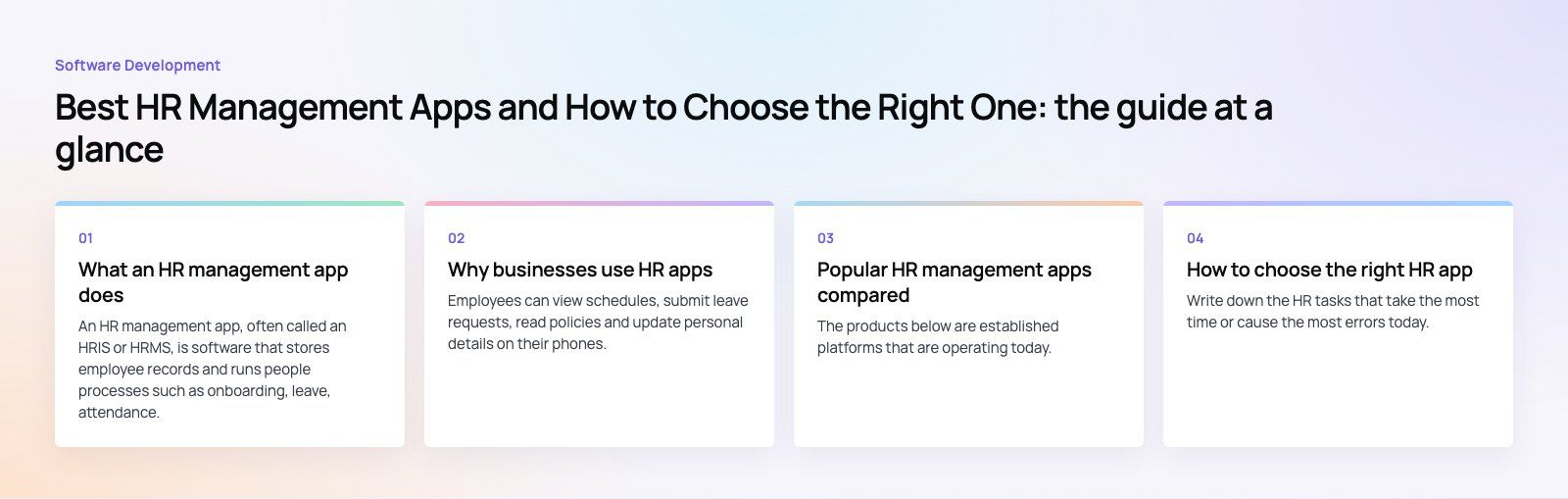
An HR management app, often called an HRIS or HRMS, is software that stores employee records and runs people processes such as onboarding, leave, attendance, performance reviews, payroll and reporting. Most modern platforms have a web dashboard for HR and a mobile app for employees and managers, so people can request time off, check payslips or approve requests from anywhere.
Why businesses use HR apps
Access from anywhere
Employees can view schedules, submit leave requests, read policies and update personal details on their phones. That matters most for teams that are remote, on shift or in the field, who rarely sit at a desk.
Less manual administration
Automated workflows replace paper forms and email chains for approvals, onboarding tasks and document collection. HR staff spend less time chasing signatures and more time on hiring, development and employee relations.
Faster onboarding
New hires can complete forms, read handbooks, watch training material and meet their checklist before day one. A structured digital onboarding flow helps people become productive sooner.
Better communication and engagement
Company news, directories, announcements and surveys keep distributed teams connected. Some platforms also include recognition features so colleagues can thank each other publicly.
Performance management
Goals, check ins, reviews and feedback live in one place, so managers and employees can track progress during the year instead of reconstructing it at review time.
Security and compliance
Role based access controls, audit trails and encryption protect sensitive personal and pay data. Good platforms also help with record retention and with local employment rules, though coverage varies by country.
Reporting and insight
Built in analytics show turnover, absence, headcount and training completion, which supports workforce planning and budgeting.
Popular HR management apps compared
The products below are established platforms that are operating today. Features and packaging change often, so treat this as a shortlist to investigate, not a ranking. Check each vendor's current plans, country coverage and pricing directly.
BambooHR
BambooHR is HR software aimed at small and medium sized businesses. It centers on the employee record, with hiring, onboarding, time off, performance and reporting around it. It is often chosen by companies replacing spreadsheets with their first dedicated HR system, because it is quick to set up and simple for employees to use.
Workday
Workday is an enterprise platform covering human capital management and finance. It suits larger and multinational organizations that need complex organizational structures, workforce planning, recruiting, talent management and analytics in one system. Implementation is a significant project, usually involving consultants and months of configuration.
Rippling
Rippling combines HR, payroll and IT administration, including employee onboarding, app access and device management, on one employee record. It appeals to growing companies that want a new hire's payroll, laptop and software accounts set up from a single workflow.
Paycor
Paycor offers HR and payroll software focused on US employers, with time tracking, benefits administration and talent features. Paychex completed its acquisition of Paycor in April 2025, according to Paycor's announcement, so buyers should ask how the product roadmap fits into the combined company.
monday.com
monday.com is a general work management platform rather than a dedicated HR system. Teams use its boards and automations for recruitment pipelines, onboarding checklists and request tracking. It is flexible and familiar to many teams, but it does not replace payroll or a full employee record system.
| App | Best suited to | Strengths | Watch out for |
|---|---|---|---|
| BambooHR | Small and midsize businesses | Ease of use, core HR and onboarding | Fewer options for complex enterprise structures |
| Workday | Large and multinational organizations | Breadth across HR and finance, analytics | Long, complex implementation |
| Rippling | Growing companies with many tools and devices | HR, payroll and IT on one record | Modular packaging to review carefully |
| Paycor | US employers | Payroll, time and benefits together | US focus; roadmap after the Paychex acquisition |
| monday.com | Teams needing simple HR workflows | Flexible boards and automation | Not a full HRIS or payroll system |
How to choose the right HR app
1. List the processes that hurt most
Write down the HR tasks that take the most time or cause the most errors today. Leave approvals, onboarding paperwork, payroll inputs and review cycles are common. Choose a platform that solves those first, rather than the one with the longest feature list.
2. Check country coverage
Payroll, leave rules and statutory reporting differ by country. Many well known platforms are built mainly for the US market. If you employ people in the Gulf, Europe or Asia, confirm local payroll, language and right to left support before going further.
3. Map integrations
The HR app should share data with your accounting or ERP system, identity provider, collaboration tools and applicant tracking. Ask for documented APIs and existing connectors. Without them, you will end up re keying data between systems.
4. Test the employee experience
Run a short pilot with real employees and managers. If the mobile app is confusing, adoption will be low and HR will keep receiving requests by email.
5. Review security and data handling
Ask where data is hosted, how access is controlled, how audit logs work and how the vendor handles data protection obligations in your markets.
6. Understand what drives cost
Costs usually depend on the number of employees, the modules you switch on, implementation and data migration effort, integrations and support level. Compare total cost over several years, not just the first year.
When a custom HR app makes sense
Off the shelf platforms cover standard HR well. A custom build or extension is worth considering when your processes are part of how you compete: shift based workforces, field teams, regulated industries or marketplaces where workers and customers interact in the same product.
Our Distinct case study covers a healthcare workforce platform with shifts, bookings, incident reports, reviews and rewards, and the Jobiq case study shows a marketplace where vendors run their teams. Many companies take a middle path: keep a standard HRIS for records and payroll, and build a focused mobile app or connect platforms such as Microsoft 365 and Power Platform for the workflows that are unique to them.
Where HR apps are heading
- AI assistance. Drafting job descriptions, answering policy questions and summarizing feedback are becoming standard features.
- Skills based talent management. Platforms increasingly map skills, recommend learning and match people to internal roles.
- Employee experience. Wellbeing, recognition and continuous feedback sit alongside core administration.
- Support for hybrid work. Remote onboarding, flexible scheduling and distributed team communication are expected.
- Deeper analytics. Predictive reporting on attrition risk and hiring needs feeds workforce planning.
If you are deciding between an off the shelf HR platform and building your own, Codeeo can help you compare the options. We have delivered 200+ projects across the UAE and the US, and a platform fit review is a practical first step before committing to either path.
Frequently asked questions
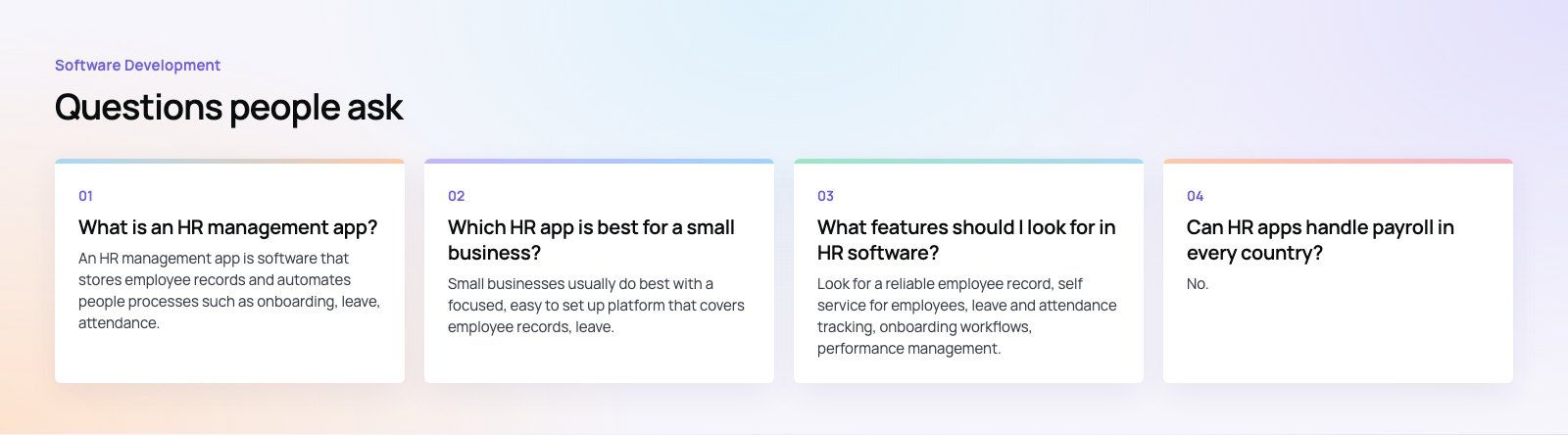
An HR management app is software that stores employee records and automates people processes such as onboarding, leave, attendance, performance reviews, payroll and reporting.
Most platforms combine a web dashboard for HR teams with a mobile app for employees and managers, so requests, approvals and updates can happen anywhere without paper forms or long email chains between departments.
Software DevelopmentSQL vs NoSQL Databases: Differences and How to ChooseHow SQL and NoSQL databases differ in data model, schema, scaling and consistency, where each one fits, and five questions to choose for your project. Software DevelopmentOpen Source Apps: Examples, Licenses and How to Build Your OwnWhat makes an app open source, well known examples, the steps to build your own, how to pick MIT, Apache or GPL, and when to customize instead.
 Software DevelopmentHow an Online HR Portal Improves Employee ExperienceWhat an online HR portal does, how self service improves employee experience, which features matter, and whether to buy, configure or build one.
Tell us what the business needs. We will tell you what to build first.
Schedule a free consultation and get a written recommendation, with costs, before you commit to anything.
Get in touchPROVEN RESULTS
4.7 / 5verified reviews on Google