 E-Commerce10 Features of a High-Converting Ecommerce WebsiteThe ten features that turn store visitors into buyers, from product pages and checkout to speed, mobile design, social proof and ongoing testing.
How to Build a Marketplace Website Like Etsy
How to build a maker marketplace like Etsy: picking a niche, platform options, buyer and seller features, split payouts, cost drivers and monetization.
To build a website like Etsy, you need a multi vendor marketplace where independent makers open their own shops, list one of a kind products with variations, and get paid automatically after each sale, while buyers discover items through search, categories and recommendations. The fastest route is to start with a niche, launch on marketplace software or a multi vendor setup, and move to a custom or headless build once you know what your sellers need. Cost depends mainly on how many features you build custom and how many integrations you add.
This guide breaks down how the Etsy model works, the features buyers and sellers expect, your platform choices, the cost drivers, monetization and the legal points to settle before launch.
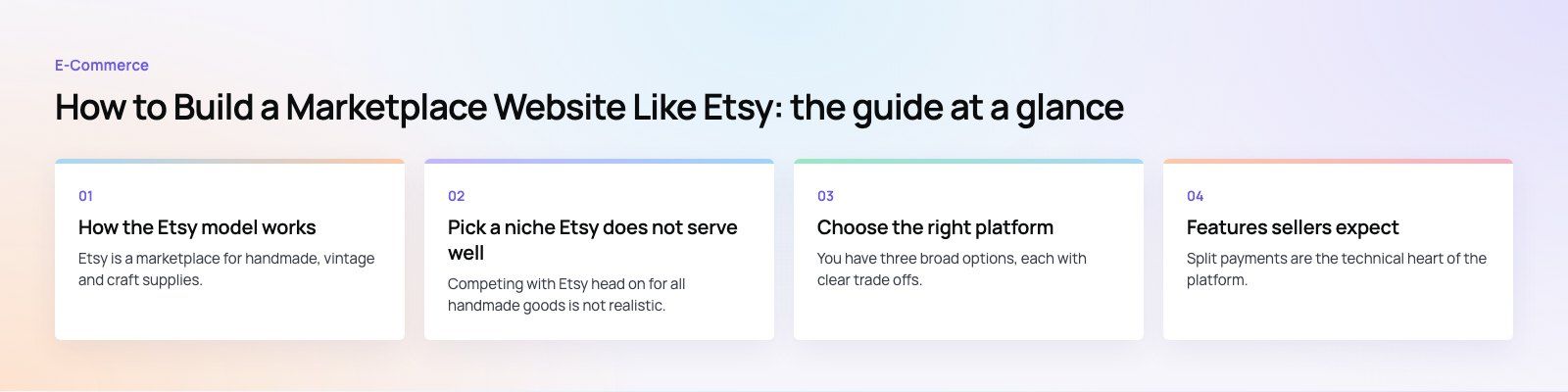
How the Etsy model works
Etsy is a marketplace for handmade, vintage and craft supplies. It does not hold stock. Thousands of small sellers run their own shops on the platform, and Etsy provides the traffic, the checkout, the payment processing and the trust signals. It earns from sellers through listing fees, a commission on each sale, payment processing fees, optional advertising and a paid seller subscription.
Three things make the model work, and any site like Etsy has to recreate them:
- A strong identity. Buyers go to Etsy for something they cannot get on a general store. Your marketplace needs the same clear reason to exist.
- Easy selling. A maker can open a shop and list a product in minutes without technical skills.
- Discovery. Search, categories, collections and recommendations surface small sellers who would never be found on their own.
Pick a niche Etsy does not serve well
Competing with Etsy head on for all handmade goods is not realistic. Successful alternatives focus on a community Etsy treats as one category among thousands: local makers in one country, sustainable fashion, art prints, modest wear, wedding stationery, regional crafts, or digital downloads for a profession. A focused niche lets you build features that matter to that group, such as custom order workflows for commissions, local pickup, or bilingual listings.
Before building, confirm you can recruit your first sellers. A marketplace with five shops does not attract buyers, and a marketplace with no buyers does not keep sellers. Line up a founding group of makers and give them a reason to list with you first, such as lower commission for early shops or featured placement at launch.
Choose the right platform
You have three broad options, each with clear trade offs.
| Option | Speed to launch | Flexibility | Upfront effort | Best for |
|---|---|---|---|---|
| Ecommerce platform with a multi vendor extension | Fast | Limited | Low to medium | Testing demand with a small seller base |
| Marketplace software as a service | Medium | Medium | Medium | Launching a standard marketplace without an engineering team |
| Headless or fully custom build | Slower | High | High | Growing marketplaces with unique seller or buyer workflows |
WooCommerce with a multi vendor plugin is a popular first step, and our WooCommerce developers often help founders test an idea that way. When the marketplace outgrows plugins, a headless commerce build keeps the catalog and checkout engine but gives you full control of the buyer and seller experience.
Features buyers expect
Discovery
- Search with autocomplete, typo tolerance and filters for price, color, size, material, occasion and shipping location.
- Categories, curated collections and gift guides.
- Recommendations based on browsing and purchase history.
Product pages
- Several high quality photos with zoom, plus video for complex items.
- Variations such as size and color, each with its own photo and stock level.
- Personalization fields for engraving, names or custom sizes.
- Materials, dimensions, care instructions and the maker's story.
- Reviews tied to real orders, with seller replies.
Cart and checkout
- A single cart that holds items from several shops, with shipping calculated per shop.
- Guest checkout, saved addresses and the payment methods your market prefers, including wallets and local options.
- Order confirmation with estimated delivery and tracking.
Communication and support
- Direct messaging between buyer and seller for custom requests.
- A help center for common questions and a clear process for returns and disputes.
Features sellers expect
Shop setup and listings
- A shop page with banner, logo, story and policies.
- A simple listing form, plus bulk upload for larger sellers.
- Inventory tracking per variation, with alerts for low stock.
Orders and shipping
- An order dashboard to accept, process and mark orders as shipped.
- Shipping profiles by weight, size and destination.
- Carrier integration for labels and tracking numbers.
Payouts and analytics
- Automatic payouts after each sale, minus your commission, with clear statements.
- Reports on views, conversion, traffic sources and best selling products.
- Promotion tools such as discount codes and paid placement in search.
Split payments are the technical heart of the platform. A marketplace payments service such as Stripe Connect, or a regional equivalent, collects from the buyer, takes your commission and pays each seller. It also handles seller identity checks, which you would otherwise have to build yourself. Our payment integration work covers this kind of flow.
Design and user experience
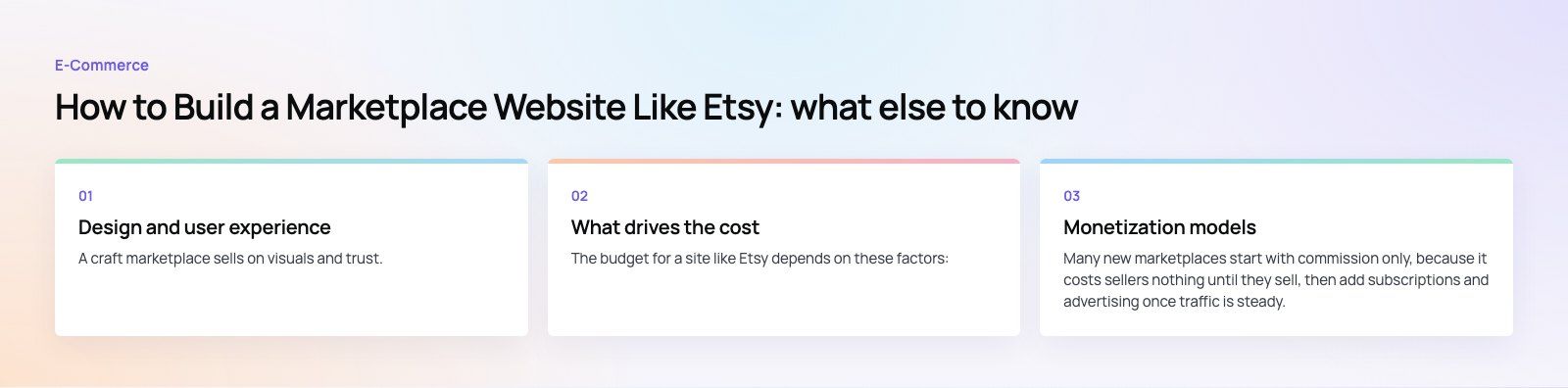
A craft marketplace sells on visuals and trust. Keep the interface quiet so product photos stand out, make navigation obvious, and show trust signals such as reviews, shop history and return policies near the buy button. Most buyers will arrive on a phone, so design the mobile product page and checkout first. Follow the WCAG accessibility guidelines so the site works for people using screen readers and keyboards. Good UI and UX design here pays back directly in conversion.
Search engine optimization also matters more than on most stores. Every listing is a potential landing page, so give sellers guidance on titles and descriptions, and make sure category and shop pages are crawlable and fast.
What drives the cost
The budget for a site like Etsy depends on these factors:
- Platform choice. A plugin based setup costs far less upfront than a custom build, but has higher limits on what you can change later.
- Feature depth. Personalization, custom order flows, multi shop carts and advanced search all add development time.
- Integrations. Payments, shipping carriers, tax calculation, email marketing and analytics.
- Design. A custom design system and separate seller dashboard cost more than a themed template.
- Running costs. Hosting, payment processing, search service, support, moderation and ongoing development.
- Marketing. Recruiting sellers and attracting buyers usually needs as much budget as the build.
Monetization models
| Model | How it works | Watch out for |
|---|---|---|
| Commission | A percentage of each sale | Too high and sellers move sales off platform |
| Listing fees | A small charge per listing | Discourages sellers from listing their full range early on |
| Seller subscriptions | Monthly plans with extra tools or lower commission | Needs real value in the paid tier |
| Advertising | Sellers pay to promote listings in search | Too many ads make search feel less trustworthy |
Many new marketplaces start with commission only, because it costs sellers nothing until they sell, then add subscriptions and advertising once traffic is steady.
Legal and regulatory points
- Terms for sellers and buyers. Set out who is the seller of record, return rules, prohibited items and how disputes are handled.
- Tax. Many countries now require marketplaces to collect sales tax or VAT on behalf of sellers, or to report seller income. Get local advice before launch.
- Consumer protection. Buyers have rights to clear pricing, delivery information and refunds that vary by country.
- Payments and data. Use a compliant payment provider so card data never touches your servers, and follow the data protection law of each market you sell into.
- Intellectual property. Have a notice and takedown process for listings that copy other people's designs.
Getting started
A site like Etsy succeeds through community, not code. Choose a niche, recruit founding sellers, launch with the essentials, and invest in custom features only when your sellers and buyers ask for them. Codeeo has delivered 200+ projects across the UAE and the US, including stores such as The Gorgeous Flower Co. Our retail and ecommerce team can help you plan and build your marketplace.
Frequently asked questions
It depends on platform choice, features and integrations.
A multi vendor plugin on an existing ecommerce platform has the lowest upfront cost. Marketplace software adds a recurring subscription. A headless or custom build costs the most but removes limits. Also plan for running costs such as hosting, payment processing and support, plus the marketing needed to recruit sellers and buyers.
E-Commerce10 Features of a High-Converting Ecommerce WebsiteThe ten features that turn store visitors into buyers, from product pages and checkout to speed, mobile design, social proof and ongoing testing. E-CommerceBenefits of Using a CMS for Ecommerce WebsitesHow a CMS helps online stores manage products, SEO, growth and security, how it compares with a custom build, and how to choose between WooCommerce, Shopify and headless.
 E-CommerceEcommerce Website Development: 9 Elements Every Store NeedsThe nine parts every online store needs, from catalog data and search to checkout, security, operations and analytics, with what to decide before you build.
Tell us what the business needs. We will tell you what to build first.
Schedule a free consultation and get a written recommendation, with costs, before you commit to anything.
Get in touchPROVEN RESULTS
4.7 / 5verified reviews on Google