 Cloud TechnologyCloud Based HR and Payroll Systems: Benefits and How to ChooseHow cloud based HR and payroll systems streamline operations, the core features to expect, cloud versus on premise, and how to choose and migrate safely.
CodeeoInsightsCloud Technology
How Cloud Computing Drives Digital Transformation in Manufacturing
How cloud computing helps manufacturers connect plants, inventory and suppliers, the benefits it brings, the trade offs on the shop floor and where to start.
Cloud computing supports digital transformation in manufacturing by giving plants on demand computing power, shared data and modern software without large hardware projects. It lets manufacturers connect machines, inventory, suppliers and customers in one place, analyze production data as it arrives and roll out new tools across sites quickly. The result is faster decisions, fewer blind spots in the supply chain and less time spent maintaining servers.
This article covers what the cloud changes on the factory floor and in the back office, the main benefits, the trade offs that are specific to manufacturing and a sensible way to start.
Why manufacturing is moving to the cloud
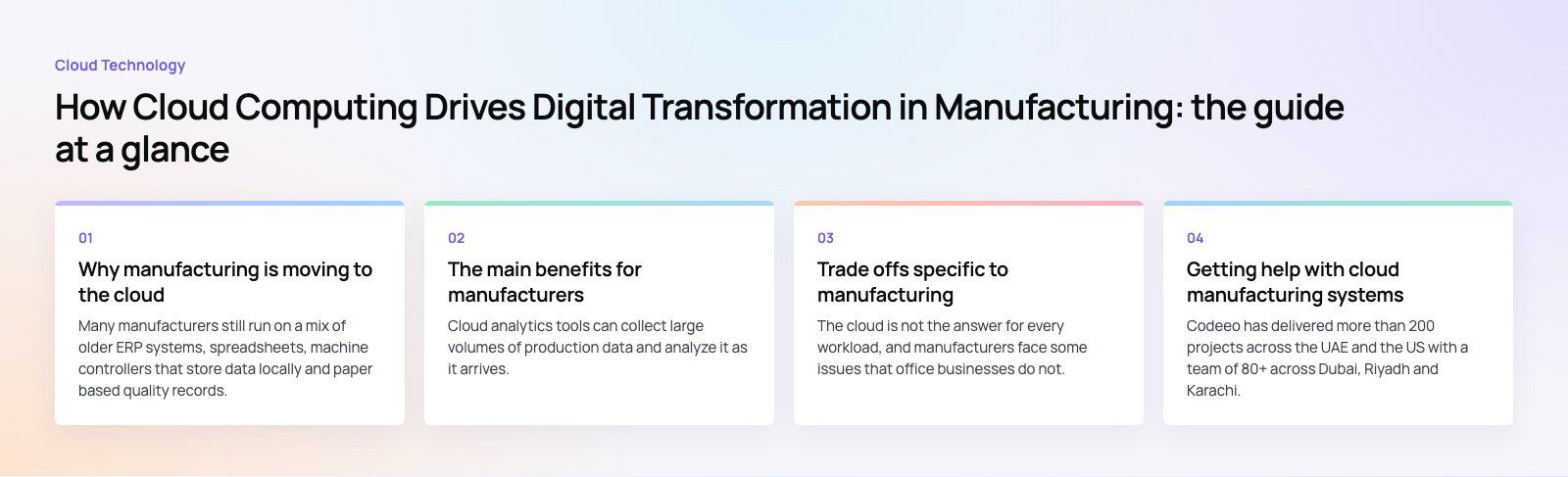
Many manufacturers still run on a mix of older ERP systems, spreadsheets, machine controllers that store data locally and paper based quality records. Each piece may work on its own, but together they create data silos. Planners cannot see real stock levels, quality issues surface days late and every site does things a little differently.
Cloud services address the underlying constraints: limited on site storage, limited processing power and the cost of upgrading and maintaining servers. The NIST definition of cloud computing describes the core idea well: shared, configurable resources that can be provisioned quickly and scaled with demand, paid for by use. For a manufacturer, that means capacity for analytics or a new application can be added in days instead of waiting on a hardware budget.
The cloud also gives access to services that would be hard to run in house, such as machine learning, large scale analytics and IoT device management. As these services mature, they become part of standard manufacturing software rather than specialist projects.
Where the cloud fits in a manufacturing business
| Area | What moves to the cloud | What it changes |
|---|---|---|
| Planning and ERP | Orders, bills of materials, production schedules, finance | One shared record across sites and departments |
| Shop floor data | Machine output, downtime, sensor readings | Live dashboards and earlier warning of problems |
| Quality | Inspection results, nonconformance reports, traceability | Faster root cause analysis and cleaner audits |
| Supply chain | Inventory, purchasing, supplier portals, logistics | Real time stock visibility and fewer shortages |
| Customers | CRM, dealer portals, order tracking, service | Self service and quicker answers to customers |
The main benefits for manufacturers
Decisions based on live data
Cloud analytics tools can collect large volumes of production data and analyze it as it arrives. Managers can track the indicators that matter, such as production rate, scrap, inventory levels and on time delivery, without waiting for a weekly report. Predictive models can then forecast demand or flag a machine whose readings suggest it will fail soon, so maintenance happens before a breakdown rather than after.
Better communication and collaboration
When drawings, work instructions, quality records and project plans live in a shared cloud platform, engineering, production and suppliers work from the same version. Project tools show who is doing what across sites, and messaging and video tools cut the number of meetings needed to resolve a problem. This matters most for manufacturers with several plants or a design team in a different country from production.
A more resilient supply chain
Cloud inventory and procurement tools show stock levels in real time across warehouses and sites. Planners can adjust production schedules before a shortage stops a line, and purchasing can be automated around reorder points and approved suppliers. Supplier portals let partners see forecasts and confirm deliveries directly, which reduces the email chains that delay orders.
Agility without heavy upfront spend
Changing processes on old, heavily customized systems is slow and expensive, which makes many manufacturers reluctant to update. Cloud applications are configurable and run in the browser on most devices, so a new process or site can be added without a hardware rollout. Capacity can grow for a busy season and shrink afterwards.
Better customer experience
A cloud CRM gives sales and service teams a full view of each customer: orders, quotes, warranty claims and conversations. Dealer and customer portals let buyers check order status, download documents and reorder parts without calling. For manufacturers that sell direct, a connected online store can show live stock and accurate lead times.
Security and modernizing legacy systems
Major cloud providers invest heavily in encryption, access control and monitoring, which can exceed what a single manufacturer can maintain in house. Moving data off ageing servers also reduces the risk of losing it to hardware failure. That said, security in the cloud is shared: the provider secures the platform, and you remain responsible for user access, configuration and data handling.
Trade offs specific to manufacturing
The cloud is not the answer for every workload, and manufacturers face some issues that office businesses do not.
- Latency and uptime on the shop floor. Machine control and safety systems must keep running if the internet connection drops. Many plants use edge computing, processing data locally and sending summaries to the cloud.
- Old equipment. Older machines may not expose data easily. Retrofitting sensors or gateways is often the first, unglamorous step.
- Operational technology security. Connecting factory networks to the internet creates new risks. Separate networks and strict access rules are essential.
- Integration effort. The value comes from connecting ERP, shop floor, quality and CRM data. Budget time for integration, not just licenses.
- Data residency. Some customers and regulators require data to stay in a particular country. Check where your provider stores it.
How to start a cloud program in manufacturing
- Pick one pain point. Stockouts, slow quality reporting or poor visibility across sites are common starting places.
- Map the data. Identify where the relevant data lives today, who owns it and how clean it is.
- Choose a platform that fits. Cloud ERP such as Business Central or Odoo often covers planning, inventory and finance, with integrations for the rest.
- Pilot at one site or line. Prove the value, fix the problems and then roll out.
- Connect and report. Integrate the systems and build dashboards, for example in Power BI, so managers see the results.
- Train and support. Operators and planners need to trust the new data before they stop keeping their own spreadsheets.
Getting help with cloud manufacturing systems
Codeeo has delivered more than 200 projects across the UAE and the US with a team of 80+ across Dubai, Riyadh and Karachi. If you are planning a move to cloud ERP, connecting shop floor data or building portals for dealers and suppliers, our Azure integration and custom software teams can help you scope the first phase and connect it to what you already run.
Frequently asked questions
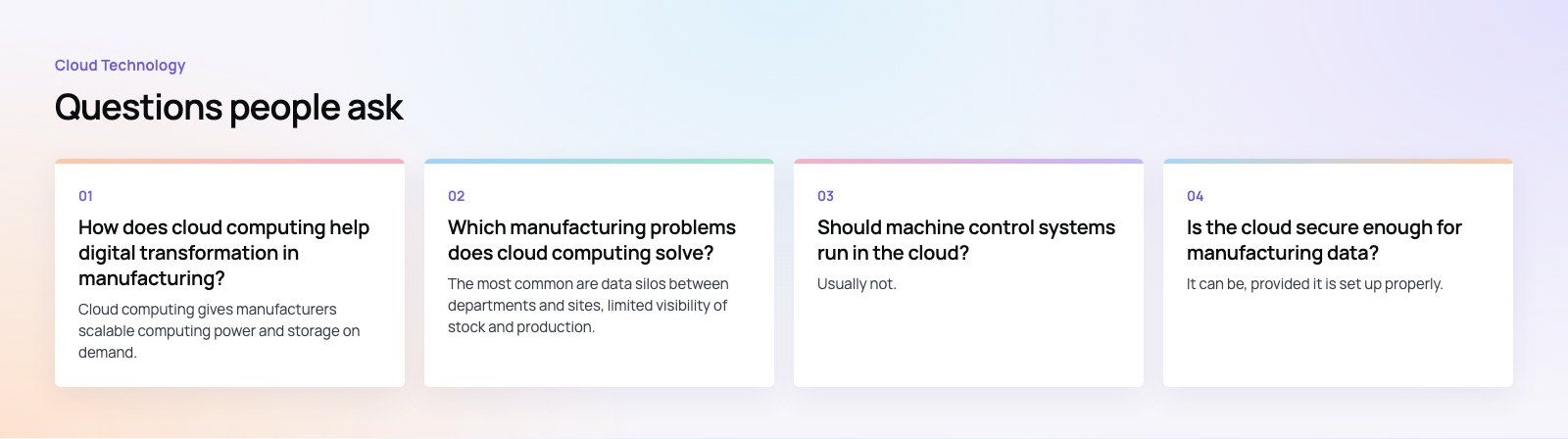
Cloud computing gives manufacturers scalable computing power and storage on demand, so new applications and analytics can be deployed without buying servers.
It brings planning, production, quality and supply chain data into shared platforms, which supports faster decisions and consistent processes across sites. It also makes services such as machine learning and IoT device management practical for companies without large IT teams.
Cloud TechnologyCloud Based HR and Payroll Systems: Benefits and How to ChooseHow cloud based HR and payroll systems streamline operations, the core features to expect, cloud versus on premise, and how to choose and migrate safely. Cloud TechnologyHow Cloud Computing Supports Digital TransformationThe real business benefits of cloud computing in digital transformation, the challenges to plan for, what to move first and how to measure progress.
 Cloud TechnologyAzure Migration Steps: A Practical Five Step GuideThe five Azure migration steps, from planning and assessment to cutover and optimization, with the Microsoft tools that help at each stage.
Tell us what the business needs. We will tell you what to build first.
Schedule a free consultation and get a written recommendation, with costs, before you commit to anything.
Get in touchPROVEN RESULTS
4.7 / 5verified reviews on Google