 Cloud TechnologyCloud Based HR and Payroll Systems: Benefits and How to ChooseHow cloud based HR and payroll systems streamline operations, the core features to expect, cloud versus on premise, and how to choose and migrate safely.
CodeeoInsightsCloud Technology
Cloud Security Tools: Main Types, Options and How to Choose
The main types of cloud security tool, from CSPM and CNAPP to secrets management and SIEM, well known options in each, and a practical way to choose.
Cloud security tools protect the data, workloads, identities and settings you run on cloud platforms such as AWS, Microsoft Azure and Google Cloud. No single tool covers everything: most organizations combine their cloud provider's built in security services with a few specialist products for posture management, workload protection, identity and secrets, and monitoring. The right mix depends on how many clouds you use, what you run there, and who will act on the alerts.
This guide explains the main categories of cloud security tool, lists well known options in each, and gives a practical way to choose.
Why cloud security needs its own tools
Cloud providers secure the physical data centers and the core platform. You remain responsible for what you configure on top: who has access, which storage is public, how secrets are handled, what is exposed to the internet and how workloads are patched. This split is usually called the shared responsibility model.
Most cloud incidents trace back to that customer side: a storage bucket left open, an access key committed to a code repository, an account with far more permissions than it needs, or a forgotten test server. Cloud environments also change constantly, as teams create and remove resources through code every day. Tools built for the cloud scan continuously and understand cloud APIs, which traditional network tools do not.
The main types of cloud security tool
| Category | What it does | Good first question |
|---|---|---|
| CSPM (cloud security posture management) | Scans cloud accounts for misconfigurations and compliance gaps | Do we know what is misconfigured right now? |
| CWPP (cloud workload protection) | Protects virtual machines, containers and serverless functions at runtime | Would we see an attack on a running workload? |
| CNAPP (cloud native application protection) | Combines posture, workload, identity and code scanning in one platform | Do we want one platform instead of several tools? |
| CIEM (cloud identity and entitlement management) | Finds excessive permissions and unused access | Who can do what, and do they need it? |
| CASB and SSE | Controls how staff use SaaS and cloud apps, and prevents data leaks | Where is our company data going? |
| SIEM | Collects logs and events, correlates them and supports investigations | Can we trace an incident from start to finish? |
| Secrets and privileged access management | Stores keys and passwords, rotates them and controls admin access | Where do our credentials live? |
| Cloud firewalls and network security | Filters traffic and connects sites and clouds securely | What is reachable from the internet? |
Native tools from the cloud providers
Start with what your provider already offers. These services understand their own platform deeply and are often the quickest win.
- Microsoft Defender for Cloud provides posture management and workload protection for Azure, with support for other clouds. Microsoft's Defender for Cloud documentation covers its features in detail.
- AWS Security Hub gathers findings from AWS security services and checks accounts against security standards.
- Google Security Command Center gives visibility of assets, misconfigurations and threats across Google Cloud.
Native tools are strongest inside their own cloud. If you run workloads across several providers, a third party platform can give one view across all of them.
Well known third party cloud security tools
The options below are established products that still operate in 2026. They are listed by focus, not ranked, and the best choice depends on your environment.
Cloud platforms (CNAPP and posture)
- Palo Alto Networks Cortex Cloud. The successor to Prisma Cloud, combining posture management, workload protection and cloud detection and response.
- Orca Security. An agentless platform that scans cloud workloads and configurations by reading cloud storage snapshots, so nothing is installed on each server.
- Trend Micro Vision One. Trend Micro's cloud protection, now delivered through its Vision One platform, covering posture, workloads and containers.
- Datadog Cloud Security. Posture and threat detection built into Datadog's monitoring platform, useful for teams already using it for observability.
Workload and endpoint protection
- CrowdStrike Falcon. Endpoint and workload protection delivered from the cloud, with modules for cloud security posture and runtime protection.
Monitoring and investigation
- Splunk Enterprise Security. A SIEM for collecting and correlating security events across cloud and on premises systems, now part of Cisco.
Identity, secrets and privileged access
- HashiCorp Vault. Secrets management for API keys, passwords, certificates and dynamic credentials, widely used in automated deployment pipelines.
- Delinea. Privileged access management, controlling and recording administrative access to servers and cloud consoles.
Data and SaaS usage
- Skyhigh Security. A CASB and security service edge platform, formerly sold as McAfee MVISION Cloud, for controlling data in SaaS and cloud apps.
Network
- Barracuda CloudGen Firewall. A firewall and secure connectivity product that runs in public clouds as well as on premises.
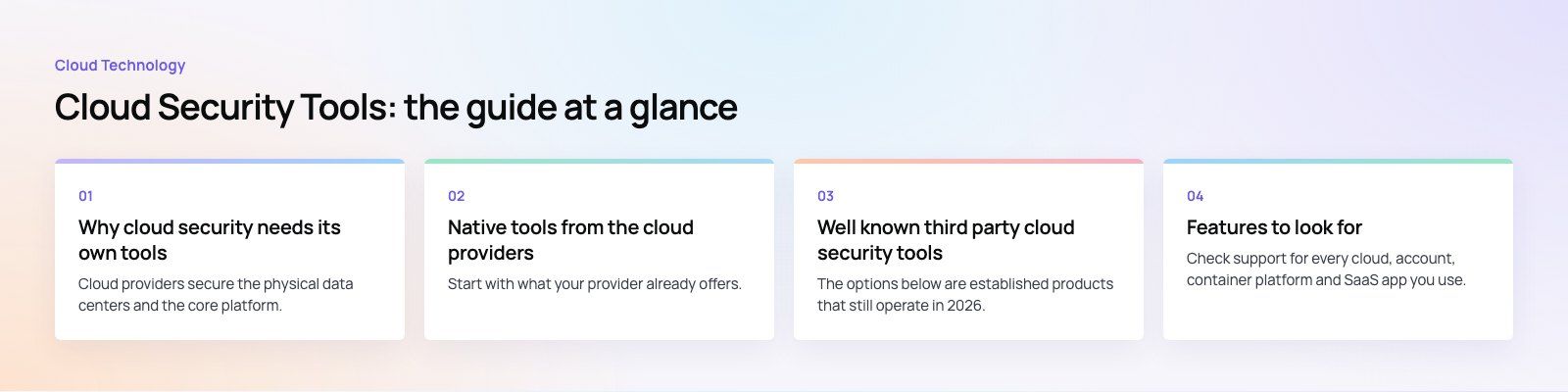
Features to look for
Coverage of your actual environment
Check support for every cloud, account, container platform and SaaS app you use. A tool that covers only part of your estate leaves blind spots.
Context and prioritization
Every tool finds problems. Good tools tell you which ones matter by combining exposure, permissions, vulnerabilities and data sensitivity, so a public server with a critical flaw and access to customer data rises to the top.
Identity and access control
Look for support for multi factor authentication, role based access and least privilege analysis. Identity is now the main attack path in cloud environments.
Encryption and key management
Data should be encrypted at rest and in transit, with keys managed and rotated properly.
Compliance reporting
Mapping to standards such as the CIS Benchmarks, ISO 27001 or SOC 2 saves time during audits.
Integration and automation
The tool should send findings to the places your team already works, such as ticketing, chat and deployment pipelines, and support automated fixes where it is safe.
How to choose: a practical process
- Inventory first. List your cloud accounts, workloads, data stores and SaaS apps.
- Turn on native tools. Enable your provider's posture and threat detection services and review the findings.
- Identify the gaps. Multi cloud visibility, secrets handling, runtime protection or log investigation are the usual ones.
- Shortlist by category. Pick two or three products for each gap rather than evaluating everything.
- Run a proof of value. Connect each candidate to a real account for a few weeks and compare the quality of findings, not their number.
- Assign owners. Decide who triages alerts and who fixes them before you buy. Unread alerts protect no one.
Common mistakes
- Buying before fixing basics. Multi factor authentication, least privilege and no long lived keys in code deliver more than any product.
- Too many overlapping tools. Several dashboards with similar findings slow teams down.
- Ignoring the code stage. Scanning infrastructure templates and dependencies before deployment prevents problems instead of reporting them later.
- Forgetting SaaS. Email, file sharing and collaboration tools hold sensitive data too.
Good cloud security comes from the basics done well, native tools switched on, and a small number of specialist products chosen for real gaps. If your team is building on Azure or Microsoft 365, our Azure integration and Microsoft 365 specialists can help set up secure foundations, and a codebase review can catch exposed secrets and risky dependencies before they reach production. For ongoing work, our dedicated developers can build security checks into your deployment pipeline.
Frequently asked questions
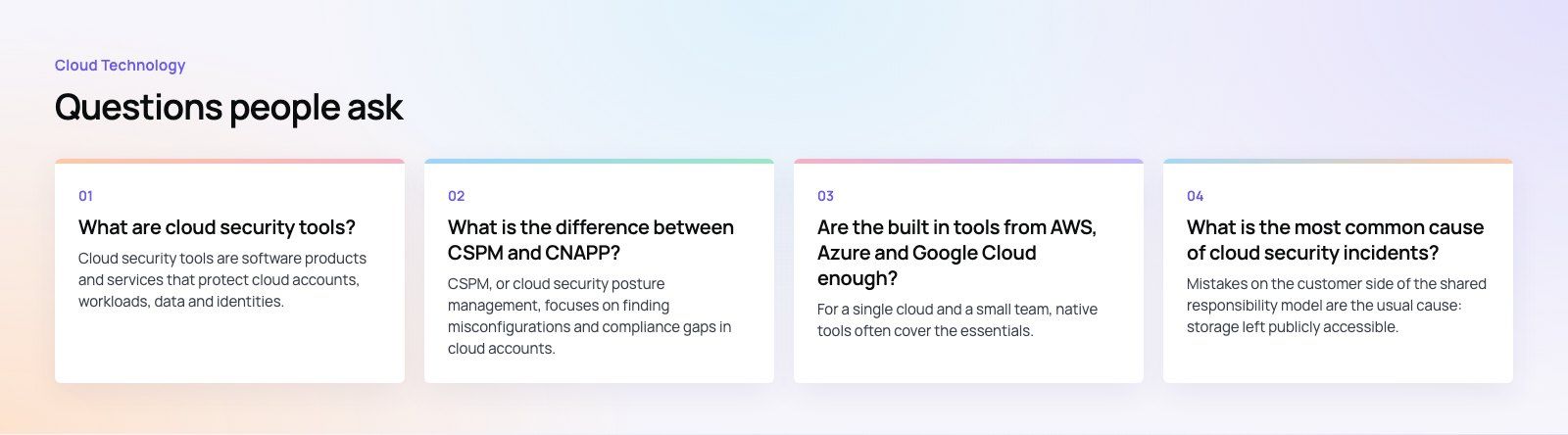
Cloud security tools are software products and services that protect cloud accounts, workloads, data and identities.
They find misconfigurations, detect threats on running systems, control who has access, manage secrets and encryption keys, and collect logs for investigation. Most organizations combine their cloud provider's built in services with a few specialist third party tools.
Cloud TechnologyCloud Based HR and Payroll Systems: Benefits and How to ChooseHow cloud based HR and payroll systems streamline operations, the core features to expect, cloud versus on premise, and how to choose and migrate safely. Cloud TechnologyHow Cloud Computing Supports Digital TransformationThe real business benefits of cloud computing in digital transformation, the challenges to plan for, what to move first and how to measure progress.
 Cloud TechnologyAzure Migration Steps: A Practical Five Step GuideThe five Azure migration steps, from planning and assessment to cutover and optimization, with the Microsoft tools that help at each stage.
Tell us what the business needs. We will tell you what to build first.
Schedule a free consultation and get a written recommendation, with costs, before you commit to anything.
Get in touchPROVEN RESULTS
4.7 / 5verified reviews on Google