 Software DevelopmentSQL vs NoSQL Databases: Differences and How to ChooseHow SQL and NoSQL databases differ in data model, schema, scaling and consistency, where each one fits, and five questions to choose for your project.
CodeeoInsightsSoftware Development
Common API Integration Challenges and How to Solve Them
Data mapping, authentication, errors, rate limits, versioning and security: the API integration problems that break systems, and how to design around each.
The most common API integration challenges are mismatched data formats, authentication and authorization, error handling, rate limits, version changes and security. Each one has a well understood fix: map and validate data at the boundary, use the right auth scheme and store secrets properly, retry with backoff, cache and queue to respect limits, pin versions and watch changelogs, and treat every external input as untrusted.
Integrations rarely fail on the first day. They fail weeks later, when a provider changes a field, a token expires at midnight or a sale doubles traffic. This guide walks through each challenge, what it looks like in practice and how to design around it from the start.
Why API integrations go wrong
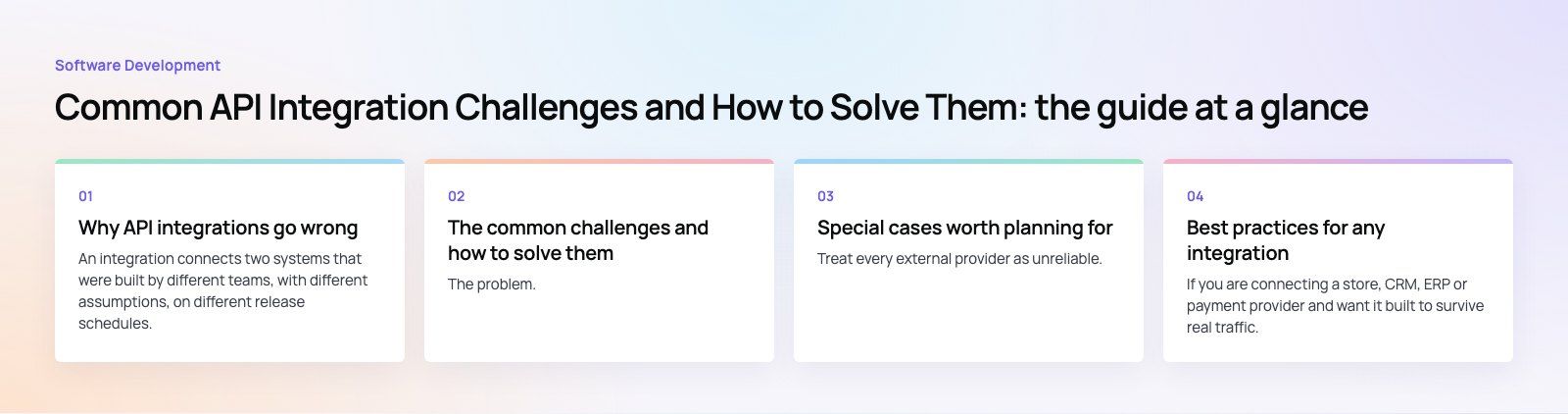
An integration connects two systems that were built by different teams, with different assumptions, on different release schedules. Your code controls only one side. Most problems come from that gap: the other system behaves in a way you did not expect, and your code has no plan for it.
The fix is not cleverness. It is defensive design: assume the other side will be slow, wrong or unavailable at some point, and decide in advance what your system does when that happens.
The common challenges and how to solve them
1. Data format and mapping
The problem. One API returns JSON, another returns XML. One sends dates as ISO strings, another as Unix timestamps. One stores a customer name in a single field, the other splits first and last names. Small mismatches like these corrupt data quietly.
The fix.
- Build a mapping layer at the boundary that converts external data into your own internal model, rather than letting external shapes leak through your codebase.
- Validate incoming payloads against a schema and reject or quarantine anything that does not match.
- Standardize on JSON internally where you can. It is defined in RFC 8259 and supported by virtually every modern API.
- Agree which system owns each field, so two systems do not overwrite each other.
2. Authentication and authorization
The problem. Expired tokens, wrong scopes, keys committed to a repository and credentials shared across environments are among the most frequent causes of integration outages and security incidents.
The fix.
- Use the scheme the provider recommends. For delegated access that is usually OAuth 2.0, defined in RFC 6749. For server to server calls, API keys or signed JWTs are common.
- Store secrets in a secrets manager or environment configuration, never in code.
- Handle token refresh automatically, before expiry, and alert when refresh fails.
- Request the narrowest scopes that do the job, and keep separate credentials for test and production.
3. Error handling
The problem. Networks drop, providers return 500 errors and timeouts happen. Code that assumes every call succeeds will lose orders, duplicate payments or leave records half updated.
The fix.
- Separate errors you can retry (timeouts, 502, 503) from errors you cannot (400, 401, 404). Retrying a bad request just repeats the failure.
- Retry with exponential backoff and jitter, and set a maximum number of attempts.
- Make write operations idempotent, using an idempotency key where the provider supports one, so a retry cannot create a duplicate.
- Log the request, response and correlation ID for every failure, and send failed jobs to a queue you can replay.
4. Rate limits
The problem. Most APIs cap how many requests you can make in a given window. Exceed the cap and you receive errors, usually HTTP 429 Too Many Requests, as described in RFC 6585. Bulk imports and traffic spikes are where this bites.
The fix.
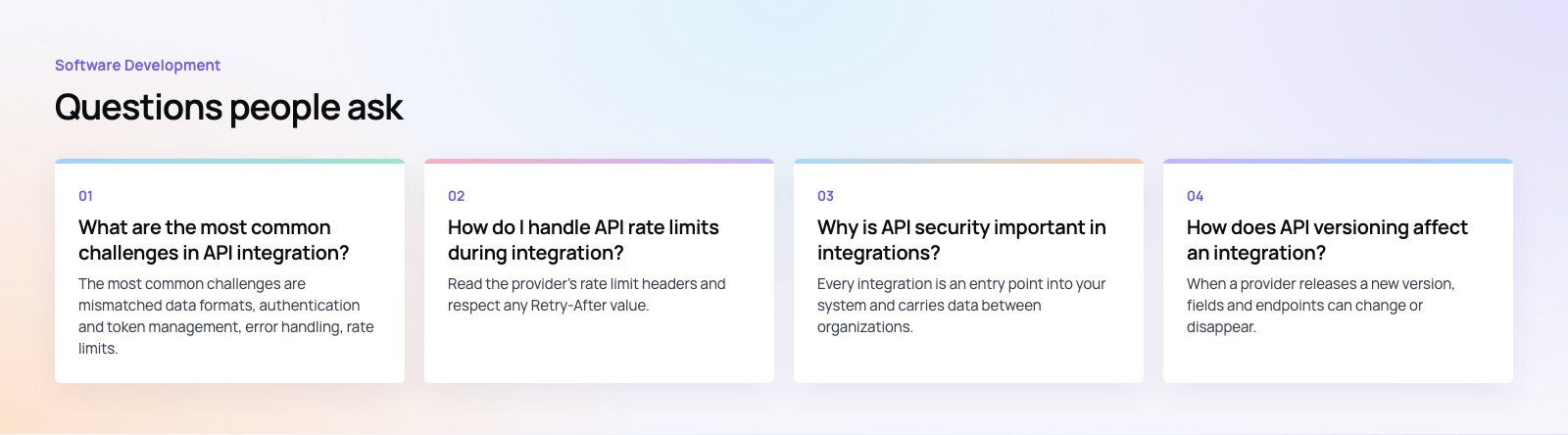
- Read the provider's rate limit headers and respect any Retry-After value.
- Throttle on your side with a token bucket or similar limiter so you stay under the cap.
- Cache responses that do not change often, such as product lists or reference data.
- Use bulk endpoints and webhooks instead of polling where the provider offers them.
- Move heavy syncs into background jobs scheduled outside peak hours.
5. Versioning and breaking changes
The problem. Providers deprecate endpoints, rename fields and change behavior. If you are not watching, the first sign is a broken integration in production.
The fix.
- Pin to a specific API version wherever the provider allows it.
- Subscribe to the provider's changelog and deprecation notices, and assign someone to read them.
- Keep integration code in one module so a change touches one place.
- Run contract tests against the provider's sandbox in your pipeline so changes surface before release.
If you publish an API yourself, version it from day one and give clients notice before anything is removed.
6. Security risks
The problem. Every integration is a door into your system. Unvalidated input, unencrypted traffic and over privileged credentials turn a third party problem into your problem.
The fix.
- Use HTTPS for every call, with certificate validation turned on.
- Validate and sanitize all incoming data, including data from trusted partners.
- Verify webhook signatures before acting on them.
- Rotate credentials on a schedule and when people leave.
- Review integrations in regular security audits, not only the main application.
Challenges and fixes at a glance
| Challenge | Typical symptom | Main fix |
|---|---|---|
| Data format | Wrong or missing values after sync | Mapping layer and schema validation |
| Authentication | Sudden 401 errors, often overnight | Automatic token refresh and managed secrets |
| Error handling | Lost or duplicated records | Retries with backoff and idempotency keys |
| Rate limits | 429 errors during imports or sales | Throttling, caching, webhooks and queues |
| Versioning | Integration breaks after a provider update | Version pinning and contract tests |
| Security | Leaked keys or injected data | HTTPS, validation, signature checks and rotation |
Special cases worth planning for
Third party APIs you do not control
Treat every external provider as unreliable. Wrap calls behind your own interface, add timeouts and a fallback, and decide what the user sees when the provider is down. A circuit breaker that stops calling a failing service protects the rest of your system.
Real time integrations
Chat, live tracking and bidding need low latency. Request and response polling is wasteful here; WebSockets or server sent events push updates as they happen. Plan for reconnection and for messages that arrive out of order.
Payments
Payment integrations deserve extra care: idempotent requests, webhook verification, reconciliation reports and clear handling of pending states. A payment that succeeded at the provider but failed to record in your system is the worst kind of bug.
Best practices for any integration
- Plan before you code. Write down which system owns each piece of data, what triggers a sync and what happens on failure.
- Read the provider's documentation fully, especially limits, error codes and deprecation policy.
- Test against a sandbox, including failure cases such as timeouts, bad data and expired tokens.
- Monitor in production. Track error rates, latency and queue depth, and alert on unusual patterns.
- Keep in touch with providers. Know who to contact when something breaks on their side.
- Document your integrations so the next developer understands the data flow without reverse engineering it.
If you are connecting a store, CRM, ERP or payment provider and want it built to survive real traffic, our custom software team designs integrations with retries, monitoring and clear ownership from the start. We also handle payment integration and Azure integration work, and a codebase review can show where an existing integration is fragile. The Pioneer Auctions case study shows live bidding and payments working together.
Frequently asked questions
The most common challenges are mismatched data formats, authentication and token management, error handling, rate limits, version changes from the provider and security.
Most integration failures trace back to one of these. Designing for each of them up front, with mapping, retries, throttling, version pinning and validation, prevents the majority of production incidents.
Software DevelopmentSQL vs NoSQL Databases: Differences and How to ChooseHow SQL and NoSQL databases differ in data model, schema, scaling and consistency, where each one fits, and five questions to choose for your project. Software DevelopmentOpen Source Apps: Examples, Licenses and How to Build Your OwnWhat makes an app open source, well known examples, the steps to build your own, how to pick MIT, Apache or GPL, and when to customize instead.
 Software DevelopmentHow an Online HR Portal Improves Employee ExperienceWhat an online HR portal does, how self service improves employee experience, which features matter, and whether to buy, configure or build one.
Tell us what the business needs. We will tell you what to build first.
Schedule a free consultation and get a written recommendation, with costs, before you commit to anything.
Get in touchPROVEN RESULTS
4.7 / 5verified reviews on Google