 Software DevelopmentSQL vs NoSQL Databases: Differences and How to ChooseHow SQL and NoSQL databases differ in data model, schema, scaling and consistency, where each one fits, and five questions to choose for your project.
CodeeoInsightsSoftware Development
How Much Does Custom Software Development Cost?
What drives custom software development cost: scope, complexity, integrations, platforms, design and team, plus pricing models and ways to reduce spend.
Custom software development cost depends on how much you are building, how complex it is, who builds it and how you contract the work. A small internal tool and an enterprise platform with dozens of integrations can differ in cost many times over, so any honest answer starts with scope rather than a headline number. The fastest way to a reliable figure is a short scoping phase that turns your idea into a feature list, then an estimate per phase from a team that has built similar systems.
This guide explains the factors that drive cost, how the common pricing models work, how to estimate a budget you can trust, and practical ways to spend less without cutting quality.
What drives the cost of custom software
| Factor | Pushes cost up | Keeps cost down |
|---|---|---|
| Scope | Many user roles, screens and workflows | A focused first version with core features only |
| Complexity | Real time features, complex rules, heavy reporting | Standard forms, lists and approvals |
| Integrations | Legacy systems, poorly documented APIs, many partners | Well documented, modern APIs |
| Platforms | Separate web, iOS, Android and admin builds | One platform first, or a cross platform framework |
| Design | Fully custom interface, motion and branding | A clean design system with reusable components |
| Compliance and security | Payments, health or financial data, audit trails | Low risk internal data |
| Team | Senior specialists in high cost locations | A balanced team with the right seniority mix |
Scope and complexity
Scope is the number of things the software must do; complexity is how hard each one is. A booking form is simple. A booking engine that handles availability across locations, deposits, cancellations, refunds and staff schedules is not. Most budget surprises come from complexity hidden inside a feature that sounded small in a meeting.
Integrations
Connecting to payment gateways, ERPs, CRMs, accounting tools or government systems often takes more effort than building screens. Modern, well documented APIs are quick to work with. Older systems with limited access, unusual data formats or no test environment can take far longer than expected.
Technology stack
Mainstream frameworks with large communities, such as React, Next.js, Laravel, Node.js or .NET, are usually cheaper to build and maintain because skilled developers are easy to find and common problems are already solved. Niche or very new technologies can cost more in learning time and in hiring later.
Platforms
Each platform adds work: a web app, an iOS app, an Android app and an admin panel are four surfaces to design, build and test. Cross platform frameworks such as Flutter or React Native share code between iOS and Android and can reduce this, though not to zero.
Design and user experience
Design is often underestimated. Research, user flows, wireframes and a polished interface take real time, but they also prevent expensive rework. Software that people find confusing generates support requests and low adoption, which cost more in the long run than good design does up front.
The team
Rates vary with seniority, specialism and location. A cheaper team is not automatically better value: an experienced team may finish faster and produce code that is cheaper to maintain. Review real portfolios and case studies, and ask how the team handles testing, code review and handover.
The costs people forget
- Discovery and scoping before development starts.
- Project management and quality assurance, which are part of every healthy project.
- Hosting, cloud services and third party licenses, which continue every month.
- App store accounts and payment provider fees where relevant.
- Maintenance: security patches, operating system updates, bug fixes and small improvements after launch.
- Training and data migration when software replaces an existing system.
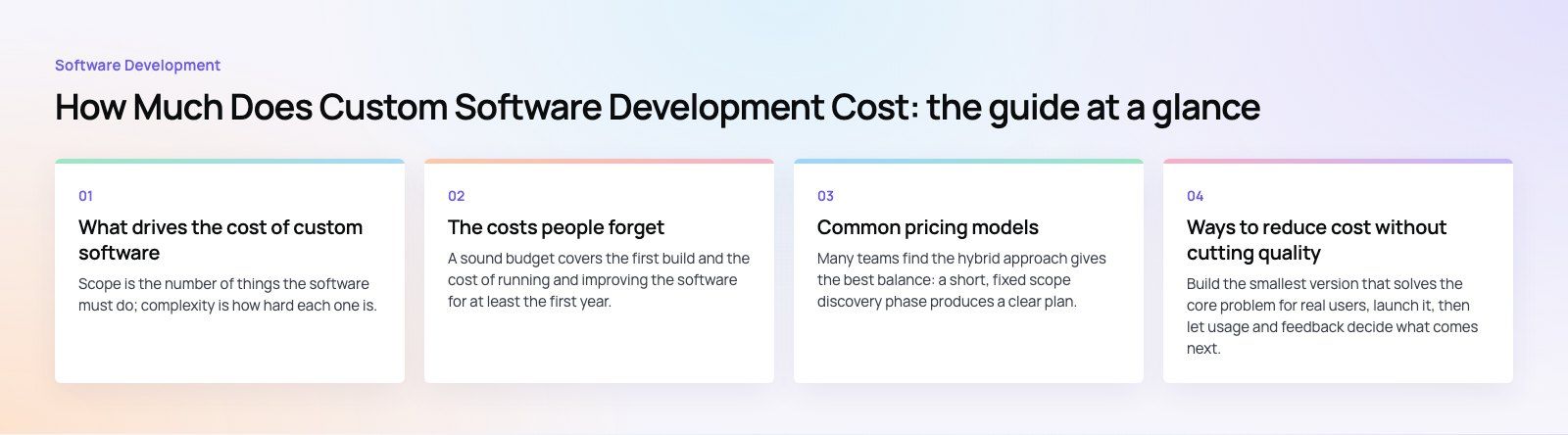
A sound budget covers the first build and the cost of running and improving the software for at least the first year.
Common pricing models
| Model | How it works | Best for | Risk |
|---|---|---|---|
| Fixed price | One agreed price for an agreed scope | Small, well defined projects | Changes need formal change requests; vendors may pad for uncertainty |
| Time and materials | You pay for the hours actually worked | Evolving products and unclear requirements | Needs active oversight to keep spend on track |
| Dedicated team | A team works for you on an ongoing basis | Long running products and continuous development | Requires steady work and good product leadership on your side |
| Phased hybrid | Fixed price discovery, then time and materials or fixed price per phase | Most medium and large projects | Slightly more planning up front |
Many teams find the hybrid approach gives the best balance: a short, fixed scope discovery phase produces a clear plan, and the build follows in phases priced from that plan.
How to estimate your budget
- Write down the goal. What problem does the software solve, and how will you know it worked?
- List users and tasks. Who uses the system, and what does each of them need to do?
- Split features into must have, should have and later. Be strict with the first list.
- Map integrations. Name every system the software must talk to and check what access each one offers.
- Ask for a phased estimate. A credible vendor breaks the work into phases with ranges and explains its assumptions.
- Add a contingency. Unknowns appear in every project; plan for them rather than hoping they will not.
- Compare against value. Estimate time saved, revenue gained or risk reduced, so the investment can be judged on return, not only on cost.
Ways to reduce cost without cutting quality
Start with a minimum viable product
Build the smallest version that solves the core problem for real users, launch it, then let usage and feedback decide what comes next. This avoids paying for features nobody uses.
Work in phases
Phases give you natural checkpoints to review progress, adjust priorities and control spend. An agile way of working, built on short cycles and regular demos, makes this practical. The Agile Manifesto sets out the principles behind it.
Use proven building blocks
Authentication, payments, notifications, file storage and analytics are solved problems. Using established services and open source libraries is usually cheaper and safer than building them yourself. Check each library's license on the Open Source Initiative's license list and confirm it is actively maintained.
Choose the right team setup
In house teams give control and deep knowledge of your business but take time to hire. Outsourcing gives speed and access to specialists. Many companies combine the two: a small internal product owner working with an external team, or extra developers added to an existing team for a period.
Manage change deliberately
Scope changes are normal, but uncontrolled ones are the most common cause of overruns. Agree a simple change process: describe the change, estimate it, decide whether it replaces something else or extends the budget.
Invest in automation and code quality
Automated tests, code review and continuous deployment cost a little more at first and much less over the life of the software. They catch bugs earlier and make each future change cheaper.
How to judge a quote
- Does it list features and assumptions, or just a single number?
- Does it include design, testing, project management and deployment?
- Is maintenance after launch explained?
- Who owns the code and the accounts at the end?
- Can the vendor show similar work that you can verify?
A very low quote with no detail is a warning sign, not a bargain. The cheapest build often becomes the most expensive system to fix.
The right budget for custom software comes from clear scope, sensible phases and a team that explains its assumptions. Codeeo has delivered 200+ projects across the UAE and the US with a team of 80+ across Dubai, Riyadh and Karachi. Our custom software development team can start with a product scoping session to turn your idea into a costed plan, and if you already have a team, our dedicated developers can join it. You can also review our case studies or contact us to discuss your project.
Frequently asked questions
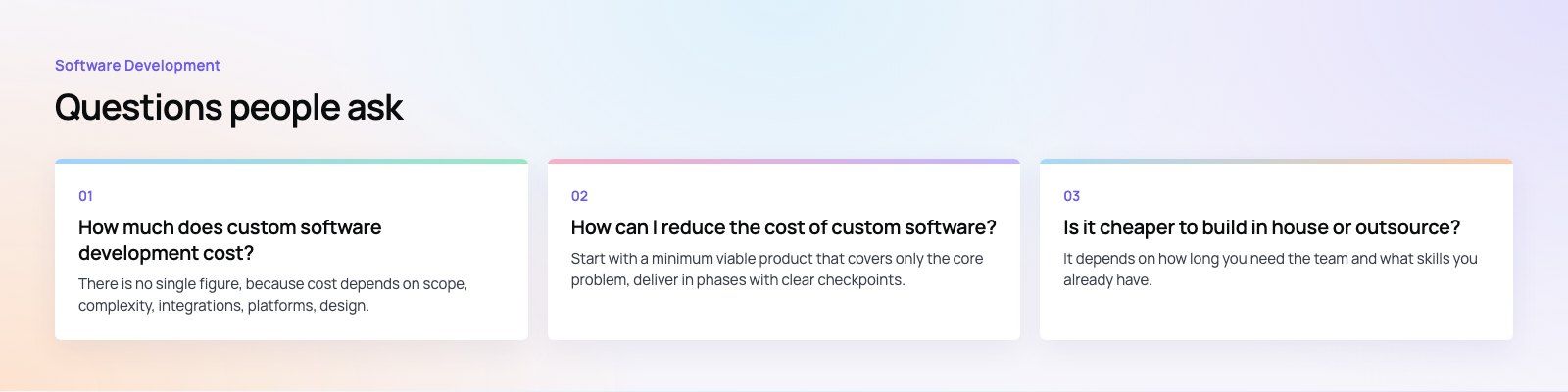
There is no single figure, because cost depends on scope, complexity, integrations, platforms, design, compliance needs and the team you hire.
A simple internal tool and a multi platform system with many integrations can differ many times over. The reliable way to get a number is a short scoping phase that lists features and assumptions, followed by a phased estimate from an experienced team.
Software DevelopmentSQL vs NoSQL Databases: Differences and How to ChooseHow SQL and NoSQL databases differ in data model, schema, scaling and consistency, where each one fits, and five questions to choose for your project. Software DevelopmentOpen Source Apps: Examples, Licenses and How to Build Your OwnWhat makes an app open source, well known examples, the steps to build your own, how to pick MIT, Apache or GPL, and when to customize instead.
 Software DevelopmentHow an Online HR Portal Improves Employee ExperienceWhat an online HR portal does, how self service improves employee experience, which features matter, and whether to buy, configure or build one.
Tell us what the business needs. We will tell you what to build first.
Schedule a free consultation and get a written recommendation, with costs, before you commit to anything.
Get in touchPROVEN RESULTS
4.7 / 5verified reviews on Google