 Digital TransformationHow Digital Transformation Is Reshaping BusinessesFive ways digital transformation is changing operations, customer experience, data, business models and work, plus the challenges and a practical roadmap.
CodeeoInsightsDigital Transformation
Digital Transformation in Government: Key Areas and First Steps
How governments use online services, digital identity, shared records and modern software to serve citizens better, plus the challenges and a practical way to start.
Digital transformation in government means redesigning public services around what citizens need to get done, then supporting those services with modern systems, shared data and secure digital identity. Done well, it cuts waiting, paperwork and duplicated effort for both residents and staff. The agencies that succeed treat it as service design first and technology second.
This guide covers the main areas where digital change makes a difference in the public sector, the software that underpins it, the challenges agencies face and a practical way to get started.
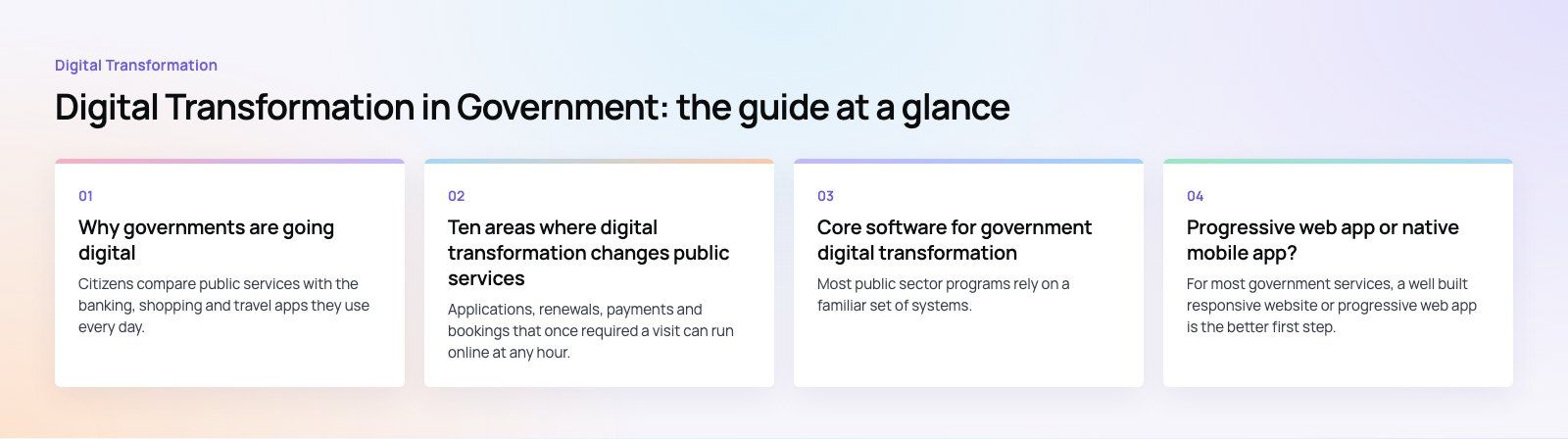
Why governments are going digital
Citizens compare public services with the banking, shopping and travel apps they use every day. When a permit still needs a printed form and an office visit, the gap is obvious. At the same time, agencies face pressure to do more with the same budgets, protect sensitive data and show how decisions are made.
The United Nations tracks how countries are progressing in its E-Government Survey (UN DESA, 2024), which compares online services, telecommunications infrastructure and human capital across member states. It is a useful reference for any agency benchmarking itself against peers.
Ten areas where digital transformation changes public services
1. Online citizen services
Applications, renewals, payments and bookings that once required a visit can run online at any hour. Mobile friendly portals and progressive web apps work on any device without an app store download, which matters for services people use only once or twice a year.
2. Efficient administrative processes
Many agencies still move work through email, paper files and spreadsheets. Workflow and business management systems route requests automatically, track status and remove re-keying. Staff time shifts from chasing paperwork to handling the cases that genuinely need judgment.
3. Digital records management
Centralized electronic records make information easier to find for authorized staff and easier to protect. Access controls, audit logs and retention rules replace physical filing rooms, and citizens can request or view their own records online where the law allows.
4. Secure digital identity
As more services move online, agencies need a reliable way to confirm who someone is. A national or regional digital identity lets citizens sign in once and access many services, while reducing fraud and repeated document checks.
5. Data-driven policy making
Combining data across programs lets policymakers see trends, measure whether a program works and target resources where need is greatest. The prerequisites are clean data, clear ownership and strong privacy safeguards.
6. Public awareness campaigns online
Social media, email and websites let agencies reach people quickly with health guidance, service changes and emergency information. Digital channels also allow two-way conversation, so agencies can hear concerns as well as broadcast messages.
7. Community participation platforms
Online consultations, idea submissions and participatory budgeting tools let residents contribute to decisions about their neighborhoods. They work best when the agency reports back on what it did with the input.
8. Regulatory compliance and cybersecurity
Every new online service expands what must be protected. Clear security standards, regular testing, incident response plans and data protection policies are part of the service, not an afterthought.
9. Resilient infrastructure
Reliable connectivity, secure cloud hosting and well maintained government websites form the foundation. Investment in broadband and digital skills also determines whether every citizen can actually use online services.
10. Electronic voting, with caution
Some governments have trialed remote or electronic voting to increase participation. It remains contested because of security, verifiability and public trust concerns. Most agencies get more value from digitizing voter registration and information than from voting itself.
Core software for government digital transformation
Most public sector programs rely on a familiar set of systems. The table shows what each one solves.
| System | What it does | Public sector benefit |
|---|---|---|
| Enterprise Resource Planning (ERP) | Joins finance, HR, procurement and assets in one system | Removes silos and duplicate entry between departments |
| Citizen Relationship Management (CRM) | Tracks every interaction with a resident or business | Faster, more consistent responses across channels |
| Document Management System (DMS) | Stores, versions and retrieves documents centrally | Easier access, better audit trails, less paper |
| Electronic signatures | Approves and signs documents digitally | Quicker approvals without printing or couriers |
| Learning and training systems | Delivers and tracks staff training | Builds the digital skills new services require |
Challenges agencies face
- Legacy systems. Older platforms are often deeply embedded, poorly documented and hard to integrate.
- Skills gaps. Agencies compete with the private sector for developers, designers and data specialists.
- Resistance to change. Long-standing processes and risk averse cultures slow adoption.
- Security and privacy. Citizen data is sensitive, and breaches damage public trust quickly.
- Procurement rules. Long, fixed scope contracts sit uneasily with iterative delivery.
- Digital inclusion. Not every resident has a device, connectivity or confidence online, so offline routes must remain.
How to get started
- Pick services by volume and pain. Start with high volume transactions that frustrate citizens and staff, such as renewals or appointment booking.
- Design with users. Research how residents actually use the service, test prototypes with them and iterate. The UK's Government Service Standard (GOV.UK, 2026) is a widely referenced example of this approach.
- Fix the back office as you go. An online form that drops into a manual queue only moves the delay.
- Build security and accessibility in. Follow recognized standards such as WCAG (W3C, 2026) so services work for people with disabilities.
- Train staff and keep them involved. Frontline teams know where processes break and need to trust the new tools.
- Measure and publish results. Track completion rates, processing times and satisfaction, and share progress openly.
Progressive web app or native mobile app?
For most government services, a well built responsive website or progressive web app is the better first step. It reaches every device, needs no download, is easier to keep accessible and can be updated instantly. A native app makes sense when citizens use a service frequently, need offline access, or rely on device features such as secure identity wallets or push notifications.
Public sector websites carry formal obligations as well as service goals. Our Modon Holding case study shows how we approached a site where governance documents and disclosures had to publish reliably. Codeeo has delivered 200+ projects across the UAE and the US with a team of 80+ across Dubai, Riyadh and Karachi. If you are planning a citizen portal or internal system, see our web development, custom software and Microsoft Dynamics 365 services, or contact us.
Frequently asked questions
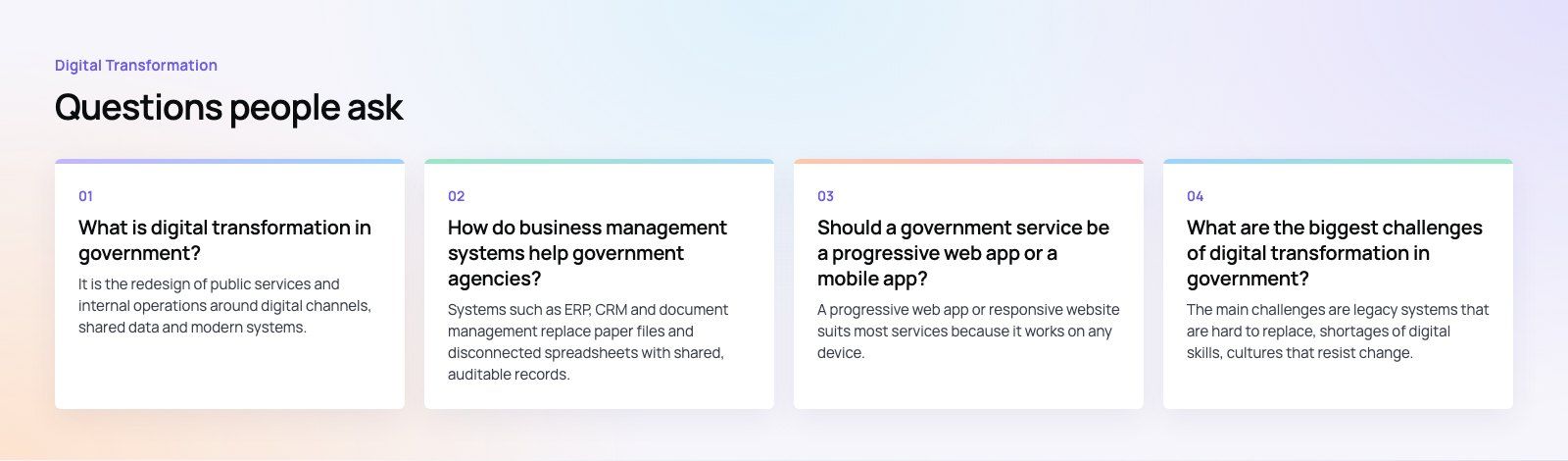
It is the redesign of public services and internal operations around digital channels, shared data and modern systems.
It covers online citizen services, digital identity, electronic records, workflow automation and data-driven policy. The aim is faster, more transparent and more accessible services for residents, with less manual effort for staff and better information for decision makers.
Digital TransformationHow Digital Transformation Is Reshaping BusinessesFive ways digital transformation is changing operations, customer experience, data, business models and work, plus the challenges and a practical roadmap. Digital TransformationStrategic Human Resource Management: Aligning HR With GoalsWhat strategic human resource management means, the components of a strategic HR model, and a six step process for aligning HR with business goals.
 Digital TransformationBest CRM for Small Businesses: 10 Options and How to ChooseTen CRM platforms that suit startups and small teams, from HubSpot and Zoho to Kommo and NetHunt, with a comparison table and a practical way to choose.
Tell us what the business needs. We will tell you what to build first.
Schedule a free consultation and get a written recommendation, with costs, before you commit to anything.
Get in touchPROVEN RESULTS
4.7 / 5verified reviews on Google