 InsightsHow Employee Engagement Drives Business PerformanceHow employee engagement affects profit, productivity, absence, retention, customers and innovation, what the evidence says, and how to link it to results.
How Employee Engagement Increases Productivity and Growth
How employee engagement drives productivity and growth, the signs of disengagement, practical steps, the metrics to track and how HR software can help.
Employee engagement increases productivity because engaged people put discretionary effort into their work: they focus better, make fewer mistakes, solve problems without being asked, and stay long enough to become expert. Gallup's research links high engagement with higher productivity, profitability and quality, and with lower absence and turnover. Growth follows because a stable, committed team serves customers better and spends less time replacing people.
This article explains how that link works, how to spot disengagement, the steps that raise engagement, the metrics to track and how HR software can help without becoming another burden.
What the evidence says
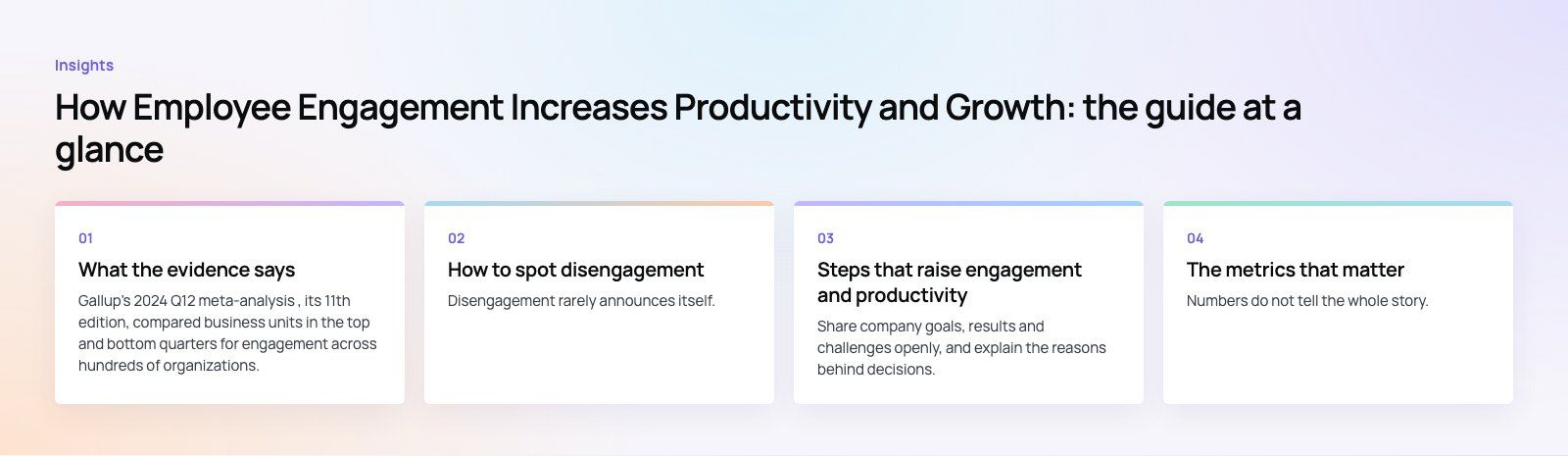
Gallup's 2024 Q12 meta-analysis, its 11th edition, compared business units in the top and bottom quarters for engagement across hundreds of organizations. The median differences favored the top units by 18% in productivity measured in sales, 23% in profitability, 10% in customer loyalty and 78% in absenteeism, with turnover 21% lower in high turnover organizations and 51% lower in low turnover ones. Those are differences between groups, not promises for any single company, but the direction is consistent across industries and countries.
The opportunity is large because engagement is low. Gallup's State of the Global Workplace 2026 report found only 20% of employees worldwide were engaged in 2025, and estimated that low engagement costs the global economy around 9% of GDP in lost productivity.
How engagement turns into productivity and growth
- Discretionary effort. Engaged employees do more than the minimum: they follow up, fix problems and help colleagues.
- Better focus and fewer errors. People who care about the outcome check their work, which shows up as higher quality and less rework.
- Lower absence. Engaged teams take fewer unplanned days off, so work flows without constant cover arrangements.
- Retention of expertise. People stay longer, so knowledge stays in the business and less time goes on hiring and training replacements.
- Ideas and improvement. Engaged people suggest better ways of working, which drives innovation and efficiency.
- Customer experience. Customers notice when staff care, which supports loyalty and repeat business.
How to spot disengagement
Disengagement rarely announces itself. Look for these patterns, especially when several appear in the same team:
- Rising absence, late arrivals and early departures
- Work that meets the bare minimum and no more
- People going quiet in meetings and sharing less information
- Negativity, cynicism or conflict spreading in a team
- Good performers leaving, often to similar roles elsewhere
These signs often point to a cause you can fix, such as an overloaded team, an unclear direction or a struggling manager.
Steps that raise engagement and productivity
Build trust through transparency
Share company goals, results and challenges openly, and explain the reasons behind decisions. Hold regular team meetings where people can ask direct questions. Give people ownership of their work and the authority to make decisions within their role. Trust grows when leaders do what they say.
Recognize achievements
Recognize individual and team successes promptly, and be specific about what made the work good. Mix public recognition with private thanks, and let people choose meaningful rewards where possible, such as extra training, flexibility or time off. A sincere thank you from a manager still goes a long way.
Invest in development
Offer training, mentoring and stretch assignments, and discuss career goals at least twice a year. Clear development paths show people you are invested in their future, which makes them more invested in yours.
Support work life balance
Flexible working, where the role allows, is one of the benefits employees value most. Set clear expectations for outcomes and availability so flexibility does not become a productivity gap. Good leave policies and realistic workloads protect energy over the long term.
Make the workplace enjoyable
Team activities, social events and friendly challenges build relationships that help people collaborate. Keep them inclusive and optional, and make sure remote staff can join in.
Remove friction
Productivity suffers when people fight their tools: duplicate data entry, slow approvals, searching for files, building the same report every week. Ask teams what slows them down, then fix the worst problems first. Small automations often return hours each week.
Ten quick ways to engage your team
- Keep communication open and honest.
- Recognize achievements, big and small.
- Offer training and mentoring.
- Support flexible working where roles allow.
- Organize inclusive team activities.
- Delegate real decisions, not just tasks.
- Encourage ideas and act on the good ones.
- Keep the environment positive and respectful.
- Value each person's strengths.
- Celebrate team wins together.
The metrics that matter
| Metric | What it shows | Watch out for |
|---|---|---|
| Employee net promoter score | Whether people would recommend working here | Small teams make scores volatile |
| Engagement and pulse surveys | Engagement levels and drivers by team | Low response rates signal low trust |
| Absenteeism | Early warning of stress or disengagement | Seasonal illness distorts short periods |
| Voluntary turnover | Who is leaving and from which teams | Separate regretted from non regretted leavers |
| Performance against goals | Whether engagement shows up in output | Goals must be fair and comparable |
| Internal communication reach | Whether updates are read and acted on | Opens are not the same as understanding |
Numbers do not tell the whole story. Pair them with one to one conversations and focus groups to understand the reasons behind the trends. Putting survey, HR and performance data in one dashboard, for example with Power BI, makes those trends visible to leaders without manual reporting.
How HR software helps
A modern HR management system (HRMS) can take admin off managers' plates and give them better information. Features that support engagement include:
- Pulse surveys for quick, frequent feedback on specific topics
- Performance management for goals, check ins and ongoing feedback in one place
- Recognition tools for peer and manager shout outs
- Learning and development modules for courses and career paths
- Communication hubs for announcements, team discussions and targeted notifications
- Self service so employees handle leave, documents and details without email chains
Choosing and implementing a system
Start from the problems you need to solve, not a feature list. Check how the system connects with payroll, finance and the tools people already use, because disconnected systems create the duplicate work you are trying to remove. Pilot with one or two teams, train managers properly, and measure adoption. If no packaged system fits your workflows, shifts or approval rules, a custom layer or app on top of your existing tools may be the better route; well planned system integration keeps data flowing between them.
Common mistakes
- Expecting software to fix culture. Tools amplify good management; they do not replace it.
- Measuring without acting. Collecting data no one uses lowers trust.
- Pushing productivity at the cost of wellbeing. Short term output gains from overwork turn into absence and turnover.
- One size fits all. Engineering, sales and frontline teams need different approaches.
Building tools your people will use
Engagement is ongoing work, not a one time project, and the right tools make it easier to sustain. Codeeo has delivered 200+ projects across the UAE and the US, including internal tools, dashboards and apps for businesses. If you are weighing up an HR or employee app, a product scoping session is a quick way to define it, and our custom software development team can build it.
Frequently asked questions
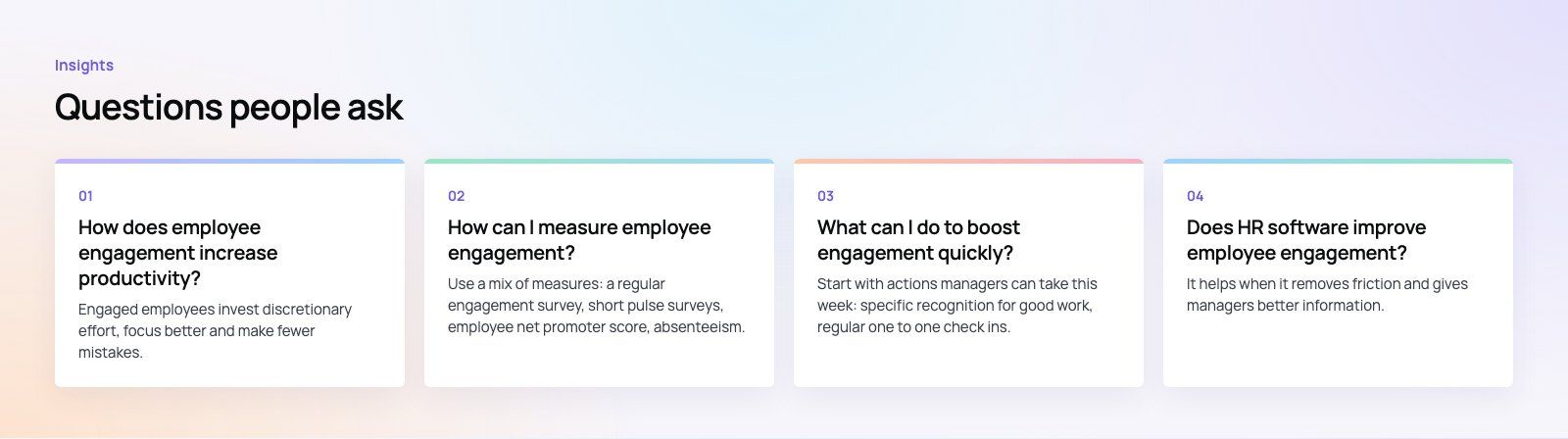
Engaged employees invest discretionary effort, focus better and make fewer mistakes.
They take fewer unplanned days off and stay longer, so teams keep their expertise and spend less time hiring and training. Gallup's 2024 meta-analysis found top quartile engagement units had 18% higher productivity in sales and 78% lower absenteeism than bottom quartile units, alongside lower turnover.
InsightsHow Employee Engagement Drives Business PerformanceHow employee engagement affects profit, productivity, absence, retention, customers and innovation, what the evidence says, and how to link it to results. InsightsThe Five Functions of Human Resource Management ExplainedThe five core functions of human resource management: recruitment, training, performance, compensation and employee relations, with practices and pitfalls.
 InsightsPerformance Management and Employee Engagement: A Practical GuideHow to run performance management that raises engagement: frequent check ins, specific recognition, growth plans, a strengths based approach and who owns what.
Tell us what the business needs. We will tell you what to build first.
Schedule a free consultation and get a written recommendation, with costs, before you commit to anything.
Get in touchPROVEN RESULTS
4.7 / 5verified reviews on Google