 InsightsHow Employee Engagement Drives Business PerformanceHow employee engagement affects profit, productivity, absence, retention, customers and innovation, what the evidence says, and how to link it to results.
Performance Management and Employee Engagement: A Practical Guide
How to run performance management that raises engagement: frequent check ins, specific recognition, growth plans, a strengths based approach and who owns what.
Performance management and employee engagement work best as one system: clear goals and regular feedback give people direction, and engagement gives them the energy to act on it. When performance management is only about ratings and annual reviews, it feels like judgment and pushes engagement down. When it is built around frequent check ins, specific recognition and growth, it becomes one of the strongest engagement tools a company has.
How engagement affects performance
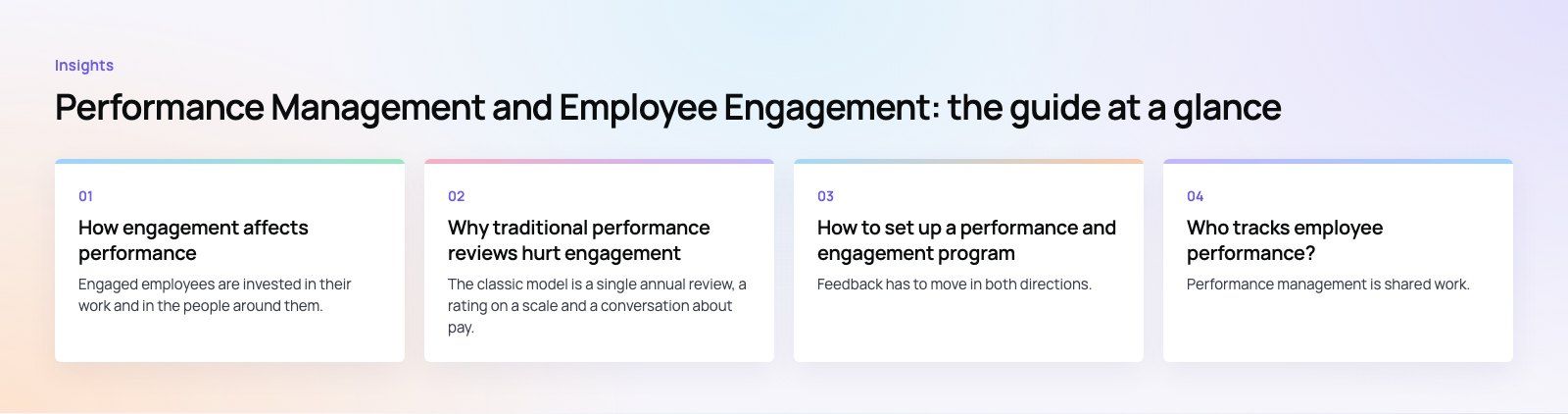
Engaged employees are invested in their work and in the people around them. That shows up in performance in several practical ways.
- Motivation and commitment. People who feel valued go beyond the minimum and care about the quality of what they deliver.
- Focus. Engaged people are less distracted and less likely to burn out, so their output stays steady over time.
- Ideas. Teams that feel safe speaking up suggest improvements and flag problems earlier.
- Retention and attendance. Engaged employees are less likely to leave or be absent, which saves the time and disruption of constant hiring.
Engagement also reaches customers. People who care about their work tend to care about the people they serve, which shows up in service quality, loyalty and, eventually, reputation as an employer.
The problem is that engagement is scarce. Gallup's State of the Global Workplace 2026 report puts global engagement at just 20% in 2025, the lowest figure in five years. Most organizations have a large group of people doing acceptable work without real commitment, and performance management is one of the few levers that touches every one of them.
Why traditional performance reviews hurt engagement
The classic model is a single annual review, a rating on a scale and a conversation about pay. It has three weaknesses.
- Feedback arrives months after the work, when it is too late to change anything.
- Ratings dominate the conversation, so people listen for the number and stop hearing the advice.
- It looks backward at what went wrong rather than forward at what to do next.
None of this means you should drop structure. Strict systems without positive reinforcement feel punitive, but a purely feel good culture lacks direction. The goal is a balance: clear standards with frequent, supportive conversations around them.
How to set up a performance and engagement program
Build a feedback friendly culture
Feedback has to move in both directions. Give people easy ways to raise roadblocks and ideas: anonymous surveys, suggestion channels, open forums and simple questions in one to ones such as "what is slowing you down?" Then act on what you hear and tell people what changed. Feedback that disappears teaches everyone to stop giving it.
Hold regular check ins
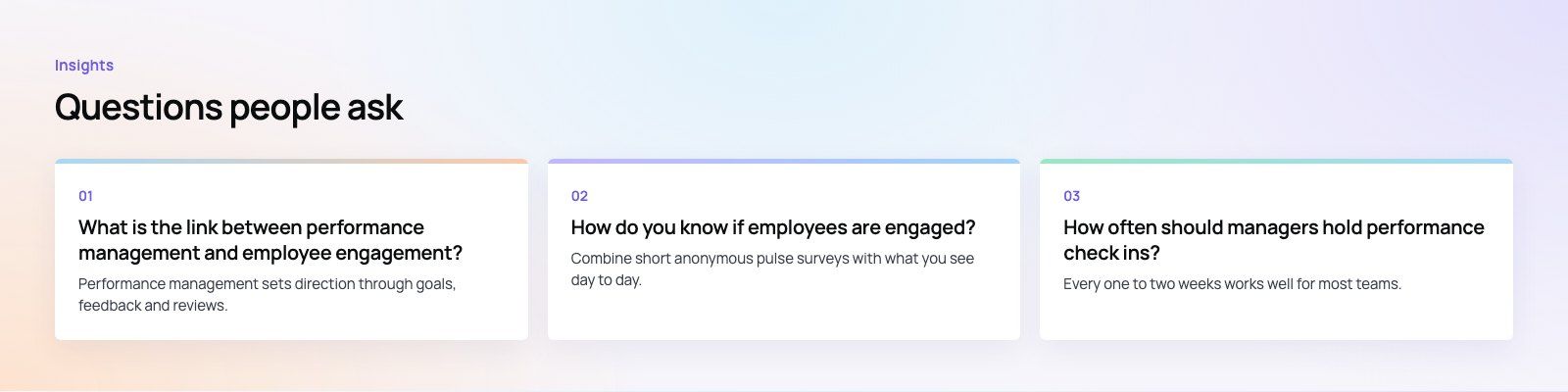
Short, frequent conversations beat long, rare ones. A twenty minute one to one every week or two lets a manager adjust goals, unblock work and spot problems before they grow. Team stand ups add shared visibility on progress. By the time a formal review arrives, nothing in it should be a surprise.
Recognize achievements and give useful criticism
Recognition reinforces the behavior you want, so make it specific and timely. Celebrate individual and team contributions, including progress on hard problems, not only finished results.
Constructive criticism belongs in the same rhythm. Focus on the work and the next step, not the person, and pair it with support: a resource, a mentor or more time.
Focus on personal development
Ask each person what they want to learn and where they want to be in a year or two, then connect their goals to real opportunities. Training, workshops, mentoring and stretch projects all count. When performance conversations include growth, they stop feeling like audits.
Support learning at work
Make learning part of the job rather than something squeezed into evenings. Give access to courses and tools, set aside time for them, and encourage peer learning so experienced staff pass on what they know. A team that keeps learning keeps performing as its work changes.
Use a strengths based approach
Traditional reviews spend most of their time on weaknesses. A strengths based approach asks what each person does best and shapes their role, projects and responsibilities around it. You still address gaps that matter, but people spend more of their time doing work they are good at, which lifts both performance and engagement.
Striking the right balance
| Principle | What it looks like in practice |
|---|---|
| Set clear expectations | Written goals and measures that each person understands and agreed to |
| Focus on improvement | Feedback framed around the next step, not past mistakes |
| Celebrate small wins | Recognition for progress, not only for finished projects |
| Give autonomy | People choose how to reach goals and own decisions in their area |
| Invest in wellbeing | Flexible arrangements, realistic workloads and support when needed |
Who tracks employee performance?
Performance management is shared work. Each group has a distinct role.
Managers and supervisors
Frontline managers own day to day performance. They set expectations, give feedback, assess progress against goals and coach people through problems. They are also the ones best placed to notice when someone is disengaging.
Human resources
HR designs the framework: review cycles, goal templates, appraisal tools and guidance for managers. HR also makes sure the process is fair and consistent across teams, and that development plans actually happen.
Senior leadership
Executives set the mission and strategic objectives that individual goals should ladder up to. They also decide whether performance management is treated as a growth tool or a compliance exercise, which shapes how everyone else approaches it.
Employees themselves
People should understand their responsibilities, help set their own goals and review their progress honestly. Many of the best improvements to a performance process come from employees who suggest a better way of working.
The role of tools
A good process can run on documents and calendars, but it gets harder as a company grows. Goals drift out of date, check in notes live in personal files, and nobody can see patterns across teams. A simple system that keeps goals, check ins, feedback and recognition in one place makes the habits easier to keep.
Some companies use an off the shelf HR suite. Others need something shaped around how they work, such as an internal app built on Microsoft Power Platform, goals and reviews held in Microsoft 365, or Power BI dashboards that show engagement trends by team. Choose the tool after you have agreed on the process, not before.
Common mistakes to avoid
- Linking every conversation to pay, so people stop being honest about problems.
- Setting goals in January and never looking at them again.
- Training managers on the review form but not on how to give feedback.
- Measuring engagement without sharing results or acting on them.
- Adding software before fixing the underlying process.
Bringing it together
Performance management and engagement are not competing priorities. Clear goals, frequent check ins, specific recognition and real development opportunities improve both at the same time. Start small: move from annual to monthly conversations, add specific recognition, and ask every person about their growth.
If you want a system that fits the way your teams already work, Codeeo builds internal tools, portals and dashboards for growing companies. Explore our custom software development service or get in touch to talk it through.
Frequently asked questions
Performance management sets direction through goals, feedback and reviews, while engagement determines how much effort and care people bring to their work.
Done well, they reinforce each other: regular, supportive feedback raises engagement, and engaged people respond better to feedback. Done badly, with rare reviews and a heavy focus on ratings, performance management can actively lower engagement.
InsightsHow Employee Engagement Drives Business PerformanceHow employee engagement affects profit, productivity, absence, retention, customers and innovation, what the evidence says, and how to link it to results. InsightsThe Five Functions of Human Resource Management ExplainedThe five core functions of human resource management: recruitment, training, performance, compensation and employee relations, with practices and pitfalls.
 InsightsEmployee Engagement and Wellbeing: How They Work TogetherHow employee engagement and wellbeing reinforce each other, the warning signs to watch, how to run wellbeing surveys and five strategies that lift both.
Tell us what the business needs. We will tell you what to build first.
Schedule a free consultation and get a written recommendation, with costs, before you commit to anything.
Get in touchPROVEN RESULTS
4.7 / 5verified reviews on Google