 InsightsHow Employee Engagement Drives Business PerformanceHow employee engagement affects profit, productivity, absence, retention, customers and innovation, what the evidence says, and how to link it to results.
The Five Functions of Human Resource Management Explained
The five core functions of human resource management: recruitment, training, performance, compensation and employee relations, with practices and pitfalls.
The five core functions of human resource management are recruitment and selection, training and development, performance management, compensation and benefits, and employee relations. Together they cover the whole employee life cycle, from attracting a candidate to keeping a motivated, fairly treated team. Each function has its own practices and pitfalls, and they work best when they share data and goals instead of running as separate departments.
This article explains each pillar, the managerial work behind it, the challenges HR teams usually meet, and how systems and data support the whole picture.
Why think of HR in five pillars
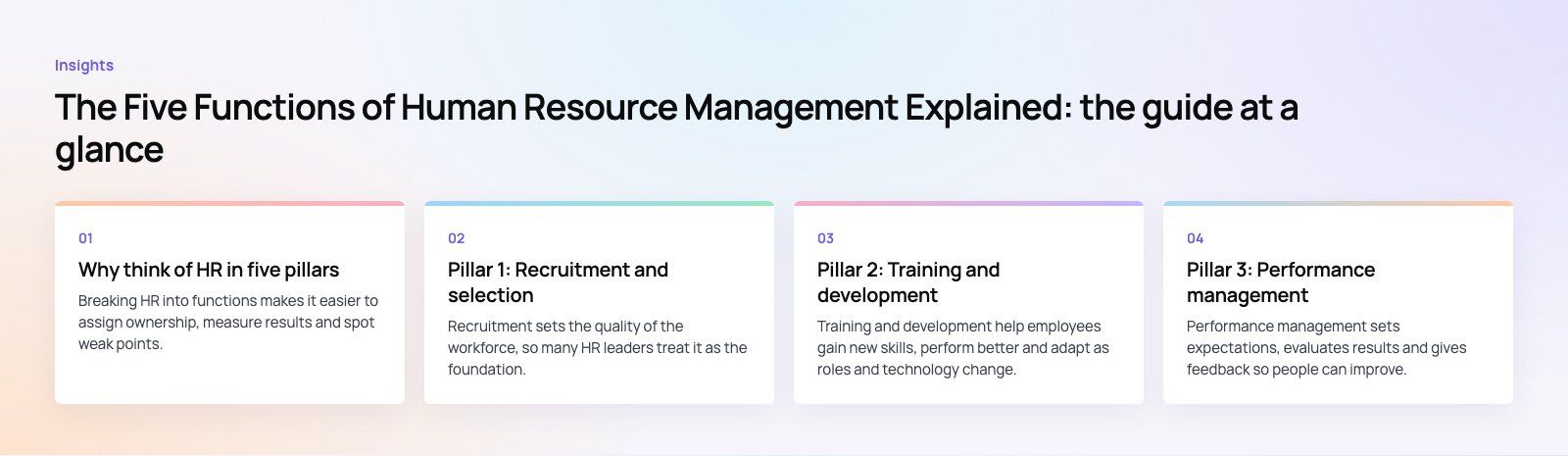
Breaking HR into functions makes it easier to assign ownership, measure results and spot weak points. A company can have excellent recruitment and still lose people because performance reviews feel arbitrary, or pay generously but struggle because managers handle conflict badly. Looking at all five pillars together shows where the real problem sits.
When the pillars work well together, organizations usually see:
- A stronger employer reputation that makes hiring easier.
- Employees whose skills keep pace with changing roles.
- A culture where people keep learning and improving.
- Individual goals that line up with company objectives.
- Better retention of people the business cannot afford to lose.
Pillar 1: Recruitment and selection
Recruitment sets the quality of the workforce, so many HR leaders treat it as the foundation. It covers defining the role, sourcing candidates, screening, interviewing, selecting and making the offer.
Good practice
- Start from the role, not the CV. Write down the outcomes the person must deliver in the first year, then derive skills and experience from that.
- Use several channels. Job boards, professional networks, referrals, communities and social media each reach different candidates.
- Structure interviews. Ask every candidate the same core questions and score answers against agreed criteria. This improves fairness and makes decisions easier to defend.
- Look after candidate experience. Clear timelines, prompt replies and useful feedback protect your reputation even with people you do not hire.
Common challenges
Competition for scarce skills is the obvious one. Less obvious is bias: unstructured interviews and narrow sourcing channels tend to produce similar hires every time. Data from your applicant tracking system, such as where successful hires came from and where candidates drop out, shows which parts of the process need work.
Pillar 2: Training and development
Training and development help employees gain new skills, perform better and adapt as roles and technology change. It includes onboarding, technical and soft skills training, leadership programs and ongoing learning.
Good practice
- Tie training to the business plan. Prioritize skills the strategy will need, not just courses people ask for.
- Mix formats. Short online modules, mentoring, shadowing and cross team projects suit different skills and schedules.
- Make onboarding structured. A clear first ninety days with goals, a buddy and regular check ins shortens the time to full productivity.
- Track completion and impact. Measure whether training changes performance, not only whether people attended.
Common challenges
Time and budget are the usual limits, and managers are often reluctant to release people from delivery work. Learning platforms that offer short sessions on mobile, together with mentoring inside teams, reduce that friction. A visible link between development and promotion is one of the strongest reasons people stay.
Pillar 3: Performance management
Performance management sets expectations, evaluates results and gives feedback so people can improve. Its purpose is to connect individual goals with organizational objectives and to build accountability.
Moving beyond the annual review
Traditional annual appraisals are often criticized as subjective and too infrequent to change behavior. Many organizations now combine them with:
- Regular one to one check ins between managers and team members.
- Clear, measurable goals reviewed during the year rather than only at the end.
- Peer feedback for roles where colleagues see the work more closely than the manager.
- Timely recognition when someone does good work.
Using data well
Performance systems can show trends in goal completion, engagement and productivity. Used carefully, they help HR spot managers who need support and teams under strain. Used badly, they reduce people to scores. Combine numbers with conversations, and be transparent about what is measured and why.
Pillar 4: Compensation and benefits
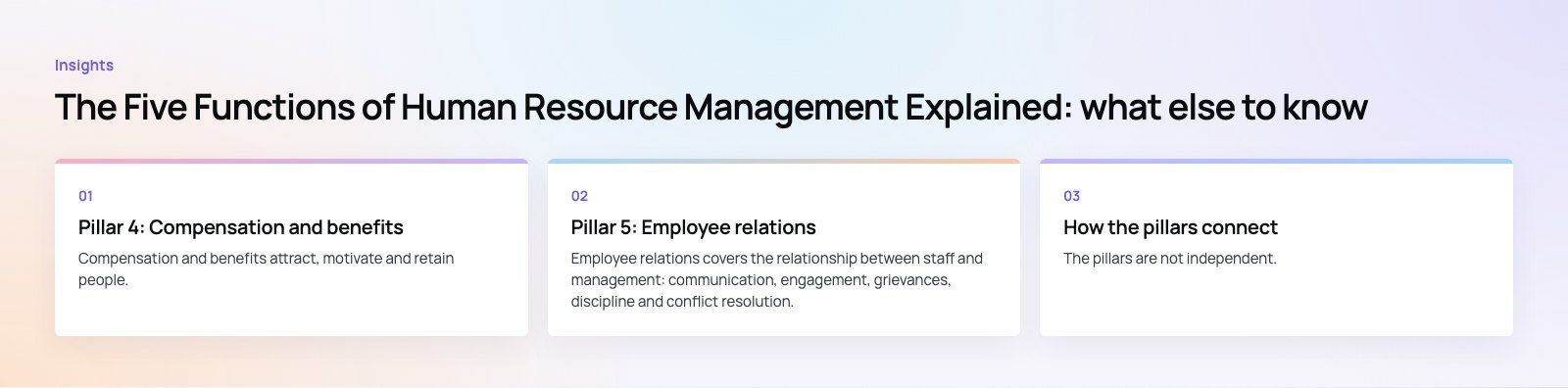
Compensation and benefits attract, motivate and retain people. This pillar covers salary structures, bonuses and incentives, health cover, retirement or end of service provisions, leave and other benefits.
What drives a competitive package
- Market benchmarks. Regular comparison with similar roles in your sector and location.
- Internal fairness. Clear pay bands and criteria, so similar work earns similar reward.
- Employee preferences. Different groups value different things; surveys show what matters most to your workforce.
- Affordability. A package the business can sustain as it grows.
Non financial rewards
Flexible working, career progression, learning budgets and recognition often matter as much as pay. Tailoring the mix to what your people actually value tends to improve loyalty more than across the board increases.
| Pillar | Main goal | Useful measures | Typical system |
|---|---|---|---|
| Recruitment and selection | Hire the right people | Time to hire, quality of hire, source of hire | Applicant tracking system |
| Training and development | Build skills | Completion, skill gains, internal promotions | Learning management system |
| Performance management | Align and improve results | Goal completion, review cycle completion | Performance module in an HRIS |
| Compensation and benefits | Reward fairly and competitively | Pay equity, benefits uptake, offer acceptance | Payroll and benefits platform |
| Employee relations | Maintain trust and resolve issues | Engagement scores, grievance resolution time | Case management and survey tools |
Pillar 5: Employee relations
Employee relations covers the relationship between staff and management: communication, engagement, grievances, discipline and conflict resolution. It rests on trust, transparency and consistent treatment.
Good practice
- Open communication. Regular updates from leadership and simple ways for employees to raise concerns.
- Clear, fair procedures. Written grievance and disciplinary processes that managers apply consistently.
- Early resolution. Most conflicts are easier to settle in a conversation than in a formal process.
- Inclusion. A culture where people of every background feel they belong makes teams more cohesive and engaged.
Legal and data responsibilities
Employee relations also means following labor law in every country where you employ people and protecting personal data. Employers handling data on people in the European Union, for instance, must follow the General Data Protection Regulation. Case notes, grievances and health information need strict access controls.
How the pillars connect
The pillars are not independent. Recruitment decisions shape training needs. Performance reviews inform pay and promotion. Pay and recognition affect employee relations. When each function keeps its own spreadsheet, these links break and decisions are made on partial information.
A shared employee record, connected payroll and a single reporting layer let HR see the whole life cycle. Our Seamfox case study shows a recruitment platform with candidates, companies, jobs and applications on a kanban board. For broader HR operations, many organizations connect their people data to an ERP such as Odoo or Microsoft Dynamics 365, and use Power BI to report across all five functions.
Mistakes that weaken HR functions
- Treating HR as administration only. Payroll and records matter, but the value comes from hiring, developing and keeping the right people.
- Training managers too little. Most of the five pillars are delivered by line managers, not HR.
- Measuring activity instead of outcomes. Counting interviews or courses says little about quality of hire or skill growth.
- Inconsistent policies. Applying rules differently across teams damages trust faster than almost anything else.
If your HR functions run on disconnected tools, Codeeo can help connect them. With a team of 80+ across Dubai, Riyadh and Karachi, we build custom software and integrations that give HR one reliable view of the workforce.
Frequently asked questions
The five core functions are recruitment and selection, training and development, performance management, compensation and benefits, and employee relations.
Recruitment brings the right people in, training builds their skills, performance management aligns their work with company goals, compensation rewards them fairly, and employee relations maintains trust and resolves issues. Together they cover the full employee life cycle from hiring to retention.
InsightsHow Employee Engagement Drives Business PerformanceHow employee engagement affects profit, productivity, absence, retention, customers and innovation, what the evidence says, and how to link it to results. InsightsPerformance Management and Employee Engagement: A Practical GuideHow to run performance management that raises engagement: frequent check ins, specific recognition, growth plans, a strengths based approach and who owns what.
 InsightsEmployee Engagement and Wellbeing: How They Work TogetherHow employee engagement and wellbeing reinforce each other, the warning signs to watch, how to run wellbeing surveys and five strategies that lift both.
Tell us what the business needs. We will tell you what to build first.
Schedule a free consultation and get a written recommendation, with costs, before you commit to anything.
Get in touchPROVEN RESULTS
4.7 / 5verified reviews on Google