 InsightsHow Employee Engagement Drives Business PerformanceHow employee engagement affects profit, productivity, absence, retention, customers and innovation, what the evidence says, and how to link it to results.
Employee Engagement and Wellbeing: How They Work Together
How employee engagement and wellbeing reinforce each other, the warning signs to watch, how to run wellbeing surveys and five strategies that lift both.
Employee engagement and wellbeing reinforce each other. People who are physically and mentally well have the energy to commit to their work, and people who find their work meaningful, with fair workloads and supportive managers, tend to be healthier and less stressed. Treating them as one agenda, measured together and owned by managers as well as HR, gives better results than running a wellness program alongside a separate engagement survey.
This article explains how the two connect, the warning signs that wellbeing is pulling engagement down, how to use wellbeing surveys well, and five strategies that improve both.
How engagement and wellbeing connect
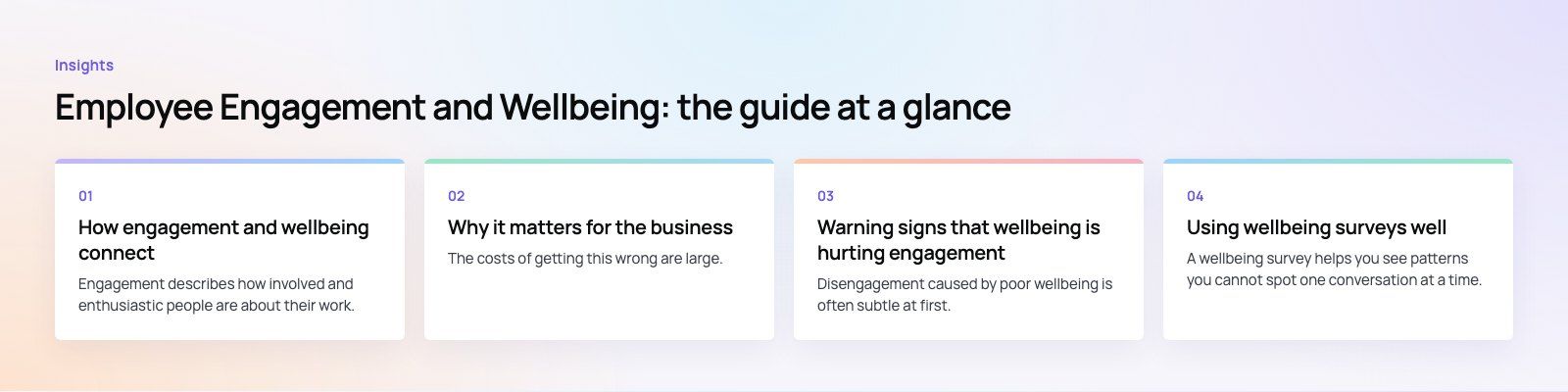
Engagement describes how involved and enthusiastic people are about their work. Wellbeing covers their physical, mental, social and financial health. The link runs both ways:
- Poor wellbeing lowers engagement. Someone who is exhausted, anxious or unwell has little left for ideas, collaboration or extra effort, however much they like the job.
- Disengaging work harms wellbeing. Unclear expectations, no control over workload, lack of recognition and poor management are recognized sources of work related stress.
- Good conditions lift both. Reasonable workloads, supportive managers, autonomy and meaningful work improve health and commitment together.
Why it matters for the business
The costs of getting this wrong are large. The World Health Organization's fact sheet on mental health at work estimates that around 12 billion working days are lost every year to depression and anxiety. At the same time, Gallup's 2024 Q12 meta-analysis found that business units in the top quarter for engagement had 78% lower absenteeism than those in the bottom quarter, along with higher productivity and profitability.
Put simply, organizations that look after people's health and engagement lose fewer days to absence, keep more of their good people and get more from the people they keep.
Warning signs that wellbeing is hurting engagement
Disengagement caused by poor wellbeing is often subtle at first. Watch for:
- Rising short term absence, or presenteeism, where people show up but cannot function well
- Lower quality work, more mistakes and missed deadlines
- Withdrawal from meetings, chat and team activities
- More cynicism, irritability or conflict in a team
- Long hours that become normal rather than occasional
- An increase in complaints or grievances
One sign alone means little. Several together, especially concentrated in one team, deserve a conversation and a closer look at workload and management.
Using wellbeing surveys well
A wellbeing survey helps you see patterns you cannot spot one conversation at a time. To make it useful:
- Ask about conditions, not just feelings. Include questions such as "Is my workload manageable?", "Can I switch off outside working hours?" and "Does my manager support me when I am under pressure?"
- Protect anonymity. Report results only for groups large enough that no individual can be identified.
- Combine with engagement questions. Seeing wellbeing and engagement side by side shows which teams struggle with both.
- Run it regularly. A fuller survey once or twice a year, with short pulse checks in between, shows whether changes are working.
- Act visibly. Share what you found and what you will change. A survey with no follow up erodes trust.
Combining survey, absence and turnover data in one place, for example in a Power BI report, helps HR and leaders spot hot spots early.
Five strategies that improve engagement and wellbeing together
1. Build a supportive culture
Culture starts with leaders. Be transparent about goals, challenges and decisions, and make it safe to raise problems. Recognize effort promptly and specifically, so people feel their work is seen. Celebrate team achievements together so everyone feels part of something bigger than their own task list. Psychological safety, the confidence that you will not be punished for speaking up, underpins both wellbeing and good ideas.
2. Protect work life balance
Balance depends on behavior more than policy. Leaders should take their own leave and avoid sending messages late at night, because teams copy what they see. Encourage regular breaks, discourage a culture of constant availability, and offer flexible arrangements where the work allows. Review workloads honestly: if a team is always stretched, the fix is fewer priorities or more people, not a resilience workshop.
3. Make mental health support easy to reach
The WHO recommends both organizational action on workplace risks and training managers to recognize and respond to distress. In practice that means:
- Offering an employee assistance program with confidential counseling, and reminding people it exists
- Training managers to notice signs of stress, have supportive conversations and point people to help
- Addressing root causes such as excessive workload, poor role clarity, harassment or unpredictable schedules
- Providing optional resources such as mindfulness sessions, workshops and digital tools
4. Give people autonomy and room to contribute
Control over how work gets done is good for both engagement and health. Let people make decisions within their role, invite ideas for improvement, and act on the good ones with credit to the person who suggested them. Small experiments, such as a team trying a new way to run meetings, build ownership and energy.
5. Invest in growth
Feeling stuck is draining. Regular career conversations, training that fits real needs, mentoring, job rotations and cross team projects give people a sense of progress. Tracking learning in a simple system helps managers see who is developing and who has been overlooked.
Wellbeing actions at a glance
| Area | Low effort actions | Deeper actions |
|---|---|---|
| Workload | Weekly priority check in with each manager | Review staffing and cut low value work |
| Mental health | Promote the employee assistance program | Manager training and risk assessments |
| Flexibility | Clear rules on after hours messages | Flexible schedules or locations where roles allow |
| Recognition | Peer shout outs in team channels | Fair, transparent reward and promotion process |
| Growth | Twice yearly development conversations | Career frameworks and internal mobility |
Common mistakes
- Offering perks instead of fixing causes. Yoga classes do not offset chronic overwork.
- Keeping wellbeing inside HR. Managers shape daily workload and tone, so they must be involved.
- Collecting sensitive data carelessly. Health information needs strict privacy controls and clear consent.
- Measuring once and stopping. Wellbeing changes with seasons, projects and restructures. Keep checking.
Tools that support the work
Technology cannot create wellbeing, but it can reduce stress and make support easier to find. Useful examples include pulse surveys, a single intranet page for support resources, scheduling tools that make shifts predictable, and automation that removes repetitive admin. Many teams start by organizing what they already have in Microsoft 365. Organizations with shift based or field teams, such as clinics, often need something more specific; see our work in healthcare and the Distinct case study, a healthcare workforce platform with shifts, bookings, incident reports and rewards. If you are planning an internal app for your people, our mobile app development team can help you scope it.
Frequently asked questions
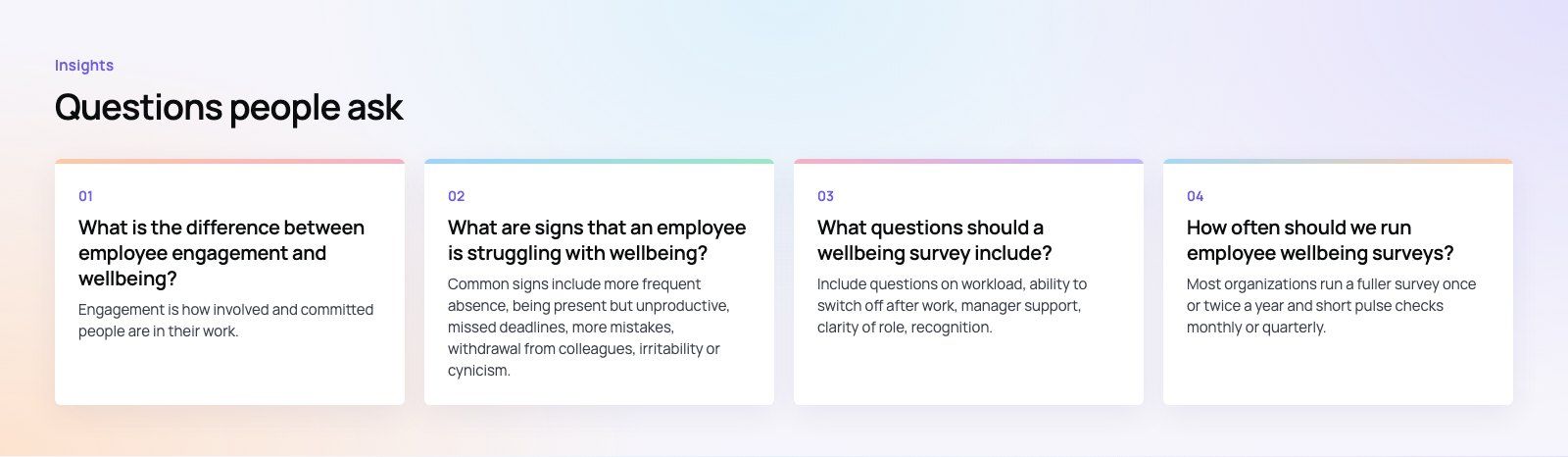
Engagement is how involved and committed people are in their work.
Wellbeing is their overall physical, mental, social and financial health. They are distinct but closely linked: poor wellbeing drains the energy people need to stay engaged, and disengaging work conditions such as unclear goals or excessive workload damage wellbeing. Improving one usually helps the other.
InsightsHow Employee Engagement Drives Business PerformanceHow employee engagement affects profit, productivity, absence, retention, customers and innovation, what the evidence says, and how to link it to results. InsightsThe Five Functions of Human Resource Management ExplainedThe five core functions of human resource management: recruitment, training, performance, compensation and employee relations, with practices and pitfalls.
 InsightsPerformance Management and Employee Engagement: A Practical GuideHow to run performance management that raises engagement: frequent check ins, specific recognition, growth plans, a strengths based approach and who owns what.
Tell us what the business needs. We will tell you what to build first.
Schedule a free consultation and get a written recommendation, with costs, before you commit to anything.
Get in touchPROVEN RESULTS
4.7 / 5verified reviews on Google