 InsightsThe Five Functions of Human Resource Management ExplainedThe five core functions of human resource management: recruitment, training, performance, compensation and employee relations, with practices and pitfalls.
How Employee Engagement Drives Business Performance
How employee engagement affects profit, productivity, absence, retention, customers and innovation, what the evidence says, and how to link it to results.
Yes, employee engagement improves business performance. Engaged employees are more productive, take fewer unplanned absences, stay longer and serve customers better, and those effects show up in profit. The largest body of evidence, Gallup's Q12 meta-analysis, finds that work units in the top half on engagement more than double their odds of success compared with units in the bottom half.
This guide explains what engagement means, how it connects to each business outcome, and how to build and measure it in a way that links back to results.
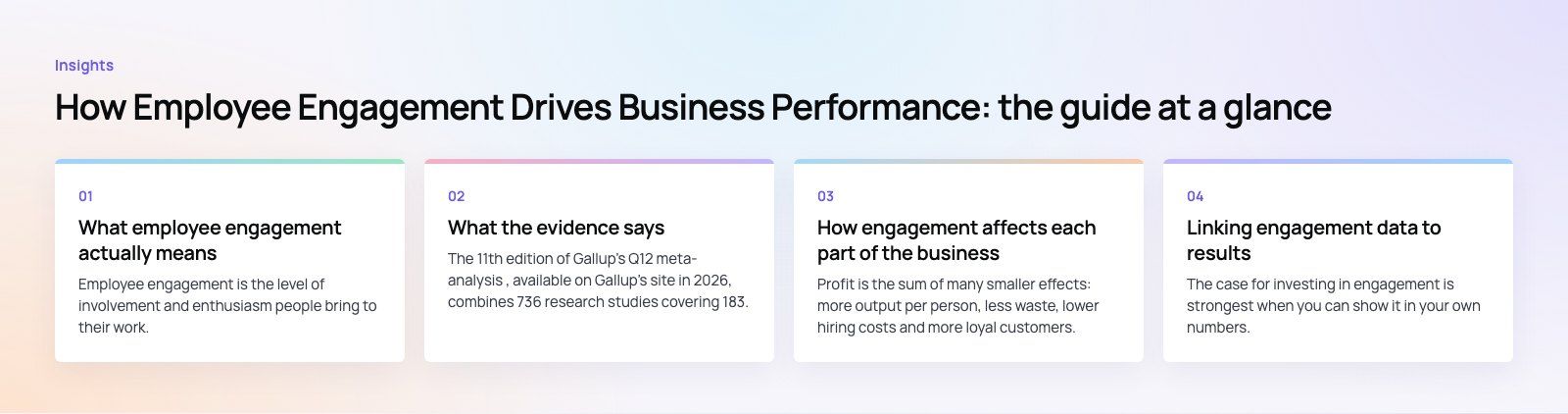
What employee engagement actually means
Employee engagement is the level of involvement and enthusiasm people bring to their work. Engaged employees understand what the organization is trying to achieve, know how their role contributes, and choose to put in effort beyond the minimum. It is different from satisfaction. A satisfied employee may be content with pay and conditions; an engaged one is invested in doing the work well.
Engagement depends heavily on everyday experience: clear expectations, the right tools, a manager who listens, recognition for good work and a chance to grow. When an organization meets those needs consistently, engagement rises. When it does not, effort drops even among talented people.
What the evidence says
The 11th edition of Gallup's Q12 meta-analysis, available on Gallup's site in 2026, combines 736 research studies covering 183,806 business and work units and more than 3.3 million employees. It examines 11 outcomes, including profitability, productivity, turnover, absenteeism, safety, quality and customer loyalty. The relationship between engagement and performance held across different organizations and industries.
The cost of getting it wrong is large. Gallup's State of the Global Workplace 2026 report estimates that low engagement cost the world economy around 9% of global GDP in lost productivity in 2025, at a time when only 20% of employees worldwide were engaged.
How engagement affects each part of the business
Profitability
Profit is the sum of many smaller effects: more output per person, less waste, lower hiring costs and more loyal customers. Engagement touches all of them, which is why engaged units tend to outperform on profitability even when they operate in the same company, market and pay structure as less engaged ones.
Productivity
Engaged employees are motivated by more than pay. They understand the purpose of their work and want it done well, so they focus on what matters, solve problems without being told and support colleagues. Strong relationships within engaged teams also make collaboration faster, because people trust each other and share information freely.
Absenteeism
Unplanned absence disrupts schedules, shifts work to colleagues and lowers service quality. Engagement is consistently linked to lower absence, partly because engaged people experience less work related stress and partly because they feel responsible to their team. Lower absence also helps the employees themselves, since being present and performing well opens the way to promotion and development.
Retention
Engaged employees are far less likely to leave. Every departure carries costs that are easy to underestimate: recruitment, onboarding, lost knowledge, the time before a new hire is fully productive and the extra load on the team in between. Higher retention protects all of that, and it keeps customer relationships with the people who built them.
Customer satisfaction and loyalty
Engaged employees take pride in their work and care about the people they serve. Customers notice. Better service leads to repeat business, positive reviews and recommendations, which in turn strengthen the company's reputation and its position against competitors. In service businesses especially, the employee experience and the customer experience are closely linked.
Innovation
Innovation depends on people offering ideas and taking reasonable risks. Engaged employees are more likely to do both, particularly when leaders make it safe to fail and learn. When people know they will be heard and will not be punished for a sensible experiment that did not work, they share more ideas and improve processes on their own initiative.
Adaptability
Organizations change constantly: new systems, new processes, new markets. Engaged employees adapt more readily because they trust leadership and understand the reasons for change. They are more willing to learn new tools and skills, which shortens the time it takes to get value from any new investment.
Engagement and business outcomes at a glance
| Outcome | How engagement helps | What to measure |
|---|---|---|
| Profitability | Combines gains in output, quality, retention and loyalty | Margin or profit by team or site |
| Productivity | More discretionary effort and better collaboration | Output per person, cycle times |
| Absenteeism | Less stress, stronger commitment to the team | Unplanned absence rate |
| Retention | People stay where they feel valued | Voluntary and regretted turnover |
| Customer loyalty | Better service and more care | Satisfaction scores, repeat business |
| Innovation | More ideas and safer experimentation | Ideas raised and implemented |
| Adaptability | Trust in change and willingness to learn | Adoption of new tools and processes |
How to build engagement that lasts
- Start with managers. Managers shape daily experience more than any program. Give them time, training and support to hold regular conversations with their teams.
- Communicate clearly. Share goals, priorities and the reasons behind decisions, and repeat them through managers, not just company announcements.
- Recognize good work. Specific, timely recognition from managers and peers matters more than an occasional ceremony.
- Offer growth. Training, stretch projects and internal moves show people a future inside the company.
- Protect work life balance. Reasonable workloads and respected time off prevent burnout that erodes engagement.
- Listen and act. Run regular surveys, share the results and show what changed because of them.
- Give people the right tools. Slow, clumsy systems frustrate capable people every day. Simple tools for requests, approvals and information remove a constant source of friction.
What works against engagement
- Unclear goals and shifting expectations
- Poor work life balance and constant overload
- Little or no feedback and recognition
- A toxic or unsafe work environment
- Limited growth opportunities
- Poor communication from leadership
- Micromanagement that removes ownership
Linking engagement data to results
The case for investing in engagement is strongest when you can show it in your own numbers. That means connecting survey results with HR data such as absence and turnover, and with business data such as sales, quality and customer scores, at team level. When this data sits in separate systems, leaders rarely see the connection. A shared dashboard built in a tool like Power BI or on the Power Platform makes it visible.
Where to begin
Measure engagement properly, connect it to the outcomes your leadership already tracks, and act first where the gaps are largest. If the tools your people use every day are part of the problem, Codeeo's custom software team can help, and projects such as Distinct, a workforce platform with shifts, reviews and rewards, show what better everyday tools look like.
Frequently asked questions
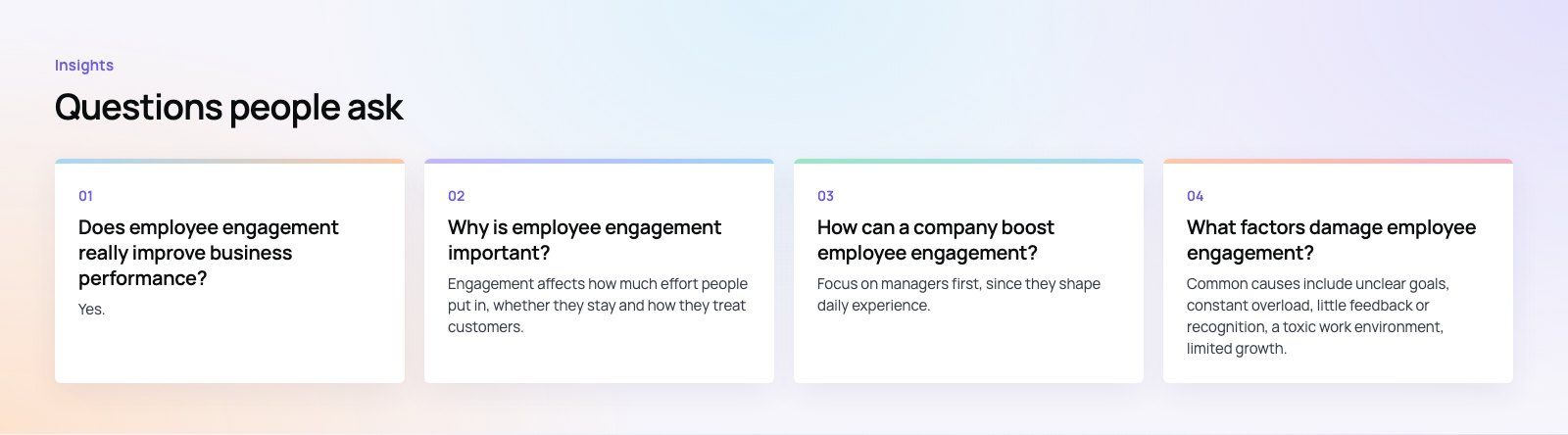
Yes.
Large studies, most notably Gallup's Q12 meta-analysis covering more than 183,000 business and work units, find a consistent link between engagement and outcomes such as profitability, productivity, retention, absenteeism, safety and customer loyalty. Units in the top half on engagement more than double their odds of success compared with those in the bottom half.
InsightsThe Five Functions of Human Resource Management ExplainedThe five core functions of human resource management: recruitment, training, performance, compensation and employee relations, with practices and pitfalls. InsightsPerformance Management and Employee Engagement: A Practical GuideHow to run performance management that raises engagement: frequent check ins, specific recognition, growth plans, a strengths based approach and who owns what.
 InsightsEmployee Engagement and Wellbeing: How They Work TogetherHow employee engagement and wellbeing reinforce each other, the warning signs to watch, how to run wellbeing surveys and five strategies that lift both.
Tell us what the business needs. We will tell you what to build first.
Schedule a free consultation and get a written recommendation, with costs, before you commit to anything.
Get in touchPROVEN RESULTS
4.7 / 5verified reviews on Google