 InsightsHow Employee Engagement Drives Business PerformanceHow employee engagement affects profit, productivity, absence, retention, customers and innovation, what the evidence says, and how to link it to results.
Employee Engagement Strategies for a Diverse Workplace
Eleven employee engagement strategies adapted for a diverse workforce, from feedback and recognition to resource groups, onboarding and fair career paths.
To achieve employee engagement in a diverse workplace, combine the basics that work everywhere (clear purpose, regular feedback, recognition, growth and wellbeing) with deliberate inclusion: communication in the languages people use, flexible ways to participate, employee resource groups and onboarding that welcomes every background. Engagement rises when every group feels heard and has a fair route to progress. This guide covers eleven strategies and how to adapt each one for a mixed workforce.
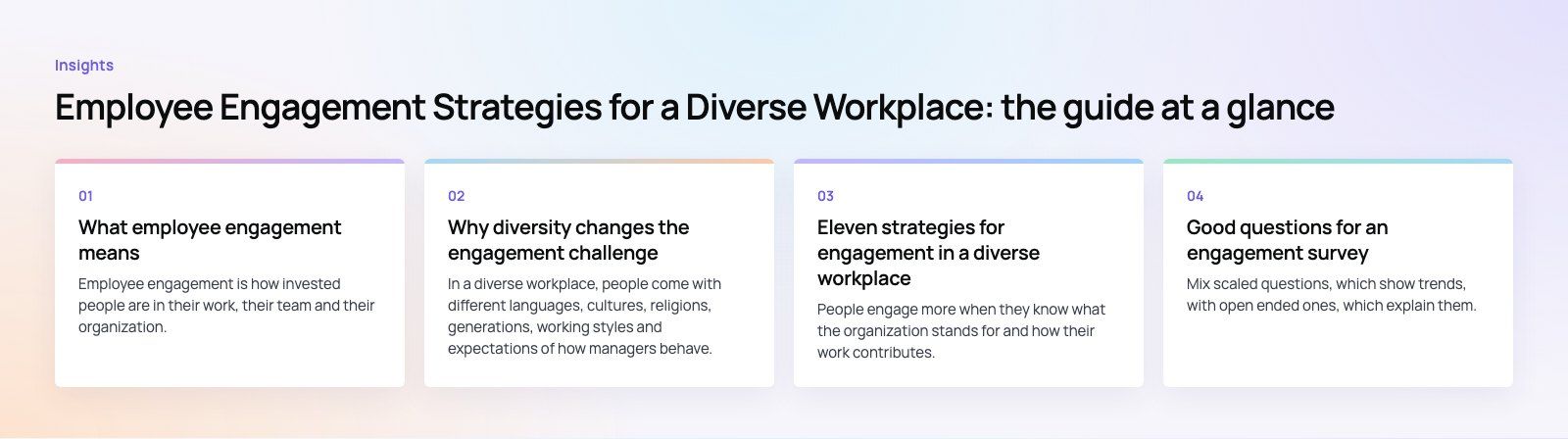
What employee engagement means
Employee engagement is how invested people are in their work, their team and their organization. Engaged people bring energy and judgment, not just attendance. They understand how their role connects to the company's goals, and they feel a genuine connection to the colleagues around them.
It is also rare. Gallup's State of the Global Workplace 2026 report found that only 20% of employees worldwide were engaged in 2025. Engagement levels move with culture, leadership and change, so even organizations that score well need to keep working at it.
Why diversity changes the engagement challenge
In a diverse workplace, people come with different languages, cultures, religions, generations, working styles and expectations of how managers behave. An engagement program designed around one group will miss the others. A team outing on a religious holiday, a survey only in English, or recognition that rewards being loudest in meetings can all leave large parts of the workforce on the outside.
The fix is not a separate program for each group. It is applying the same strategies with inclusion built in.
Eleven strategies for engagement in a diverse workplace
1. Define your mission and values together
People engage more when they know what the organization stands for and how their work contributes. Write a clear mission and a short list of values, then explain them in onboarding and refer to them in real decisions. In a diverse company, involve people from different groups when shaping or reviewing values so they reflect the whole workforce, not just leadership.
2. Make feedback easy for everyone
Employees want to be heard. Offer several ways to give feedback: regular review sessions with managers, anonymous online forms and open team discussions. Some people speak up readily in meetings, while others, often because of cultural norms or language confidence, prefer writing or anonymous channels. Offering both captures far more honest input.
3. Engage your managers first
Managers set the tone for their teams. Disengaged managers rarely produce engaged teams. Give managers training on inclusive leadership, time for one to ones and support for their own wellbeing. A manager who understands cultural differences in communication will get far more out of a mixed team.
4. Support physical and mental wellbeing
Work affects health, and health affects engagement. Offer wellbeing initiatives such as flexible hours, mental health resources, quiet spaces and healthy food options. Make sure they suit different needs: prayer spaces, dietary requirements, fasting periods and different family responsibilities all matter in a diverse team.
5. Recognize and reward achievement fairly
Everyone wants their effort noticed. Recognize good work promptly and specifically. Watch for bias: if recognition always goes to the same visible people, others will stop trying. Some people value public praise, while others prefer private thanks, so ask.
6. Run regular engagement surveys
Surveys show what is working and what is not, and running them regularly tells people their opinion matters. In a diverse workplace, offer surveys in the main languages your people use, keep them anonymous, and break results down by team, location and tenure (where groups are large enough to protect anonymity) so you can spot groups that feel left out.
7. Organize inclusive team activities
Colleagues who know each other work better together. Outings and social events help, but they do not need to be elaborate. What matters is that everyone can join comfortably. Vary timing, choose venues and food that suit different customs, and keep events optional rather than after hours obligations.
8. Create employee resource groups
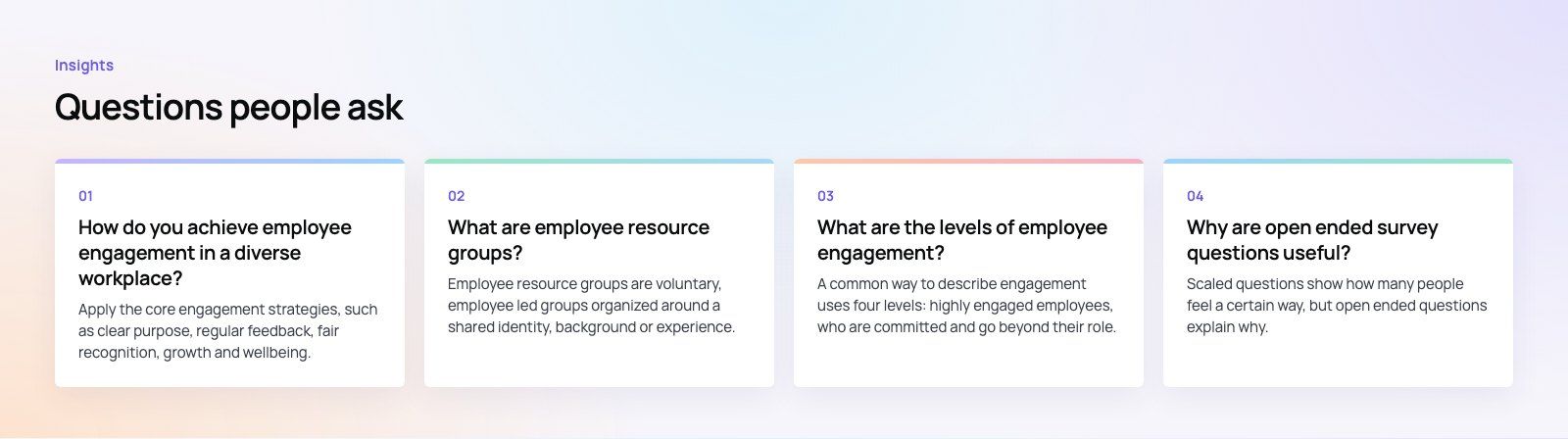
Employee resource groups (ERGs) are voluntary, employee led groups built around a shared identity or experience, such as women in technology, working parents, a cultural community or early career staff. They give people a sense of community, a voice to leadership and a way to celebrate different cultures. Give ERGs an executive sponsor and a small budget, and listen when they raise issues.
9. Focus on onboarding
The first few weeks shape how engaged a new hire becomes. Explain goals, team norms and company values, and make clear why the role matters. Pair each new starter with a buddy, provide materials in their preferred language where possible, and check in after the first week and the first month.
10. Show clear career paths
People commit when they see a future. Make promotion criteria transparent and apply them consistently, so everyone can see the route forward regardless of background. Ask employees what growth they want, and track whether progression is fair across groups.
11. Offer training and development
Many employees want new skills but do not know where to start. Offer workshops, courses and mentoring that build long term capability, not only skills for the current task. External trainers can help with specialist topics. Language and cross cultural communication training can be especially valuable in mixed teams.
Strategies compared
| Strategy | Effort | Inclusion check |
|---|---|---|
| Mission and values | Medium | Were different groups involved in shaping them? |
| Feedback channels | Low | Is there an anonymous, written option? |
| Manager engagement | Medium | Are managers trained in inclusive leadership? |
| Wellbeing | Medium | Do initiatives suit different faiths, diets and family needs? |
| Recognition | Low | Does it reach quieter and less visible people? |
| Surveys | Low | Are they in the languages people use? |
| Team activities | Low | Can everyone join comfortably? |
| Resource groups | Medium | Do they have a sponsor and are they heard? |
| Onboarding | Medium | Are materials accessible to all new hires? |
| Career paths | High | Is progression fair across groups? |
| Training | Medium | Is it open to every level and location? |
Good questions for an engagement survey
- Are you satisfied with your work? If not, what would change that?
- Do you understand how your role contributes to the company's goals?
- Do you find the company's mission meaningful?
- Do you feel recognized when you do good work?
- Do you feel you can be yourself at work?
- Do you feel respected by your team, regardless of background?
- Is there anything stopping you from contributing fully?
Mix scaled questions, which show trends, with open ended ones, which explain them.
Using technology to support engagement
Tools will not create engagement, but they can make inclusion easier. A multilingual intranet in Microsoft 365, survey dashboards in Power BI, or a mobile app for frontline staff who never sit at a desk can all help people take part. Bilingual and right to left support matters for many workforces in the Gulf.
Where to begin
Start with a survey that every group can answer comfortably, then pick two or three strategies that address the biggest gaps it reveals. Adapt each one to your cultural norms and constraints, and review progress every quarter.
If you need internal tools that work for a multilingual workforce, Codeeo has delivered 200+ projects across the UAE and the US, including bilingual platforms. See our custom software development service or contact us.
Frequently asked questions
Apply the core engagement strategies, such as clear purpose, regular feedback, fair recognition, growth and wellbeing, and build inclusion into each one.
That means surveys and communication in the languages people use, several ways to give feedback, activities everyone can join, employee resource groups and transparent promotion criteria. Measure engagement by group so you can see who is being left out.
InsightsHow Employee Engagement Drives Business PerformanceHow employee engagement affects profit, productivity, absence, retention, customers and innovation, what the evidence says, and how to link it to results. InsightsThe Five Functions of Human Resource Management ExplainedThe five core functions of human resource management: recruitment, training, performance, compensation and employee relations, with practices and pitfalls.
 InsightsPerformance Management and Employee Engagement: A Practical GuideHow to run performance management that raises engagement: frequent check ins, specific recognition, growth plans, a strengths based approach and who owns what.
Tell us what the business needs. We will tell you what to build first.
Schedule a free consultation and get a written recommendation, with costs, before you commit to anything.
Get in touchPROVEN RESULTS
4.7 / 5verified reviews on Google