 InsightsHow Employee Engagement Drives Business PerformanceHow employee engagement affects profit, productivity, absence, retention, customers and innovation, what the evidence says, and how to link it to results.
How to Build an Employee Engagement Strategy Plan That Lasts
An eight step method for an employee engagement strategy plan: diagnose, set outcomes, choose initiatives, communicate, close the feedback loop and review.
An employee engagement strategy plan is a written, prioritized set of actions that links what your employees need to what the business is trying to achieve, with owners, timelines and measures for each action. To build one, diagnose your current engagement, agree the outcomes you want, choose a small number of initiatives, plan how you will communicate them, and review progress on a fixed schedule. The plan should be short enough that managers actually use it.
This guide walks through the steps, gives a simple template, and covers the mistakes that make engagement plans fade after launch.
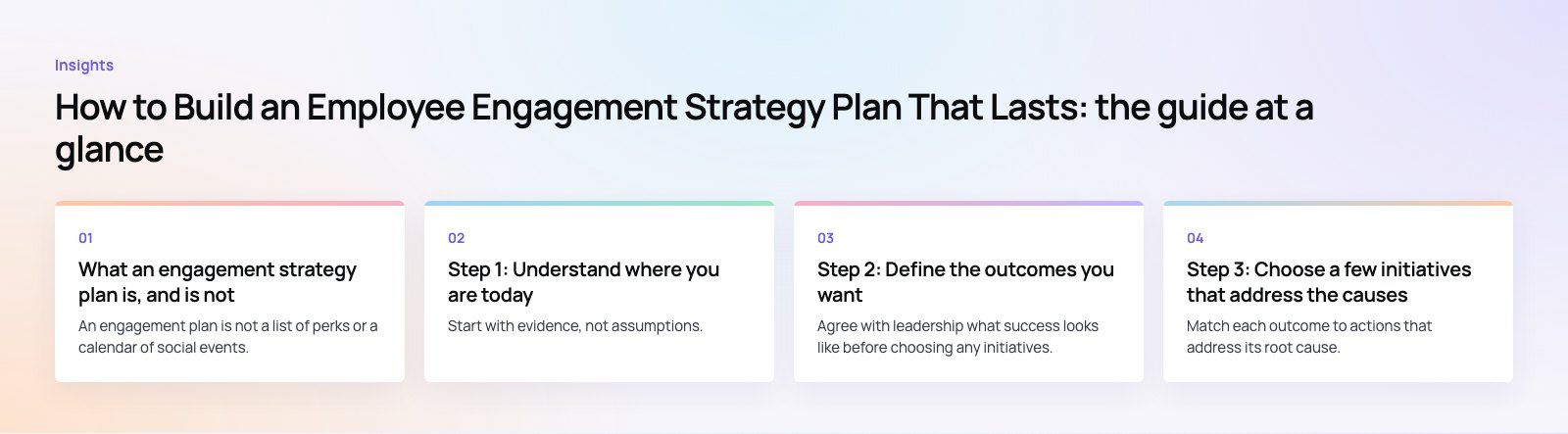
What an engagement strategy plan is, and is not
An engagement plan is not a list of perks or a calendar of social events. It is a management document that answers four questions: where engagement stands today, what you want to change, what you will do about it, and how you will know it worked. Good plans tie each action to a business outcome such as lower turnover in a key team, faster onboarding or better customer feedback.
The need is real. Gallup's State of the Global Workplace 2026 report puts global employee engagement at 20% for 2025, its lowest level in five years. Most organizations start from a low base, which is why a deliberate plan outperforms good intentions.
Step 1: Understand where you are today
Start with evidence, not assumptions. Combine several sources so no single data point misleads you:
- A baseline survey. Use a consistent engagement survey so you can compare results over time. If a full survey is not possible yet, start with a short pulse survey or focus groups with a sample of teams.
- Turnover and retention data. Look at voluntary leavers by team, manager, tenure and role. High early turnover often points to hiring or onboarding problems.
- Exit and stay interviews. Exit interviews explain why people leave; stay interviews explain why people remain. Both are useful.
- Absence patterns. Rising short term absence in one area is often an early sign of stress or disengagement.
- Manager conversations. Managers usually know where the friction is. Ask them directly.
Summarize the findings in a simple SWOT: strengths to protect, weaknesses to fix, opportunities to use and threats to watch, all through the lens of engagement. Bringing these data sources into one view, for example a Power BI dashboard, saves hours of manual reporting every cycle.
Step 2: Define the outcomes you want
Agree with leadership what success looks like before choosing any initiatives. Work from organizational outcomes down to engagement outcomes:
- Business outcomes. For example, reduce regretted turnover in the engineering team, or improve customer satisfaction in the support center.
- Engagement outcomes. For example, raise survey scores on "I know what is expected of me" and "my manager cares about my development."
- Communication outcomes. For example, every employee understands the plan's priorities and knows how to give feedback.
Limit yourself to three to five outcomes. A plan that tries to fix everything changes nothing.
Step 3: Choose a few initiatives that address the causes
Match each outcome to actions that address its root cause. If people do not see a future, fix career paths and development conversations. If managers are the issue, invest in manager training and coaching. If friction is the problem, fix the processes and tools that waste time.
A simple plan template
| Outcome | Initiative | Owner | Timeline | Measure |
|---|---|---|---|---|
| Lower early turnover | Redesign onboarding with a 90 day plan and buddy system | HR business partner | Next two quarters | Leavers in first year, new hire survey |
| Stronger manager support | Monthly one to ones and manager coaching program | Head of people and department heads | Start next quarter | Survey items on manager support |
| Clearer growth paths | Publish career frameworks and run development reviews twice a year | HR with team leads | Within six months | Internal moves and promotions |
| Less wasted effort | Automate the three most hated manual processes | Operations with IT | Within two quarters | Hours saved, pulse survey on tools |
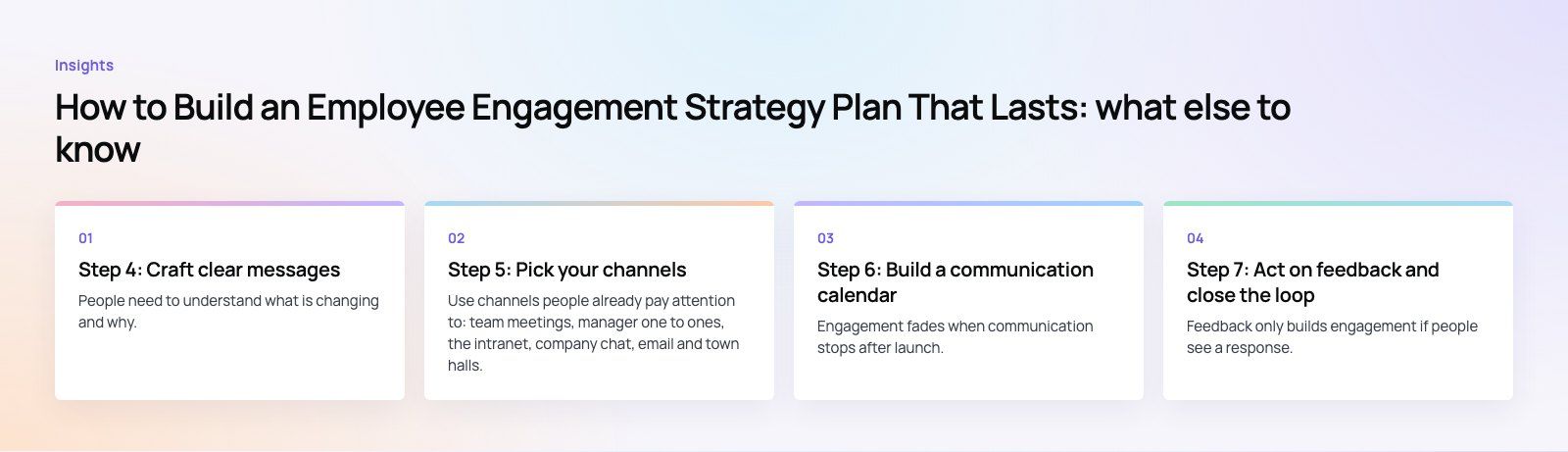
Step 4: Craft clear messages
People need to understand what is changing and why. Write a short core message for the plan, then add supporting points, facts from your survey and real examples from teams. Use the five Ws and an H to check nothing is missing:
- What did we learn about engagement today?
- Why are we acting, and why on these priorities?
- When will each change happen?
- Where did the priorities come from? Show that employee feedback shaped them.
- Who owns each initiative and makes decisions?
- How will it be delivered, and how can employees take part?
Step 5: Pick your channels
Use channels people already pay attention to: team meetings, manager one to ones, the intranet, company chat, email and town halls. Frontline staff without desks may need mobile friendly updates or printed summaries. Make sure every channel includes a way to respond, not just to receive. A well organized Microsoft 365 setup, with team channels and a central intranet page for the plan, keeps updates and feedback in one place.
Step 6: Build a communication calendar
Engagement fades when communication stops after launch. Map the year ahead: launch announcements, monthly progress updates, survey dates, results sharing, and quarterly reviews. Track it in the same project tool you use for other work so it gets the same discipline. Consistent, predictable updates show employees the plan is still alive.
Step 7: Act on feedback and close the loop
Feedback only builds engagement if people see a response. Assign a named owner or system for answering questions and ideas, respond within a set time, and explain decisions even when the answer is no. Share "you said, we did" updates so employees see the link between their input and the changes. When a suggestion is adopted, credit the person or team who made it.
Repetitive steps like routing feedback, sending reminders and collecting approvals can be automated with low code tools such as the Microsoft Power Platform, leaving HR more time for conversations.
Step 8: Measure, review and adjust
Review the plan every quarter against the measures you set. Useful indicators include:
- Engagement survey and pulse scores, by team
- Voluntary turnover and retention of high performers
- Absenteeism
- Employee net promoter score
- Internal promotions and moves
- Customer satisfaction in teams where engagement changed
Expect some initiatives to work and others not to. Drop what does not move the measures, double down on what does, and update the plan openly. No engagement plan works unchanged for long, because the organization, the market and the way people work keep changing, including through automation and AI.
Learning from other organizations
Many companies publish parts of their people strategy, and industry peers often share what has worked at events and in case studies. Use them for ideas, not as templates. An approach that works for a fast growing tech firm may not suit a hospital or a retail chain. Start with your own diagnosis and borrow only what fits.
Mistakes that make engagement plans fail
- No leadership ownership. If senior leaders do not sponsor the plan and model it, managers will deprioritize it.
- Too many initiatives. Spread effort thinly and nothing improves visibly.
- No owners or dates. Actions without a name and a deadline drift.
- Launch and forget. A big announcement with no follow up damages trust.
- Measuring activity instead of outcomes. Counting workshops held says little; changes in turnover and survey scores say more.
Putting the plan into practice
The best engagement plans are short, specific and reviewed often. When tools get in the way, for example when recruitment, onboarding or feedback live in disconnected spreadsheets, a purpose built system can help; our Seamfox case study shows a recruitment platform that manages candidates and applications on a kanban board. If your plan depends on better internal tools, our custom software team can help you scope and build them.
Frequently asked questions
A good plan includes a summary of current engagement based on data, three to five agreed outcomes linked to business goals, a short list of initiatives with an owner, timeline and measure for each, a communication plan and calendar, a process for collecting and answering feedback, and a review schedule. It should fit on a few pages so managers can actually use it.
InsightsHow Employee Engagement Drives Business PerformanceHow employee engagement affects profit, productivity, absence, retention, customers and innovation, what the evidence says, and how to link it to results. InsightsThe Five Functions of Human Resource Management ExplainedThe five core functions of human resource management: recruitment, training, performance, compensation and employee relations, with practices and pitfalls.
 InsightsPerformance Management and Employee Engagement: A Practical GuideHow to run performance management that raises engagement: frequent check ins, specific recognition, growth plans, a strengths based approach and who owns what.
Tell us what the business needs. We will tell you what to build first.
Schedule a free consultation and get a written recommendation, with costs, before you commit to anything.
Get in touchPROVEN RESULTS
4.7 / 5verified reviews on Google