 InsightsHow Employee Engagement Drives Business PerformanceHow employee engagement affects profit, productivity, absence, retention, customers and innovation, what the evidence says, and how to link it to results.
How to Build Employee Engagement Through Autonomy and Trust
Practical ways to raise employee engagement by building trust, handing over real ownership, encouraging ideas, measuring progress and acting on feedback.
You build employee engagement through autonomy and trust by giving people clear goals, real ownership of how they reach them, and the information and support to make good decisions. Leaders who share openly, delegate meaningful work, coach rather than micromanage, and act on feedback create teams that take initiative. The rest of this guide covers how to do each of those things and how to tell whether it is working.
Why autonomy and engagement go together
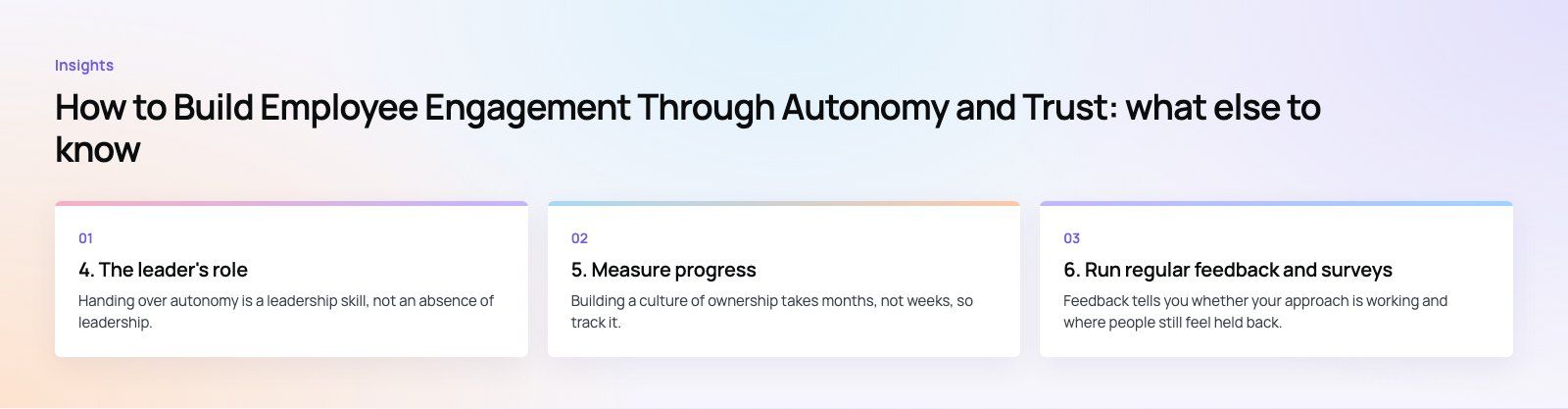
Engagement is how invested people are in their work. Autonomy is how much say they have over it. The two are closely linked: people care more about work they shape themselves, and they disengage quickly when every decision is made for them.
That does not mean leaving people alone. Autonomy without direction feels like neglect. The aim is a clear frame (goals, standards, boundaries) with freedom inside it.
The gap is wide in most workplaces. Gallup's State of the Global Workplace 2026 report found only 20% of employees worldwide were engaged in 2025. Giving people more ownership of their work is one of the most direct ways leaders can change that number in their own teams.
1. Build trust through open communication
People will not take ownership if they do not trust that speaking up is safe or that decisions are made fairly. Trust starts with communication.
- Hold regular team meetings and informal one to ones so conversation flows both ways.
- Listen with real interest, ask follow up questions and avoid getting defensive.
- Be transparent about company goals, decisions and challenges, including bad news.
Openness creates a sense of shared responsibility. When people understand the full picture, they make better decisions on their own.
2. Grant autonomy and ownership
Micromanagement is one of the fastest ways to drain motivation. It tells capable people that their judgment is not trusted, and it turns managers into bottlenecks.
Instead, agree on the outcome and the constraints, then step back on the method.
- Let people own projects from start to finish rather than handing them fragments.
- Assign challenging but achievable work that fits each person's strengths.
- Trust the team to make decisions, and treat mistakes as learning rather than proof they needed more control.
- Recognize people who take ownership and go beyond the brief.
An example of handing over ownership
Picture a marketing team asked to plan a new campaign. A controlling leader picks the channels, writes the brief and approves every asset. A leader building ownership sets the goal, the budget and the deadline, then lets the team choose channels, messaging and execution, checking in at agreed points. The second team usually produces more creative work and cares far more about the result.
3. Encourage new ideas
Teams with autonomy need room to experiment. If every new idea is met with "we have always done it this way", people stop offering them.
- Run brainstorming sessions where ideas are collected without judgment before anything is ruled out.
- Recognize good suggestions even when they are not implemented right away.
- Give people time to learn new skills through courses, workshops and seminars, which brings fresh ideas back to the team.
4. The leader's role
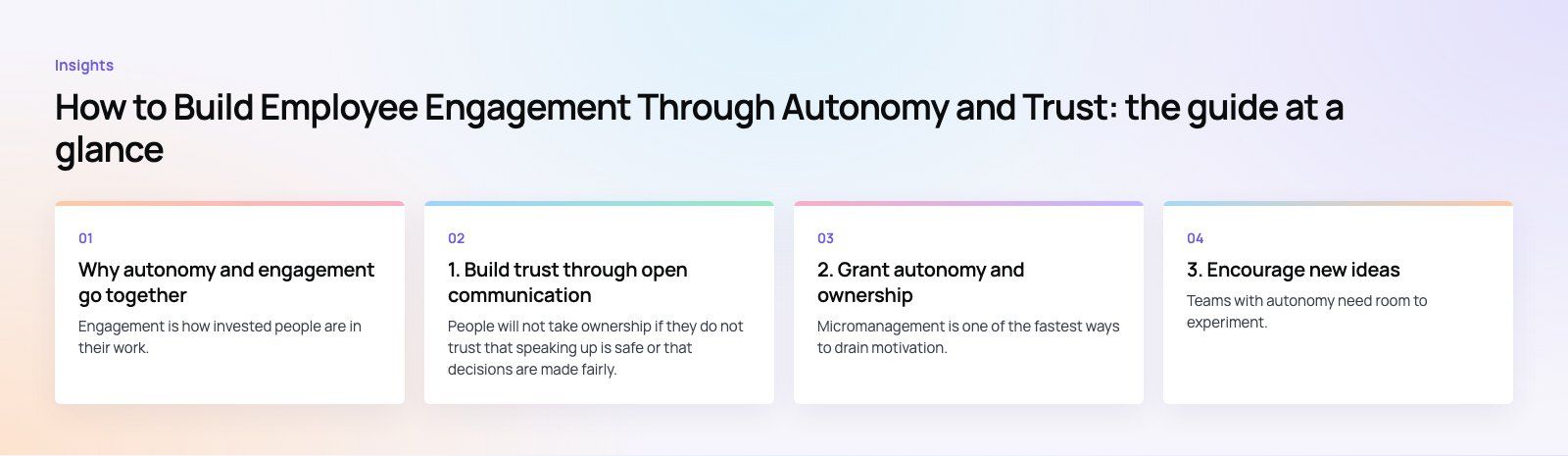
Handing over autonomy is a leadership skill, not an absence of leadership. It takes more thought than giving instructions.
Provide resources and authority
Ownership without the means to act is frustrating. Give people the tools, information, budget and decision rights they need. If someone owns a project but needs three approvals for every small change, they do not really own it.
Delegate well and mentor
Delegate based on strengths and growth goals, so each assignment builds skills as well as getting work done. Pair delegation with ongoing mentoring: a safe space to ask questions, talk through options and get honest feedback. People grow in confidence fastest when they know support is there if they need it.
Keep refining how the team works
Ways of working that suited a team of five rarely suit a team of fifty. Ask the team regularly which processes slow them down and change them together. Modern tools help here. Shared workspaces in Microsoft 365, simple approval apps built on Power Platform, or a purpose built internal tool can remove a lot of the friction that makes people wait for permission.
5. Measure progress
Building a culture of ownership takes months, not weeks, so track it. Look beyond output figures to signals such as engagement survey scores, the number of ideas raised, how often decisions are escalated, and voluntary turnover. Review them every quarter, look at trends rather than single results, and adjust.
A simple dashboard in Power BI or a similar tool can bring survey and HR data together so leaders see patterns across teams.
6. Run regular feedback and surveys
Feedback tells you whether your approach is working and where people still feel held back.
Gather honest insight
Run short, anonymous surveys and ask direct questions: Do you have the authority you need to do your job? Do you feel trusted to make decisions? What is the biggest thing slowing you down?
Keep the dialogue open
Feedback is a two way conversation. Share what you learned, explain what you will change and what you will not, and follow through. This is what turns a survey into trust.
Improve continuously
Use the results to find where ownership is working and where it is not. Some teams may need clearer goals, others more training, others fewer approval steps.
Five ways to build ownership at a glance
| Principle | What leaders do | Warning sign it is missing |
|---|---|---|
| Trust and transparency | Share goals, decisions and challenges openly | People hear about changes through rumor |
| Ownership and autonomy | Agree outcomes, let people choose methods | Every small decision waits for a manager |
| Challenge and growth | Give stretch work and time to learn | Strong performers leave for "more responsibility" |
| Recognition | Notice initiative and contributions specifically | Only finished results ever get mentioned |
| Ideas and feedback | Ask for input and act on it visibly | Meetings are silent when you ask for ideas |
Common mistakes
- Announcing "you own this now" without changing who actually makes decisions.
- Delegating tasks but keeping all the authority.
- Taking ownership back the first time something goes wrong.
- Asking for feedback and never reporting what changed.
Start this month
Choose one decision that currently sits with you and hand it to the team, with clear goals and a check in point. Ask in your next one to ones what slows each person down, and remove one blocker. Small, visible changes build trust faster than any program launch.
If outdated tools are what keep your team waiting for approvals, Codeeo's team of 80+ across Dubai, Riyadh and Karachi builds internal apps and workflow automation. Browse our case studies or contact us to talk about it.
Frequently asked questions
People care more about work they help shape.
When employees have clear goals and the freedom to decide how to reach them, they feel trusted and responsible for the result, which raises motivation and initiative. When every decision is made for them, they tend to do only what is asked. Trust and autonomy turn compliance into commitment.
InsightsHow Employee Engagement Drives Business PerformanceHow employee engagement affects profit, productivity, absence, retention, customers and innovation, what the evidence says, and how to link it to results. InsightsThe Five Functions of Human Resource Management ExplainedThe five core functions of human resource management: recruitment, training, performance, compensation and employee relations, with practices and pitfalls.
 InsightsPerformance Management and Employee Engagement: A Practical GuideHow to run performance management that raises engagement: frequent check ins, specific recognition, growth plans, a strengths based approach and who owns what.
Tell us what the business needs. We will tell you what to build first.
Schedule a free consultation and get a written recommendation, with costs, before you commit to anything.
Get in touchPROVEN RESULTS
4.7 / 5verified reviews on Google