 Software DevelopmentSQL vs NoSQL Databases: Differences and How to ChooseHow SQL and NoSQL databases differ in data model, schema, scaling and consistency, where each one fits, and five questions to choose for your project.
CodeeoInsightsSoftware Development
ERP for Pharma: Modules, Compliance and Implementation
How ERP for pharma supports GMP compliance, batch traceability and efficiency, the modules that matter and how to implement one without disrupting production.
ERP for pharma is an enterprise resource planning system configured for the way pharmaceutical companies work: batch based manufacturing, strict quality control, full traceability and audit ready records. It brings finance, procurement, inventory, production, quality and sales into one system, so a single batch can be traced from raw material to customer. The payoff is fewer manual records, faster audits and better control of stock, cost and compliance.
This guide explains the challenges that make pharma different, the benefits of a pharma ready ERP, the modules that matter and how to implement one without disrupting production.
Why the pharmaceutical industry needs specialized ERP
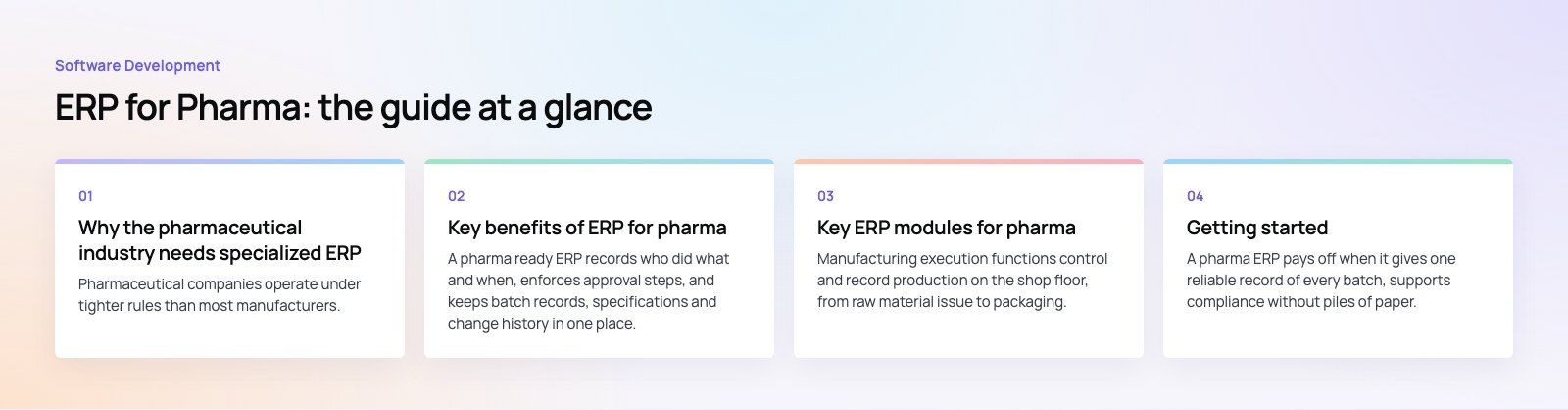
Pharmaceutical companies operate under tighter rules than most manufacturers. Patient safety depends on product quality, supply chains are long and regulated, and every step of production has to be documented. Generic ERP systems can handle the accounting, but they often lack the batch control, quality workflows and electronic record controls pharma needs.
| Challenge | Impact on pharma companies |
|---|---|
| Supply chain complexity | Shortages, higher costs and delays in production |
| Regulatory compliance | Legal exposure, failed inspections and reputational damage |
| Data management | Poor visibility, slow decisions and compliance gaps |
| Product safety and quality | Recalls, patient safety risks and damage to the brand |
Key benefits of ERP for pharma
Support for regulatory compliance
A pharma ready ERP records who did what and when, enforces approval steps, and keeps batch records, specifications and change history in one place. That makes it far easier to meet good manufacturing practice expectations and to produce evidence during an inspection. Where electronic records and signatures replace paper, systems need controls that meet rules such as the US FDA's 21 CFR Part 11 (eCFR, 2026) and the EU GMP guidance in EudraLex Volume 4 (European Commission, 2026), including Annex 11 on computerized systems. Validation of the system itself is part of the project, not an afterthought.
Better operational efficiency
When production, inventory and procurement share one set of data, planners can see stock, capacity and demand together. Routine tasks such as purchase approvals, stock movements and reorder alerts can be automated, and fewer spreadsheets means fewer transcription errors.
Full traceability
Batch and lot tracking lets a company see exactly which raw materials went into which finished batch and where that batch was shipped. If a quality issue appears, a targeted recall becomes possible instead of a broad one.
Better decisions and room to grow
Real time reporting on yields, costs, quality results and sales helps leaders decide where to invest. A single platform also makes it easier to add new product lines, sites or markets without building new systems each time. Many companies add Power BI dashboards on top of ERP data for this reason.
Key ERP modules for pharma
Manufacturing execution (MES)
Manufacturing execution functions control and record production on the shop floor, from raw material issue to packaging. Important capabilities include:
- Batch and process management: following approved recipes and procedures and recording every step.
- In-process quality checks: capturing inspections and results during production rather than afterwards.
- Equipment management: scheduling maintenance and calibration and recording equipment use per batch.
- Data collection: capturing yields, times and deviations to find bottlenecks and improvement opportunities.
Quality management (QMS)
Quality functions keep the company inspection ready throughout the product lifecycle:
- Document control: managing SOPs, specifications and change control records with version history and approvals.
- Deviations and CAPA: recording deviations, investigating root causes and tracking corrective and preventive actions.
- Complaint handling: logging and investigating customer complaints and linking them to batches.
- Audit management: planning internal and supplier audits and tracking findings.
- Risk management: assessing and reducing quality risks in a documented way.
Supply chain management
- Inventory management: tracking stock by batch, expiry date and status such as quarantined, released or rejected.
- Procurement: managing approved suppliers, purchase orders and supplier performance.
- Demand planning: forecasting demand to balance stock levels against expiry risk.
- Logistics and distribution: coordinating warehousing, cold chain where needed, and delivery.
Laboratory information management (LIMS)
Laboratories test raw materials, in-process samples and finished products. A LIMS, either built into the ERP or integrated with it, handles sample tracking with chain of custody, connects lab instruments for automatic data capture, and stores results for release decisions and reporting.
Customer relationship management (CRM)
CRM functions track accounts, sales activity and customer service, including returns and inquiries. Linking CRM to batch data means a complaint can be traced to the exact product involved.
Financial management
Finance modules cover the general ledger, payables, receivables, budgeting and forecasting, and product costing. Because costs flow from production and procurement automatically, margins per product or batch become visible.
How to implement ERP in a pharma company
1. Plan and scope the project
- Define clear objectives, such as faster batch release, fewer manual records or better stock control.
- Map current processes and identify where they need to change.
- Assess vendors on pharma features, validation support, implementation partners and fit with your size. Platforms such as Business Central, Dynamics 365 and Odoo are often compared, each with different strengths and add-ons.
2. Prepare and migrate data
- Clean master data such as items, specifications, suppliers and customers before migration.
- Write a migration plan with mapping rules from old systems to the new one.
- Migrate in stages and check data integrity at each step.
3. Configure and validate the system
- Configure workflows, approvals and roles to match your approved processes.
- Keep customization to what is genuinely needed, because every change must be validated and maintained.
- Plan computer system validation with your quality team, documenting requirements, tests and results.
4. Train users and manage change
- Create training materials for each role, from warehouse staff to quality approvers.
- Give hands-on training in a test environment before go-live.
- Explain why the change is happening and involve key users early to reduce resistance.
5. Go live and support
- Plan the cutover in detail, including opening stock and open orders.
- Test full scenarios, such as receiving material through to shipping a released batch.
- Provide close support for the first weeks and keep a list of improvements for later phases.
Common mistakes to avoid
- Treating ERP as an IT project instead of a business and quality project.
- Overcustomizing the system, which raises validation effort and makes upgrades harder.
- Migrating dirty master data and inheriting old problems.
- Leaving validation planning until after configuration.
- Cutting training time to meet a go-live date.
Getting started
A pharma ERP pays off when it gives one reliable record of every batch, supports compliance without piles of paper, and helps leaders see cost and capacity clearly. Codeeo has delivered 200+ projects across the UAE and the US with a team of 80+ across Dubai, Riyadh and Karachi. If you are planning an ERP project, explore our Dynamics 365 consultants and custom software services or talk to our team.
Frequently asked questions
ERP for pharma is an enterprise resource planning system set up for pharmaceutical operations.
It combines finance, procurement, inventory, production, quality and sales in one system, with features such as batch and expiry tracking, quality workflows, electronic records and audit trails. These help companies control costs, trace every batch and meet good manufacturing practice requirements.
Software DevelopmentSQL vs NoSQL Databases: Differences and How to ChooseHow SQL and NoSQL databases differ in data model, schema, scaling and consistency, where each one fits, and five questions to choose for your project. Software DevelopmentOpen Source Apps: Examples, Licenses and How to Build Your OwnWhat makes an app open source, well known examples, the steps to build your own, how to pick MIT, Apache or GPL, and when to customize instead.
 Software DevelopmentHow an Online HR Portal Improves Employee ExperienceWhat an online HR portal does, how self service improves employee experience, which features matter, and whether to buy, configure or build one.
Tell us what the business needs. We will tell you what to build first.
Schedule a free consultation and get a written recommendation, with costs, before you commit to anything.
Get in touchPROVEN RESULTS
4.7 / 5verified reviews on Google