 Software DevelopmentSQL vs NoSQL Databases: Differences and How to ChooseHow SQL and NoSQL databases differ in data model, schema, scaling and consistency, where each one fits, and five questions to choose for your project.
CodeeoInsightsSoftware Development
Event Driven Microservices Architecture: Principles and Uses
How event driven microservices work, the principles that keep them reliable, from idempotency to schema versioning, and where the architecture fits best.
An event driven microservices architecture is one where independent services communicate by publishing and reacting to events, such as "order placed" or "payment captured", instead of calling each other directly. It rests on a few principles: loose coupling, asynchronous messaging, eventual consistency, idempotent handlers, versioned event schemas and strong observability. It suits systems with many moving parts that must react in real time, such as ecommerce, payments, logistics, healthcare and marketplaces.
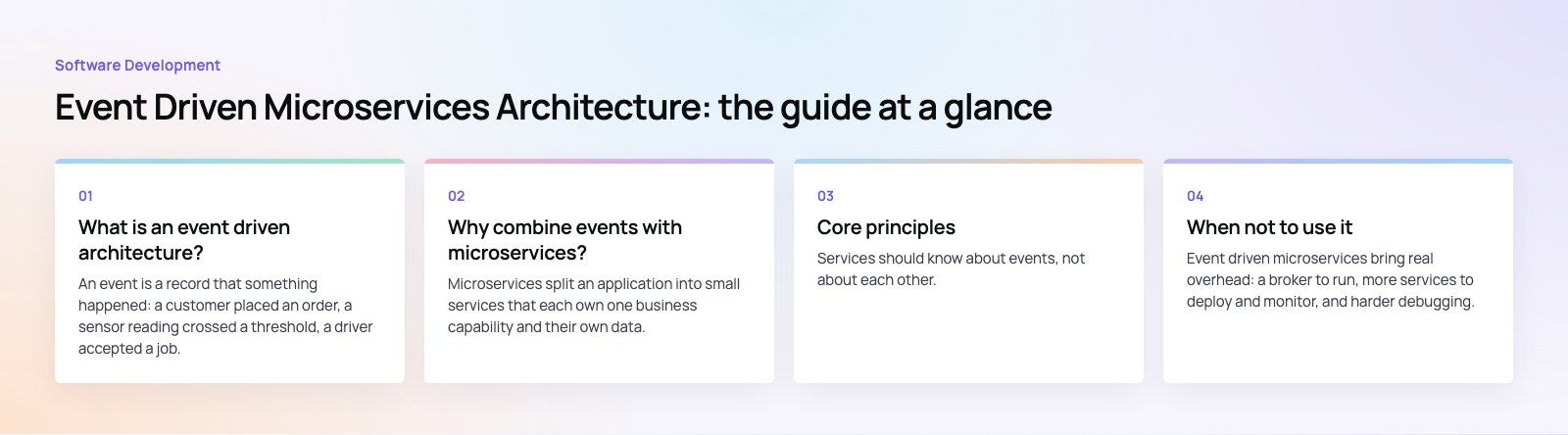
What is an event driven architecture?
An event is a record that something happened: a customer placed an order, a sensor reading crossed a threshold, a driver accepted a job. In an event driven system, the service where it happened publishes that event to a message broker. Any service that cares subscribes and reacts in its own time. The publisher does not know or wait for its consumers.
Events come in two broad styles. A notification event carries just enough to say what happened, such as an order ID, and consumers fetch details if they need them. An event carrying state includes the relevant data, such as the items and prices in the order, so consumers can act without calling back. Most systems use a mix.
Common brokers include Apache Kafka, RabbitMQ and managed cloud services such as Amazon EventBridge, Amazon SNS and SQS, Azure Service Bus, Azure Event Hubs and Google Cloud Pub/Sub. Microsoft's architecture guide gives a clear vendor neutral overview of the style.
Why combine events with microservices?
Microservices split an application into small services that each own one business capability and their own data. If those services call each other synchronously for everything, they become tightly linked: one slow service slows the chain, and one failure can cascade. Events break that chain. The order service records the order and publishes an event; inventory, payments, notifications and analytics each react independently.
The result is fewer dependencies between services, the ability to scale each service on its own, and better resilience when something fails.
Core principles
Loose coupling
Services should know about events, not about each other. A producer publishes to a topic without knowing who consumes it, and new consumers can be added without changing the producer. This is what lets teams release their services independently.
Asynchronous communication
Producers do not wait for consumers. That keeps user facing actions fast and lets slow or temporarily unavailable services catch up later from the broker. Use synchronous calls only where a user genuinely needs an immediate answer.
Eventual consistency
Each service owns its own data store and updates it when it processes an event. For a short time, different services may hold slightly different views of the same order. Design the user experience and business rules to tolerate that, for example by showing "payment processing" rather than assuming instant confirmation.
Fault tolerance
Assume any service, network link or broker partition can fail. Use retries with backoff, dead letter queues for messages that keep failing, and circuit breakers on any remaining synchronous calls. Because services are decoupled, one failure should delay work rather than stop the whole system.
Idempotent handlers
Most brokers deliver a message at least once, which means duplicates happen. Every handler should produce the same result if it processes the same event twice, typically by tracking processed event IDs or using natural keys. Without this, retries can charge a card twice or send duplicate emails.
Reliable publishing
A classic bug is saving to the database and then failing to publish the event, or the reverse. The transactional outbox pattern solves this: write the event to an outbox table in the same transaction as the business data, then relay it to the broker separately.
Independent scalability
Each consumer can scale according to its own load. A notifications service under heavy traffic can add instances without touching inventory or payments. Partitioned topics let several instances share the work while keeping related events in order.
Event sourcing
Instead of storing only the current state, an event sourced service stores every event that changed it and rebuilds state by replaying them. This gives a full audit trail and the ability to reconstruct past states, which is valuable in finance and compliance heavy domains. It also adds complexity, so use it where the audit history is worth it rather than everywhere.
CQRS
Command Query Responsibility Segregation separates the model that handles writes from the models that serve reads. Events from the write side update read models shaped for specific screens or reports. It pairs naturally with event driven systems, but like event sourcing it is a tool for specific problems, not a default.
Schema evolution
Events are contracts between teams. Version them, add fields rather than renaming or removing them, and keep changes backward compatible so old consumers keep working. A schema registry and a standard envelope such as CloudEvents help keep producers and consumers in step.
Observability
When work flows through many services asynchronously, you need to follow it. Add correlation IDs to every event, use distributed tracing, and monitor consumer lag, error rates and dead letter queues. Without this, debugging becomes guesswork.
Security
Authenticate producers and consumers, authorize who can publish and subscribe to each topic, encrypt data in transit and at rest, and keep sensitive personal data out of events wherever an ID would do. Apply least privilege to every service account.
Where event driven microservices fit
| Domain | Typical events | What the architecture enables |
|---|---|---|
| Ecommerce | Order placed, payment captured, stock reserved, shipped | Inventory, payments, emails and analytics update independently |
| Financial services | Transaction created, limit breached, trade executed | Real time fraud checks, ledgers and alerts with a full audit trail |
| IoT | Reading received, device offline, threshold exceeded | Processing high volumes of device data and reacting quickly |
| Logistics | Shipment created, location updated, delivered | Live tracking, customer notifications and stock updates |
| Healthcare | Appointment booked, result available, patient admitted | Workflows across scheduling, records and notifications |
| Marketplaces and on demand | Job posted, provider assigned, job completed | Dispatch, chat, payment and ratings working in parallel |
| Travel booking | Availability changed, booking confirmed, payment authorized | Reservations, pricing and itineraries kept in sync |
| Gaming, media and social | Player moved, content uploaded, comment posted | Real time feeds, notifications and processing pipelines |
When not to use it
Event driven microservices bring real overhead: a broker to run, more services to deploy and monitor, and harder debugging. A small product with one team is often better served by a well structured monolith that publishes internal events, which can later be split into services where the load or team structure demands it. Strongly consistent operations, such as a simple bank transfer within one ledger, may also be simpler as a single transaction.
Common mistakes
- Splitting into many services before the domain boundaries are clear.
- Non idempotent handlers that break on duplicate messages.
- Publishing events without a schema or versioning policy.
- No tracing, so nobody can follow an order through the system.
- Using events for requests that really need an immediate answer.
Codeeo has delivered 200+ projects across the UAE and the US, including platforms such as Teachers Lunch and JobIQ, where orders, dispatch and payment run across several apps. If you are designing or untangling a distributed system, our custom software development team can help, or start with a codebase review. For Microsoft based estates, see our Azure integration work.
Frequently asked questions
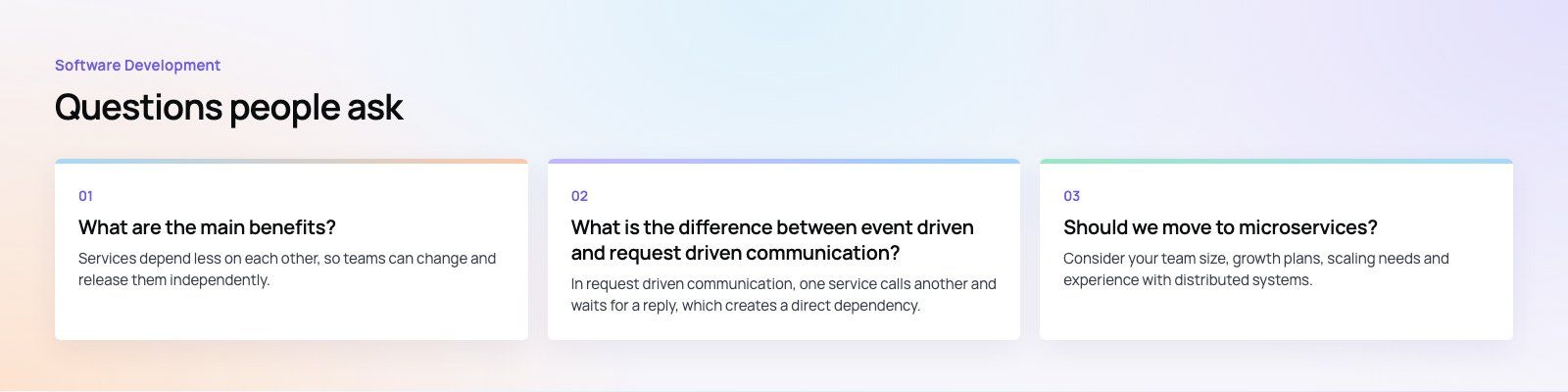
It is a way of building software where small, independent services talk to each other by announcing what happened rather than calling each other directly.
When one service does something important, it publishes an event to a message broker. Other services that care about that event pick it up and do their own work, without the first service waiting for them.
Software DevelopmentSQL vs NoSQL Databases: Differences and How to ChooseHow SQL and NoSQL databases differ in data model, schema, scaling and consistency, where each one fits, and five questions to choose for your project. Software DevelopmentOpen Source Apps: Examples, Licenses and How to Build Your OwnWhat makes an app open source, well known examples, the steps to build your own, how to pick MIT, Apache or GPL, and when to customize instead.
 Software DevelopmentHow an Online HR Portal Improves Employee ExperienceWhat an online HR portal does, how self service improves employee experience, which features matter, and whether to buy, configure or build one.
Tell us what the business needs. We will tell you what to build first.
Schedule a free consultation and get a written recommendation, with costs, before you commit to anything.
Get in touchPROVEN RESULTS
4.7 / 5verified reviews on Google