 InsightsHow Employee Engagement Drives Business PerformanceHow employee engagement affects profit, productivity, absence, retention, customers and innovation, what the evidence says, and how to link it to results.
Fintech Industry Trends: What Is Changing and What to Build
The fintech industry trends that matter for product teams: embedded finance, open banking, contactless, AI in credit and fraud, digital identity and RegTech.
The biggest fintech industry trends right now are embedded payments, open banking, AI in credit and fraud decisions, stronger digital identity, and real time payment rails run by banks themselves. Together they move financial services out of the branch and into the apps people already use. For a business, the practical question is no longer whether to go digital but which of these shifts to build into its own product first.
This guide explains how fintech is changing everyday money management, which trends matter most for product teams, and how to decide where to start.
How fintech is changing the way people manage money
Traditional banking was built around branches, opening hours and paper. Fintech rebuilt the same services around the phone. The core products did not change much: people still pay, save, borrow, invest and insure. What changed is where those services live and how fast they respond.
Access at any time, from any device
A customer can now open an account, verify identity, move money and dispute a charge without visiting anyone. For people in regions that were poorly served by bank branches, a mobile wallet is often the first financial account they ever hold. The World Bank tracks this shift closely in its Global Findex 2025 database, which measures account ownership, digital payments and saving across economies.
Personalized money management
Budgeting apps and banking apps now categorize spending automatically, flag unusual charges and suggest savings goals based on income patterns. The data is the same data a bank always held. The difference is that it is now shown back to the customer in a form that helps them act on it.
Investing without a high entry barrier
Fractional shares, automated portfolios and low minimum deposits made investing reachable for people who were previously ignored by wealth managers. Robo advisers handle rebalancing and allocation with rules rather than a personal adviser, which keeps the service cheap enough to offer at scale.
New ways to borrow and raise money
Peer to peer lending, buy now pay later and crowdfunding platforms all sit between a person who needs money and the people or institutions willing to provide it. Each comes with its own regulation, and in many markets the rules for these products have tightened since they first appeared.
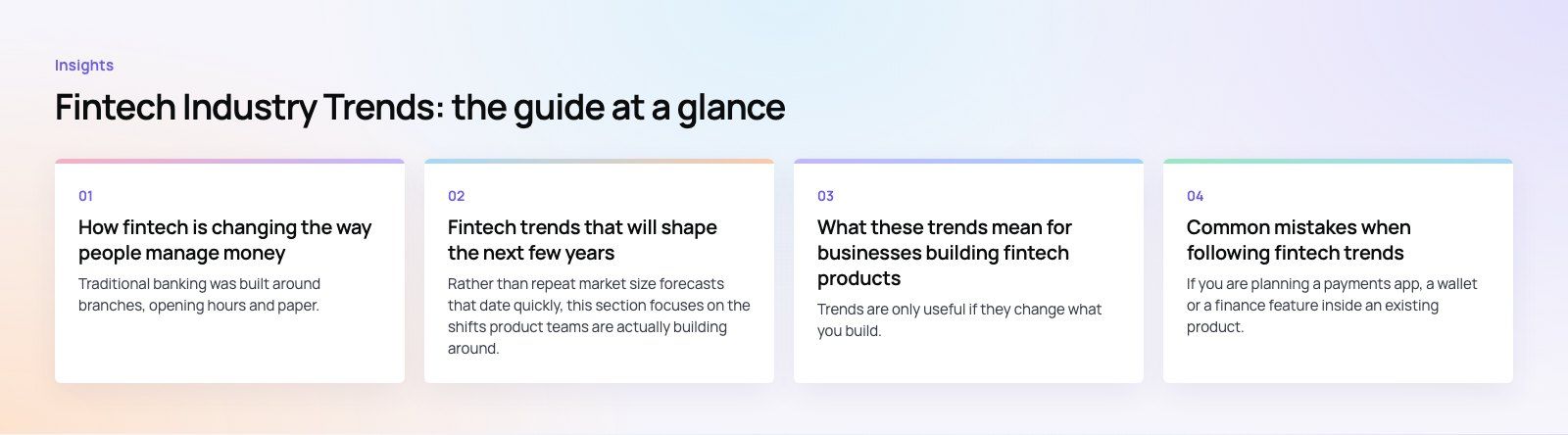
Fintech trends that will shape the next few years
Rather than repeat market size forecasts that date quickly, this section focuses on the shifts product teams are actually building around.
1. Embedded finance
Payments, lending and insurance are increasingly offered inside non financial products. A marketplace offers instalments at checkout, a ride app holds a driver wallet, a school app collects fees. The business never becomes a bank. It connects to licensed providers through APIs and keeps the customer relationship. This is the trend most companies outside finance will touch first, usually through payment integration on an existing site or app.
2. Open banking and account to account payments
Open banking rules in several markets require banks to share account data and initiate payments through secure APIs when the customer consents. That allows budgeting tools to read balances across banks and lets merchants take payment straight from a bank account instead of a card. Bank run instant payment systems add to this, so banks are competing with fintech startups on speed rather than losing that ground to them.
3. Contactless and wallet payments
Tap to pay with cards, phones and watches is now normal at the till in most cities. The underlying standards are maintained by EMVCo, which publishes the EMV contactless specifications that card schemes and terminal makers build on. For product teams, the trend means checkout flows should assume a wallet first and a typed card number second.
4. AI in credit, fraud and support
Machine learning models now score credit using a wider range of signals, spot fraud patterns in real time and answer routine support questions. The trade off is explainability. Regulators expect lenders to say why an application was declined, so models need audit trails and human review for edge cases, not just accuracy scores.
5. Digital identity and stronger verification
Remote onboarding depends on proving who someone is without seeing them. Document scanning, liveness checks, device signals and national digital ID schemes are replacing photocopies and branch visits. As fraud attempts get more sophisticated, identity checks are moving from a single step at sign up to continuous checks during risky actions such as adding a new payee.
6. Regulatory technology
RegTech covers the software that runs know your customer checks, anti money laundering monitoring, sanctions screening and regulatory reporting. As rules multiply across markets, firms automate compliance rather than staffing it manually. For a new product, building compliance into the data model from day one is far cheaper than retrofitting it.
7. Tokenization and blockchain, used carefully
The speculative phase of crypto has cooled, but the underlying ideas remain in use: tokenized assets, stablecoin settlement and shared ledgers for trade finance. Most businesses do not need a blockchain. The useful test is whether several parties who do not trust each other need to share one record. If not, a normal database is simpler and safer.
Traditional banking compared with fintech
| Aspect | Traditional banking | Fintech approach |
|---|---|---|
| Access | Branches and business hours | Mobile and web, available all day |
| Onboarding | Paper forms and in person checks | Remote identity verification in minutes |
| Payments | Cash, checks and cards | Wallets, contactless and account to account transfers |
| Lending decisions | Manual review of documents | Automated scoring with human review for exceptions |
| Investing | Adviser led, higher minimums | Automated portfolios and fractional ownership |
| Fraud control | Rules and after the fact review | Real time monitoring and device signals |
| Inclusion | Limited reach in underserved areas | Mobile wallets reach people without a branch nearby |
What these trends mean for businesses building fintech products
Trends are only useful if they change what you build. A few practical lessons apply to most teams.
Start from one job the customer needs done
The strongest fintech products solve one specific problem well: splitting bills, paying suppliers, collecting school fees, saving for a goal. Trying to launch a full digital bank on day one usually means a long build, a heavy licensing burden and a vague product. Narrow scope also makes regulatory conversations easier.
Partner for the regulated parts
Card issuing, money holding, lending capital and identity checks can all be bought from licensed providers. Your own engineering effort should go into the experience, the data and the workflow that make your product different. A product scoping session is a good place to separate what to build from what to rent.
Treat security and compliance as product features
Customers judge a finance app on whether they trust it. Clear permissions, visible security settings, sensible session timeouts and fast fraud responses are part of the design, not a separate project.
Plan the data from the start
Most of the trends above depend on clean, well structured transaction data: personalization, fraud detection, credit scoring and reporting. Decide early how events are recorded, how long they are kept and who can see them. Retrofitting a ledger is one of the most expensive mistakes in fintech development.
Design for more than one market
Payment methods differ sharply between countries. Buy now pay later providers dominate checkout in some regions, bank transfers in others, cards elsewhere. The EGO Sustainable store, for example, runs Tabby and Tamara across five GCC markets. Building a payment layer that can swap providers per market saves a rebuild when you expand.
Common mistakes when following fintech trends
- Chasing technology instead of a problem. Adding AI or blockchain because competitors mention it rarely moves customer numbers.
- Underestimating licensing. Holding customer funds or lending money usually needs a licence or a licensed partner. Check this before design starts.
- Ignoring support. When money goes missing, customers want a fast human answer. Budget for support tooling.
- Weak onboarding. Long identity flows lose users. Test them on real devices and real documents.
- No plan for failure. Payment providers go down. Retry logic, clear error messages and reconciliation reports matter as much as the happy path.
If you are planning a payments app, a wallet or a finance feature inside an existing product, Codeeo builds fintech software and mobile apps for teams across the UAE and the US, with 200+ projects delivered, including the Purpose Payment app, portals and API.
Frequently asked questions
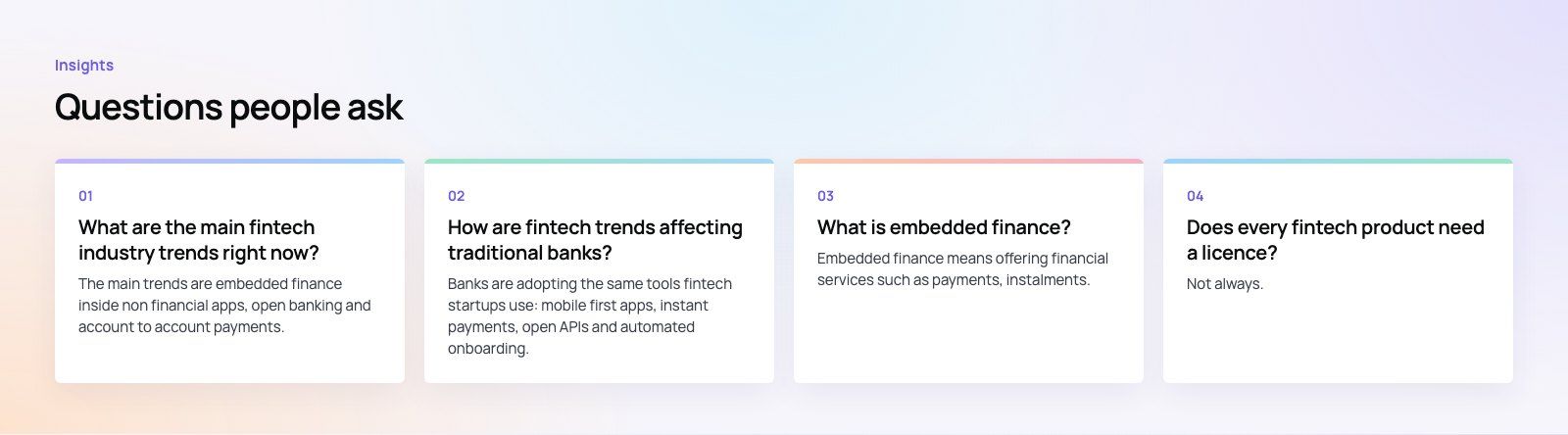
The main trends are embedded finance inside non financial apps, open banking and account to account payments, contactless and wallet payments, AI used for credit scoring and fraud detection, stronger digital identity checks, and regulatory technology that automates compliance. Tokenization is still developing but is used more selectively than during the crypto boom, mostly where several parties need to share one trusted record.
InsightsHow Employee Engagement Drives Business PerformanceHow employee engagement affects profit, productivity, absence, retention, customers and innovation, what the evidence says, and how to link it to results. InsightsThe Five Functions of Human Resource Management ExplainedThe five core functions of human resource management: recruitment, training, performance, compensation and employee relations, with practices and pitfalls.
 InsightsPerformance Management and Employee Engagement: A Practical GuideHow to run performance management that raises engagement: frequent check ins, specific recognition, growth plans, a strengths based approach and who owns what.
Tell us what the business needs. We will tell you what to build first.
Schedule a free consultation and get a written recommendation, with costs, before you commit to anything.
Get in touchPROVEN RESULTS
4.7 / 5verified reviews on Google