 InsightsHow Employee Engagement Drives Business PerformanceHow employee engagement affects profit, productivity, absence, retention, customers and innovation, what the evidence says, and how to link it to results.
How Leaders Influence Employee Engagement: 8 Practices That Work
How managers shape employee engagement, with eight practical leadership habits, a comparison table, ways to measure progress and common mistakes to avoid.
Leaders shape employee engagement more than any perk, policy or tool, because people decide how much effort to give based on how their manager treats them week to week. The leaders who raise engagement do a handful of ordinary things consistently: they set clear expectations, listen and act on what they hear, recognize good work specifically, and remove the friction that makes work feel pointless. This guide breaks those habits down into practices you can start using with your team this month.
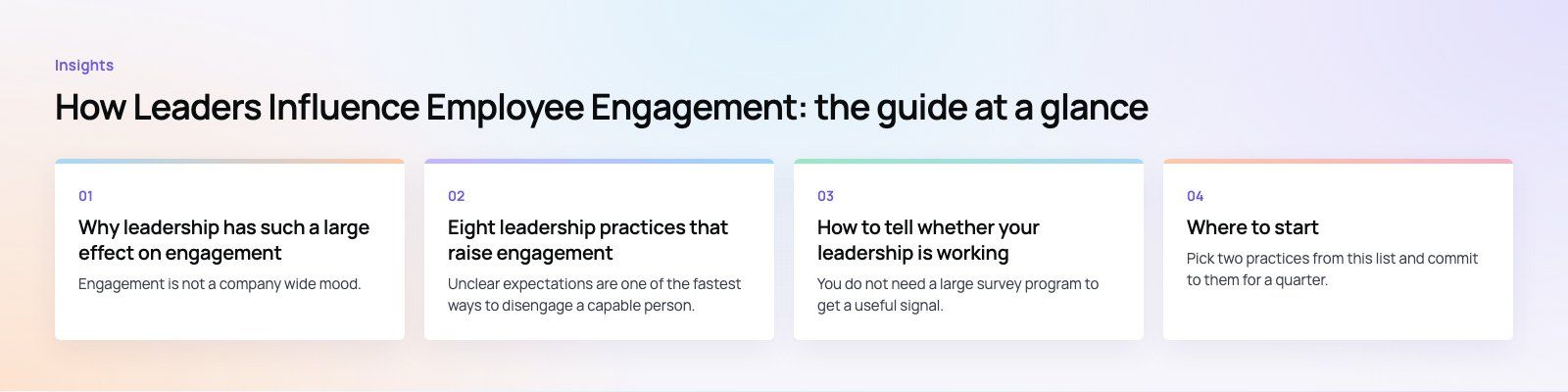
Why leadership has such a large effect on engagement
Engagement is not a company wide mood. It forms inside teams, and the person with the most influence over a team's daily experience is its manager. A good manager can keep a team engaged inside a struggling company, and a poor one can drain a team inside a thriving company.
The wider numbers show how much room there is to improve. Gallup's State of the Global Workplace 2026 report found that global employee engagement fell to 20% in 2025, and that manager engagement dropped from 27% to 22% between 2024 and 2025. When the managers themselves are disengaged, it is very hard for their teams to be anything else.
That is why engagement cannot be delegated to HR or handed to an annual survey. Leaders at every level, from team leads to the chief executive, carry it in how they run meetings, give feedback and make decisions.
Eight leadership practices that raise engagement
1. Set clear expectations from the first conversation
Unclear expectations are one of the fastest ways to disengage a capable person. They work hard on the wrong things, get corrected, and start to feel they can never win. Good leaders state what success looks like early, ideally during hiring and again in the first week.
- Describe the outcomes the role owns, not just the tasks.
- Agree on how progress will be measured and how often you will review it.
- Revisit expectations when priorities change, rather than assuming people will notice.
Clear does not mean rigid. Know when to push for a deadline and when a team needs breathing room after a heavy stretch.
2. Build trust by listening and acting
Trust grows slowly and breaks quickly. People trust leaders who ask for input, listen without getting defensive and then visibly do something with what they heard. Even a decision not to act, explained honestly, builds more trust than silence.
Transparency matters too. When a leader explains the reasoning behind a decision, including the trade offs, people feel treated as adults. When decisions simply appear, people fill the gap with the least generous explanation available.
3. Communicate strategy and goals, then invite challenge
Employees engage more when they understand how their work connects to what the organization is trying to achieve. Share the goals, the priorities behind them and the decisions that affect the team, and do it on a regular rhythm rather than once a year.
Then open the floor. Ask the team where the plan is weak or what they would do differently. People closest to the work often see risks and shortcuts leadership misses, and being asked tells them their judgment counts.
4. Recognize good work specifically and promptly
Recognition is one of the cheapest and most reliable engagement levers, but only when it is specific. "Great job, everyone" fades instantly. "The way you restructured the onboarding checklist cut a day off setup for new starters" tells someone exactly what to repeat.
Recognize effort and behavior as well as results, and do it close to the moment. Be careful with public rankings and leaderboards: some healthy competition can motivate, but recognition that turns colleagues into rivals usually damages collaboration more than it helps output.
5. Look after wellbeing, not just workload
People who are exhausted cannot be engaged for long. Leaders who pay attention to workload, protect time off and notice early signs of burnout keep their teams productive over years rather than months.
Practical steps include realistic deadlines, flexibility where the work allows it, and a culture where saying "I am at capacity" is treated as useful information rather than weakness. Know what your people need to do their jobs well, and where you can, be a little more generous than the minimum.
6. Model the energy you want to see
Teams take their cues from the people above them. A leader who treats setbacks as problems to solve, stays curious and shows real interest in the work makes it easier for everyone else to do the same. A leader who is visibly checked out gives the team permission to check out too.
This is not about forced positivity. It is about showing up consistently, being honest when things are hard and still pointing to a way forward.
7. Invest in training and growth
People stay engaged when they can see themselves growing. Leaders can make development normal rather than exceptional: give time for learning, connect people with mentors, and hand out stretch assignments that build new skills.
Senior support matters here. An employee is far more likely to take a course or a new responsibility if their manager actively backs it and helps them make room for it in their week.
8. Remove friction and distractions
Few things kill motivation faster than broken processes nobody is allowed to fix: approvals that take days, tools that do not talk to each other, information scattered across email, chat and spreadsheets. Leaders who ask "what slows you down?" and then remove those blockers send a strong signal that people's time matters.
Often this is where technology helps. Replacing manual handoffs with a simple internal app or automated workflow can give a team hours back each week. Tools such as Microsoft Power Platform or a small piece of custom internal software are common ways to do it.
Leadership habits compared
| Habit | What engaged teams experience | What disengaged teams experience |
|---|---|---|
| Expectations | Clear outcomes agreed early and revisited | Shifting goals discovered through criticism |
| Feedback | Regular, two way, acted on | Annual, one way, ignored |
| Recognition | Specific and timely | Generic or absent |
| Communication | Strategy shared, questions welcome | Decisions announced without context |
| Wellbeing | Workload watched, time off protected | Burnout treated as commitment |
| Growth | Time and backing for development | Training mentioned, never scheduled |
How to tell whether your leadership is working
You do not need a large survey program to get a useful signal. Combine a few sources:
- Short pulse surveys every few weeks with three to five questions, kept anonymous.
- One to one conversations where you ask directly what is getting in the way.
- Behavioral signals such as voluntary turnover, absence patterns and how often people volunteer ideas in meetings.
Track the trend rather than any single result. If scores dip after a reorganization or a heavy quarter, say so openly, explain what you will change, and report back on it. Closing that loop is itself an engagement practice.
Some teams build a simple dashboard that pulls survey results and HR data together so leaders can see patterns by team. Power BI is a common choice when the data already lives in Microsoft systems.
Common mistakes leaders make
- Treating engagement as an HR project. HR can run surveys, but only managers can change daily experience.
- Asking for feedback and doing nothing. This is worse than not asking, because it proves the input does not matter.
- Confusing perks with engagement. Snacks and outings are pleasant, but they do not fix unclear goals or a dismissive manager.
- Ignoring manager wellbeing. Managers carry pressure from both directions. If they are burned out, their teams will feel it.
- Being rigid under pressure. Deadlines are real, but how a leader behaves in a crunch is exactly what people remember.
Where to start
Pick two practices from this list and commit to them for a quarter. For most leaders, the best starting pair is clearer expectations and more specific recognition, because both are cheap, fast and visible. Add a short pulse survey so you can see whether anything changes, then build from there.
If friction in your tools is part of the problem, Codeeo's team of 80+ across Dubai, Riyadh and Karachi builds internal apps, portals and workflow automation for growing companies. See our custom software development work, browse the case studies, or talk to us about what is slowing your team down.
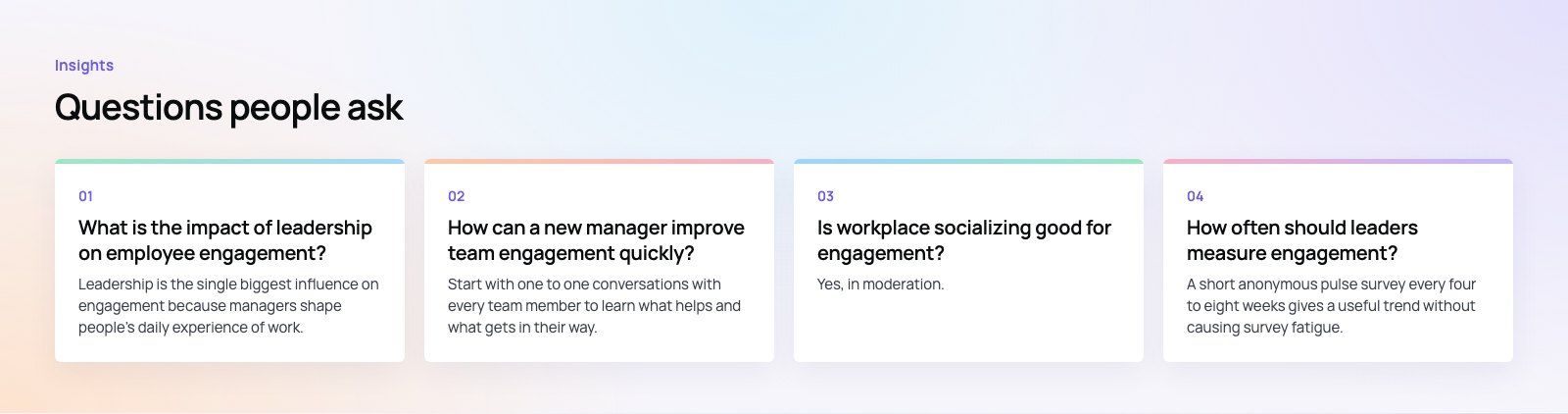
Frequently asked questions
Leadership is the single biggest influence on engagement because managers shape people's daily experience of work.
They set expectations, give or withhold feedback and recognition, control workload and decide how openly information flows. Teams with attentive, consistent managers tend to stay engaged even when the wider company is struggling, while teams with disengaged managers rarely stay engaged for long.
InsightsHow Employee Engagement Drives Business PerformanceHow employee engagement affects profit, productivity, absence, retention, customers and innovation, what the evidence says, and how to link it to results. InsightsThe Five Functions of Human Resource Management ExplainedThe five core functions of human resource management: recruitment, training, performance, compensation and employee relations, with practices and pitfalls.
 InsightsPerformance Management and Employee Engagement: A Practical GuideHow to run performance management that raises engagement: frequent check ins, specific recognition, growth plans, a strengths based approach and who owns what.
Tell us what the business needs. We will tell you what to build first.
Schedule a free consultation and get a written recommendation, with costs, before you commit to anything.
Get in touchPROVEN RESULTS
4.7 / 5verified reviews on Google