 InsightsHow Employee Engagement Drives Business PerformanceHow employee engagement affects profit, productivity, absence, retention, customers and innovation, what the evidence says, and how to link it to results.
HR Planning: A Step by Step Guide to Building a Workforce Plan
How to build an HR plan in ten steps: workforce audit, demand and supply forecasts, gap analysis, inclusion, succession and the data systems behind it.
HR planning is the process of working out how many people, with which skills, your organization will need over the next one to three years, then closing the gap between that and the team you have today. A good plan starts with an honest picture of the current workforce, forecasts demand from the business strategy, and turns the difference into specific hiring, training, succession and inclusion actions with owners and dates.
This guide walks through that process step by step, explains why it matters, and covers the systems and data that make a plan something people actually use rather than a document that sits in a shared drive.
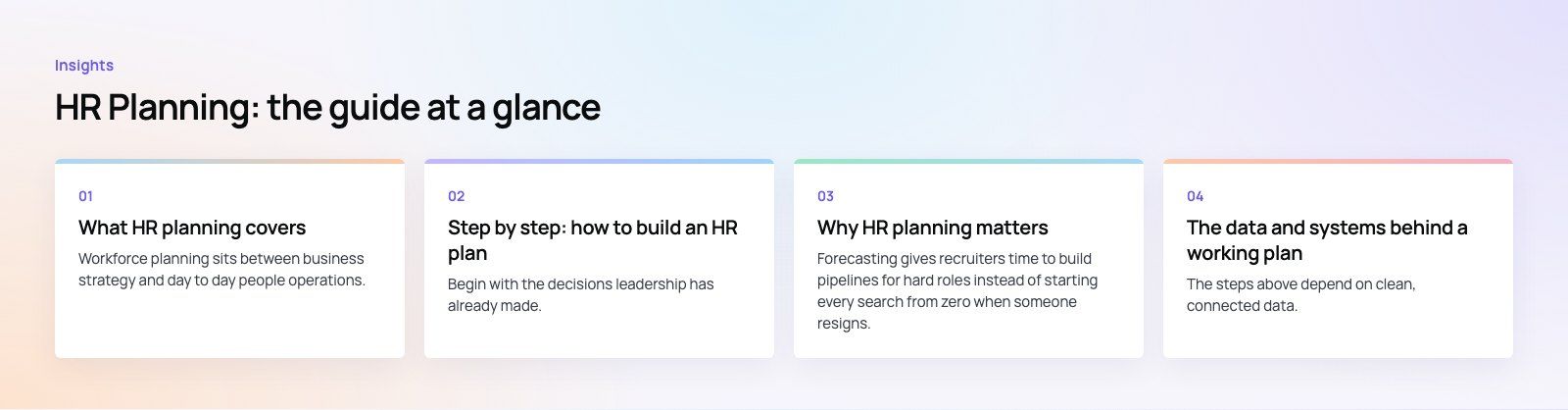
What HR planning covers
Workforce planning sits between business strategy and day to day people operations. Leadership decides where the company is going: new markets, new products, automation of some roles, a change in operating model. HR planning translates that into headcount, skills, locations, cost drivers and timelines.
Most plans have five building blocks:
- Workforce analysis: who you employ now, in which roles, with which skills, and how they are performing.
- Demand forecasting: the roles and capabilities the strategy will require.
- Supply forecasting: what your internal talent pool and the external market can realistically provide.
- Gap analysis: where demand and supply do not match, by role, team and time period.
- Action planning: the recruitment, development, redeployment and retention work that closes the gaps.
Modern workforces are also more varied than they were a decade ago. Teams span generations, nationalities and work arrangements, including remote, hybrid and contract staff. A plan that ignores that variety tends to recruit from the same narrow channels and lose good people it could have kept, so inclusion belongs inside the plan rather than in a separate initiative.
Step by step: how to build an HR plan
1. Start from the business strategy
Begin with the decisions leadership has already made. Which services will grow, which will shrink, and what will change in how work gets done? If the company plans to automate parts of finance operations or open a new office, those choices drive the people plan. Write the assumptions down so they can be revisited when the strategy shifts.
2. Audit the current workforce
Build an accurate baseline: headcount by team and role, contract types, tenure, performance distribution, skills, open roles, turnover and absence patterns. Include demographic data where it is lawful to collect and employees have agreed, because it shows where representation is thin. This step often exposes the first problem: data is spread across spreadsheets, payroll exports and email, and nobody trusts the totals.
3. Forecast demand
For each team, estimate the roles and skills needed at the end of each planning period. Use the volume drivers that actually create work, such as customer numbers, projects, transactions or locations, and agree them with the budget holders. Separate roles that grow with volume from roles that grow with complexity, since they respond differently to automation.
4. Forecast supply
Project what your current workforce will look like if you do nothing: expected attrition, retirements, internal moves and people ready for promotion. Then look outward at how hard each skill is to hire in your markets and how long it usually takes. Supply forecasting is where many plans become unrealistic, so use your own historical hiring and turnover data where you have it.
5. Run the gap analysis
Compare the two forecasts by role and period. Each gap should be labeled as a shortage or a surplus, with a size and a date. A shortage of senior engineers in six months needs a different response from a surplus of manual data entry roles in eighteen months.
6. Choose actions for each gap
There are only a handful of levers, and each has a cost driver and a lead time:
| Lever | Best for | Lead time | Main risk |
|---|---|---|---|
| External hiring | New capabilities the team does not have | Weeks to months | Competing for scarce skills |
| Training and upskilling | Adjacent skills existing staff can learn | Months | Time away from delivery |
| Internal moves | Surplus in one team, shortage in another | Weeks | Leaving the original team short |
| Contractors and partners | Peaks or short projects | Days to weeks | Knowledge leaving with the contract |
| Automation | Repetitive, rules based work | Months | Underestimating change management |
7. Build inclusion into recruitment and promotion
Review where vacancies are advertised and who sees them. Widen sourcing channels, use structured interviews with consistent scoring, and consider removing names and photos from early screening to reduce bias. Apply the same thinking to promotion: succession plans should name more than one candidate per critical role and include people from different backgrounds.
8. Review policies and practices
Check that leave, flexible working, pay review and grievance policies do not create barriers for particular groups. A policy written for office based staff can quietly disadvantage remote or shift workers. Update policies before the hiring wave starts, not after complaints arrive.
9. Develop leaders and successors
Identify the roles where an unexpected departure would hurt most, then name and develop successors for them. Mentoring, stretch assignments and structured leadership programs work best when they are tracked in the same system as performance reviews, so progress is visible.
10. Measure, report and adjust
Pick a short list of indicators and review them quarterly: time to hire, quality of hire, regretted attrition, internal fill rate, training completion, and representation at each level. Compare actuals with the plan and update the forecasts. HR planning is a cycle; a plan that is not revisited goes stale within a year.
Why HR planning matters
Hiring the right people at the right time
Forecasting gives recruiters time to build pipelines for hard roles instead of starting every search from zero when someone resigns.
Controlling people costs
Overstaffing wastes budget and understaffing burns out the people you have. Planning lets you see both early and choose the cheaper lever, such as training or internal moves, before resorting to rushed external hires.
Keeping skills aligned with strategy
When the business adopts new technology or enters a new market, skills gaps show up in the plan months before they show up in missed deadlines.
Continuity through succession
Named successors and development plans mean a resignation in a key role becomes a handover rather than a crisis.
Compliance and fair treatment
Labor law, data protection and equal treatment rules differ by country. Planning makes sure contracts, working hours and employee records are handled correctly in every location before the team grows there. If you hold data on employees in the European Union, for example, the General Data Protection Regulation governs how that workforce data may be collected and used.
Engagement and retention
People stay longer when they can see a future in the organization. A visible plan for development and promotion is one of the clearest signals that you are investing in them.
The data and systems behind a working plan
The steps above depend on clean, connected data. In practice, the biggest obstacle is not the method but the tools: headcount in one spreadsheet, payroll in another system, training records in a learning platform, and recruitment in an applicant tracking tool that nobody has linked to the rest.
A few practical fixes make a large difference:
- One employee record. Agree a single source of truth for each person, role and cost center, and make other systems read from it.
- Automated reporting. Dashboards built in tools such as Power BI can pull headcount, attrition and hiring data together so the quarterly review uses live numbers, not copies.
- Connected business systems. Linking HR data with finance in an ERP such as Business Central or Odoo lets you forecast people costs alongside revenue.
- Simple workflows. Approval flows for new roles, transfers and training requests can be built with Power Platform so the plan updates as decisions are made.
Our Distinct case study shows a healthcare workforce platform with shifts, bookings and incident reports in one product, the kind of operational data that makes supply forecasting far more accurate.
Common mistakes to avoid
- Planning in isolation. A plan written by HR alone, without budget holders, rarely survives the first budget cycle.
- Forecasting headcount without skills. Ten new hires is not a plan; ten people with specific capabilities by a specific date is.
- Treating inclusion as a separate project. Diversity goals that are not tied to sourcing, interviewing and promotion decisions do not change outcomes.
- Ignoring internal talent. Many shortages can be filled faster by developing people you already employ.
- Setting and forgetting. Without a quarterly review, the plan drifts away from reality.
If your workforce data lives in disconnected spreadsheets and tools, we can help you bring it together. Codeeo has delivered 200+ projects across the UAE and the US, and our team builds custom software and connected business systems that give HR teams reliable numbers to plan with.
Frequently asked questions
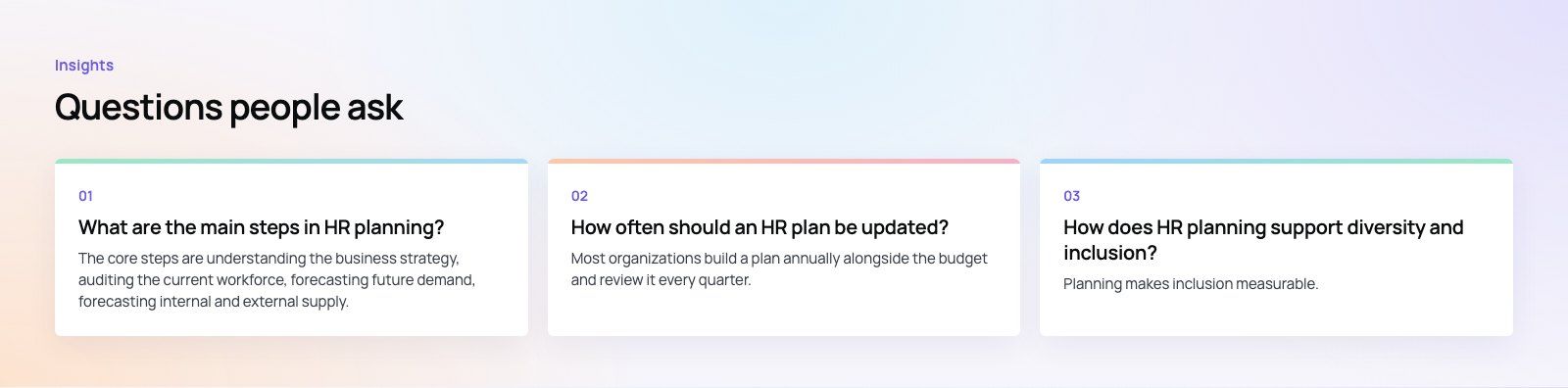
HR planning, also called workforce planning, is the process of forecasting the people and skills an organization will need and building actions to meet that need.
It compares the current workforce with future demand from the business strategy, identifies shortages and surpluses, and sets out hiring, training, internal moves and succession steps with owners and timelines so the company has the right people when it needs them.
InsightsHow Employee Engagement Drives Business PerformanceHow employee engagement affects profit, productivity, absence, retention, customers and innovation, what the evidence says, and how to link it to results. InsightsThe Five Functions of Human Resource Management ExplainedThe five core functions of human resource management: recruitment, training, performance, compensation and employee relations, with practices and pitfalls.
 InsightsPerformance Management and Employee Engagement: A Practical GuideHow to run performance management that raises engagement: frequent check ins, specific recognition, growth plans, a strengths based approach and who owns what.
Tell us what the business needs. We will tell you what to build first.
Schedule a free consultation and get a written recommendation, with costs, before you commit to anything.
Get in touchPROVEN RESULTS
4.7 / 5verified reviews on Google