 Software DevelopmentSQL vs NoSQL Databases: Differences and How to ChooseHow SQL and NoSQL databases differ in data model, schema, scaling and consistency, where each one fits, and five questions to choose for your project.
CodeeoInsightsSoftware Development
In House Software Development: Pros, Cons and When It Fits
The real pros and cons of in house software development compared with outsourcing, a side by side table, and four questions to decide which model fits your company.
In house software development gives you the most control over priorities, knowledge and intellectual property, but it costs more to set up, takes longer to staff and leaves you carrying salaries whether or not there is work. Outsourcing gets you skills and speed quickly, at the price of less direct control. Most companies end up with a mix: a small internal core that owns the product, plus outside capacity for specialist or peak work.
Below we set out the real advantages and drawbacks of each model, a side by side comparison, and a simple way to decide which fits your situation.
What in house software development means
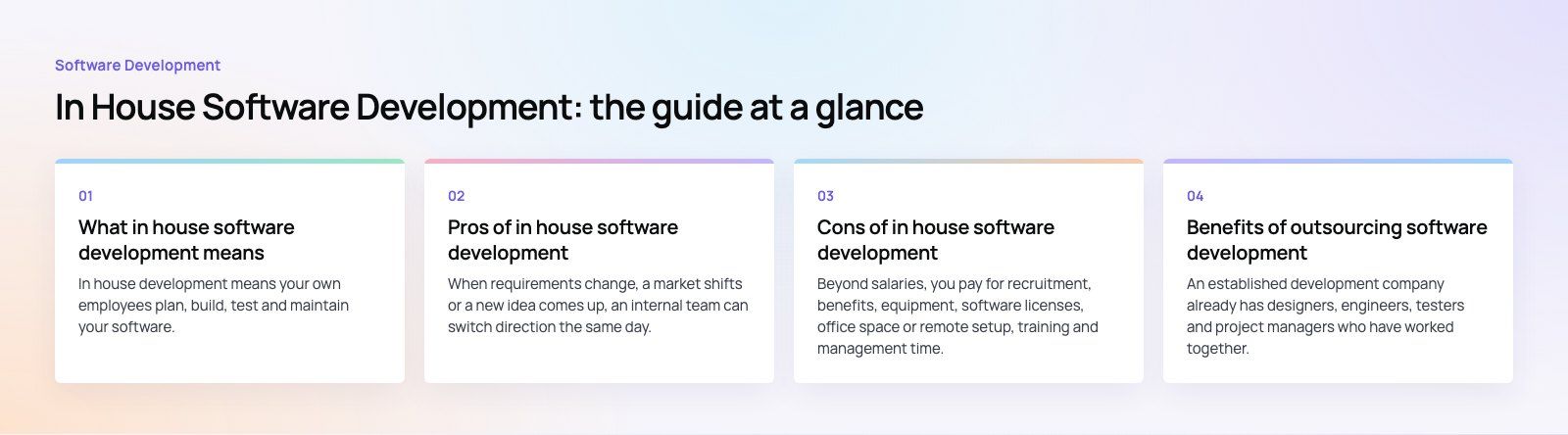
In house development means your own employees plan, build, test and maintain your software. You hire the developers, designers, testers and product managers, and they sit inside your company structure. Outsourcing means a separate company or freelancers do some or all of that work under contract.
There is a middle ground too. Staff augmentation and dedicated teams put external developers inside your process, working to your backlog and tools, while the vendor handles hiring and employment. That option matters because the choice is rarely all or nothing.
Pros of in house software development
Control over priorities and pace
When requirements change, a market shifts or a new idea comes up, an internal team can switch direction the same day. There is no change request, no contract amendment and no waiting for another company's sprint planning. You decide what gets built and in what order.
Ownership of knowledge and intellectual property
Every decision, workaround and piece of context stays inside your company. Intellectual property ownership is usually simpler too, because work made by employees in the course of their job normally belongs to the employer. With a vendor, ownership depends on the contract, so it must be written down clearly.
Security you set yourself
You define access rules, review processes and where data lives. For products that handle sensitive personal, financial or health data, keeping development close can make compliance and audits simpler, although outsourcing partners can meet the same standards when the contract and controls are right.
Faster informal communication
A developer who sits near sales, support and operations hears customer problems first hand. Quick questions get quick answers, and that shared context is hard to recreate across companies and time zones.
Close fit with business strategy
An internal team lives with the product for years. It understands why features exist, which customers matter most and where the business is heading, so it makes better small decisions without being told.
Cons of in house software development
High setup and running costs
Beyond salaries, you pay for recruitment, benefits, equipment, software licenses, office space or remote setup, training and management time. These costs continue for as long as the team exists, so in house only pays off when there is steady work for years.
Hiring and keeping good people is hard
Experienced developers have options, and many expect flexible or remote work. Hiring the first few engineers can take months, and losing one senior person can stall a project because so much knowledge sits in their head.
Skill gaps
A small team cannot cover everything. You might have strong web developers but nobody for iOS, cloud infrastructure, security testing or data work. Hiring a full time specialist for a short need rarely makes sense, and training takes time.
Slower start
Before an internal team writes useful code, you need to hire it, onboard it and set up tools and processes. For a new product with a deadline, that lead time can be the deciding factor.
Management overhead
Someone has to run hiring, reviews, career paths, conflict and planning. If nobody in the business has managed engineers before, this overhead lands on founders or operations leaders who already have full plates.
Paying for idle time
Workload is uneven. After a launch, there may be weeks of lighter maintenance, but salaries stay the same. Scaling up for a big push is just as slow, because every new hire goes through the same recruitment cycle.
Benefits of outsourcing software development
Speed to start
An established development company already has designers, engineers, testers and project managers who have worked together. You can usually start within weeks rather than months.
Access to specialist skills
You can bring in mobile, cloud, payments or integration experience for exactly as long as you need it, without hiring permanently. A good partner also brings patterns and reusable components from previous projects, which saves time on common problems such as sign in, payments and admin panels.
Flexible capacity
Team size can follow the roadmap. Add people for a launch, reduce after it, and avoid paying for a full team during quiet periods.
Less hiring and management work
The vendor recruits, trains and manages its own people. Your job shifts to setting priorities, reviewing work and accepting deliverables.
Your internal team stays focused
Many companies keep operations, product ownership and customer knowledge in house and outsource the build. Internal staff spend their time on what only they can do.
Drawbacks of outsourcing
- Less day to day control. Priorities pass through a contract and a project manager.
- Knowledge can leave with the vendor unless documentation and handover are agreed from the start.
- Communication takes effort, especially across time zones and languages.
- Quality varies widely between vendors, so selection matters more than price.
- Data protection must be contracted. If a vendor handles personal data of people in the EU, for example, the GDPR requires a written processing agreement.
In house vs outsourcing at a glance
| Factor | In house team | Outsourced team |
|---|---|---|
| Control | Full and immediate | Through contract and project manager |
| Time to start | Months to hire and onboard | Usually weeks |
| Cost pattern | High fixed cost, ongoing | Variable, tied to scope or team size |
| Skills range | Limited to who you hire | Wide, can add specialists |
| Scaling | Slow in both directions | Faster up and down |
| Product knowledge | Stays in the company | Needs documentation and handover |
| IP ownership | Usually straightforward | Must be set in the contract |
| Management load | High | Lower, but needs a product owner |
How to decide
Ask four questions:
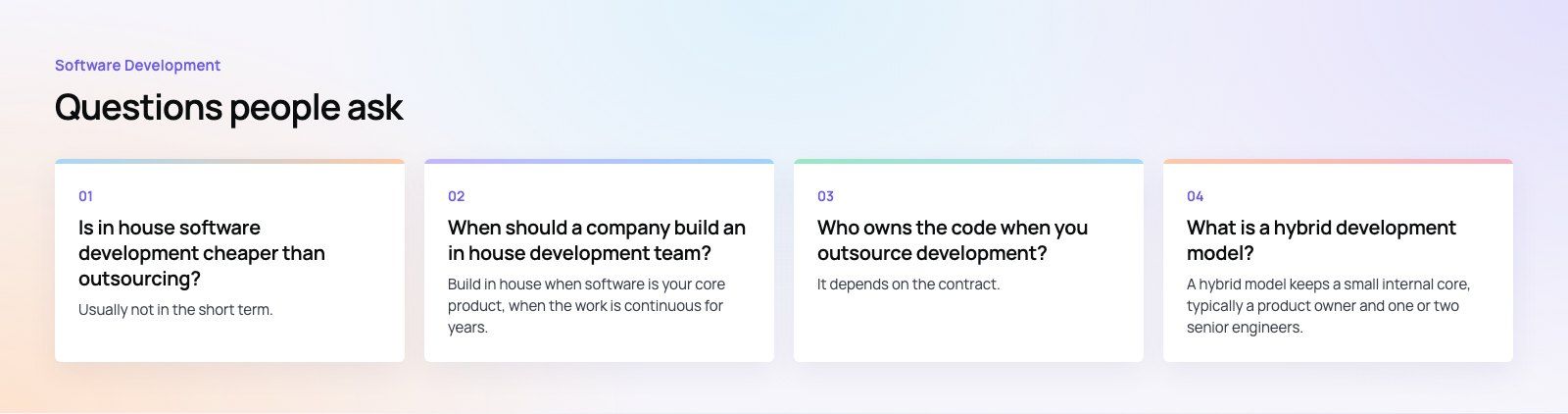
- Is software your core product? If the software is what customers pay for, build at least a small internal team to own architecture and roadmap.
- Is the work steady or project based? A one off app, website or integration suits outsourcing. Continuous product work over years suits in house or a long term dedicated team.
- How fast do you need to ship? If the deadline is months away, you may not have time to hire.
- Do you have someone to manage engineers? Without technical leadership, an internal team struggles. An outsourcing partner can cover that gap while you hire.
The hybrid model most companies use
A common setup is a product owner and one or two senior engineers in house, with an external team doing most of the build. The internal people own decisions, code reviews and knowledge; the partner supplies capacity and specialist skills. This keeps control where it matters while avoiding the cost of a full internal department.
Making outsourcing work if you choose it
- Agree on IP ownership, source code access and handover in the contract.
- Keep the code in a repository your company owns.
- Insist on written documentation and regular demos of working software.
- Start with a scoped first phase before committing to a long engagement.
- Name one internal person who makes product decisions.
Get the right team shape
Codeeo has a team of 80+ across Dubai, Riyadh and Karachi and has delivered 200+ projects across the UAE and the US. If you want developers who work inside your process, see our dedicated developers service. For a full build, start with custom software development or a short product scoping session. If you already have code from an earlier team, a codebase review shows what you are inheriting, and you can meet the people behind the work on our teams page.
Frequently asked questions
Usually not in the short term.
In house teams carry fixed costs such as salaries, benefits, recruitment, equipment and management time, whether or not there is work. Outsourcing turns most of that into a variable cost tied to scope. Over many years of steady product work, an internal team can become better value, which is why software companies tend to build one.
Software DevelopmentSQL vs NoSQL Databases: Differences and How to ChooseHow SQL and NoSQL databases differ in data model, schema, scaling and consistency, where each one fits, and five questions to choose for your project. Software DevelopmentOpen Source Apps: Examples, Licenses and How to Build Your OwnWhat makes an app open source, well known examples, the steps to build your own, how to pick MIT, Apache or GPL, and when to customize instead.
 Software DevelopmentHow an Online HR Portal Improves Employee ExperienceWhat an online HR portal does, how self service improves employee experience, which features matter, and whether to buy, configure or build one.
Tell us what the business needs. We will tell you what to build first.
Schedule a free consultation and get a written recommendation, with costs, before you commit to anything.
Get in touchPROVEN RESULTS
4.7 / 5verified reviews on Google