 SEOHow to Optimize Your Website for Search EnginesA practical guide to optimizing a website for search engines: technical health, mobile first indexing, on page content, earning links and measuring results.
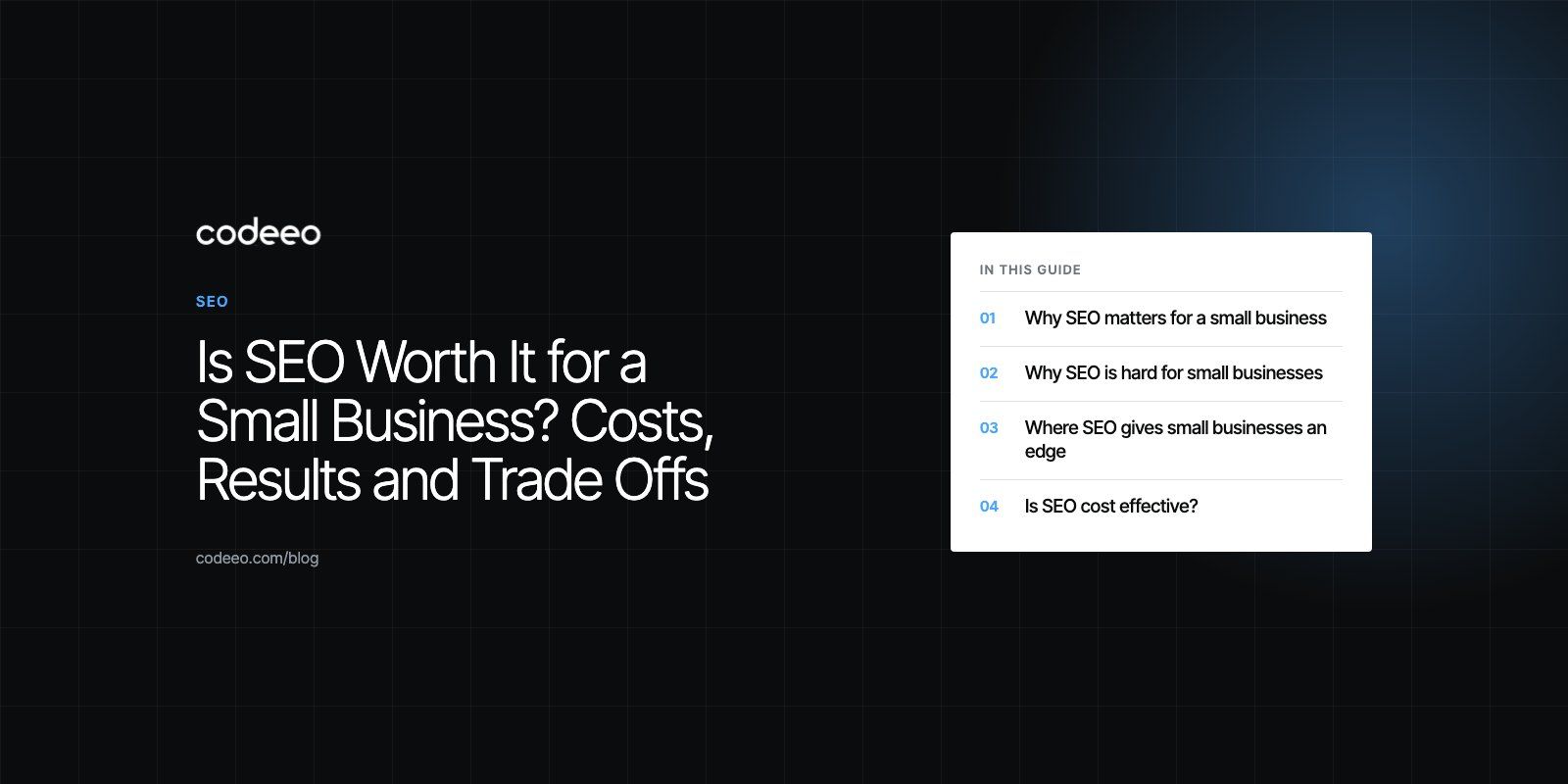
Is SEO Worth It for a Small Business? Costs, Results and Trade Offs
Is SEO worth it for small businesses? Why it usually pays off, where it gets hard, how it compares with paid ads and how to start without wasting money.
Yes, SEO is worth it for most small businesses, as long as you treat it as a long term channel and focus on the searches your customers actually make. It brings in people who are already looking for what you sell, and the traffic keeps coming after the work is done, unlike ads that stop when the budget does. It is less worth it if you need sales this week, or if nobody searches for your product at all.
Below we look at why SEO pays off for small companies, where it gets hard, how it compares with paid ads, and how to start without wasting time or money.
Why SEO matters for a small business
Most buying decisions now start with a search. Someone looking for a plumber, a dentist, a gift shop or an accountant types what they need into Google and picks from the first results. If your business does not appear there, those customers go to a competitor who does.
SEO, or search engine optimization, is the work of making your website easy for search engines to understand and worth showing for relevant searches. Done well, it brings three things a small business needs:
- Targeted visitors: people searching for your service already have the need. They convert better than people who scroll past an ad.
- Compounding results: a page that ranks keeps bringing visitors for months or years without paying per click.
- Trust: appearing in organic results and on the map signals that you are an established, real business.
Why SEO is hard for small businesses
SEO is worth it, but it is not easy. Knowing the obstacles in advance helps you set realistic expectations.
Competition with bigger brands
National retailers, directories and marketplaces have large teams and strong domains. Competing head on for broad terms is rarely realistic for a small company.
Changing search algorithms
Google updates its ranking systems many times a year. Tactics that worked once, such as keyword stuffing or buying cheap links, now tend to hurt rather than help.
Time and patience
New pages often take months to rank, and results build gradually. Many owners give up just before the work starts to pay off.
Content and technical skills
Good SEO needs useful content, a fast site that works on mobile, clean code and sound structure. Few small business owners have all of those skills or the time to build them.
Where SEO gives small businesses an edge
The good news is that small businesses do not need to beat big brands everywhere. They need to win the searches that matter to them.
- Local search: searches with a location or "near me" intent favor businesses that are genuinely nearby, with a complete Google Business Profile and good reviews. Local SEO is often the fastest win for service businesses and shops.
- Specific, long searches: a query like "emergency boiler repair for older homes" has less volume but far less competition and much clearer intent than "plumber".
- Real expertise: owners know their customers' questions better than any large brand. Answering those questions in depth is the kind of helpful content search engines reward.
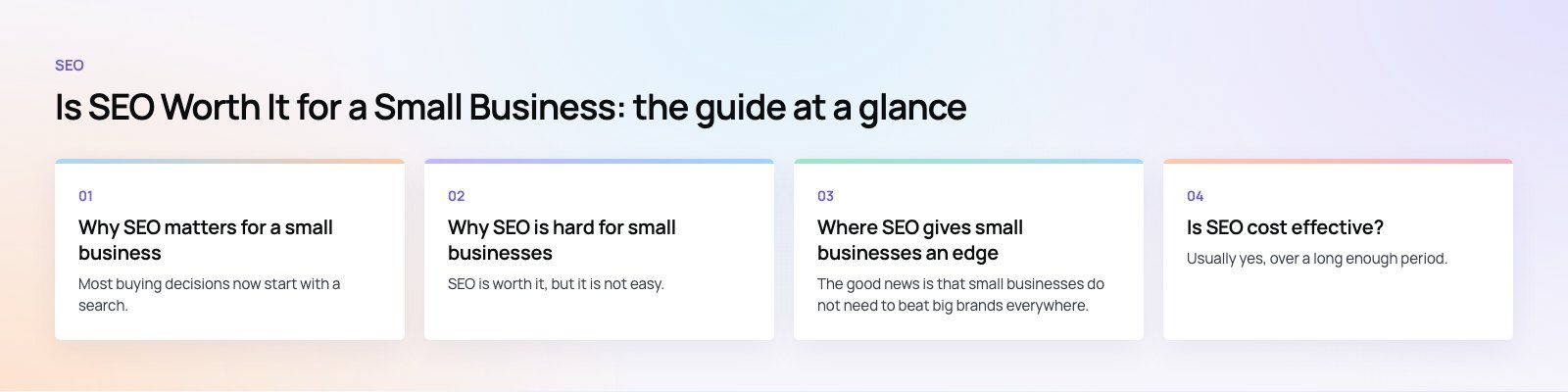
Is SEO cost effective?
Usually yes, over a long enough period. The cost of SEO is mostly time: writing and improving pages, fixing technical issues and earning mentions from other sites. Whether you spend your own hours or pay a specialist, what you get is an asset that keeps working. Paid ads, by contrast, are a running cost that stops the moment you stop paying.
What drives the cost of SEO is the competition in your market, the state of your current website, how many locations or services you need to cover, and how much content you need to create. A local business in a quiet niche needs far less than an online store competing nationally.
Be careful with cheap packages that promise quick rankings or a fixed number of backlinks. Low quality links and thin content can damage your site, and recovering costs more than doing it properly the first time.
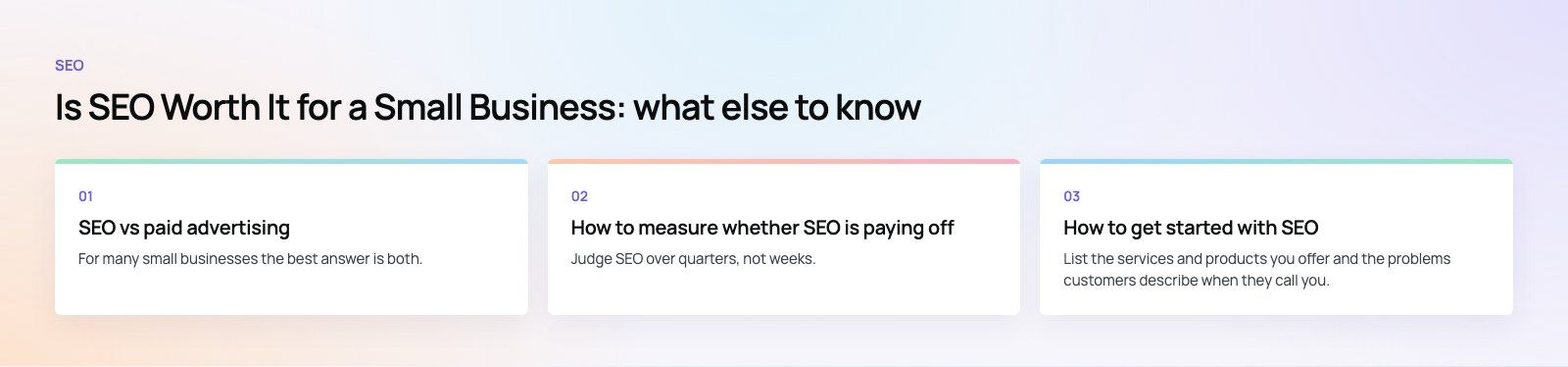
SEO vs paid advertising
| Factor | SEO | Paid search and social ads |
|---|---|---|
| Speed | Slow; usually months | Fast; traffic from the day ads go live |
| Ongoing cost | Time and content; no fee per click | You pay for every click or impression |
| When you stop | Rankings fade slowly | Traffic stops immediately |
| Trust | Organic results are often trusted more | Clearly labeled as ads |
| Control | Less control over timing and position | Precise control over budget, audience and message |
| Best for | Steady, long term demand | Launches, offers and testing what sells |
For many small businesses the best answer is both. Ads bring early sales and show which keywords convert. SEO then targets those proven terms so you can rely less on paid traffic over time. Our digital marketing team often plans the two together for this reason.
How to measure whether SEO is paying off
- Organic traffic: track visits from search in Google Analytics and see which pages bring them.
- Search performance: Google Search Console shows the queries you appear for, your average position and your click through rate.
- Conversions: calls, form submissions, bookings and sales from organic visitors are what really matter. Set these up as goals from the start.
- Keyword positions: watch a short list of terms that bring buyers, not vanity terms with high volume and no intent.
Judge SEO over quarters, not weeks. A steady rise in qualified visitors and leads is a sign it is working, even if rankings move up and down along the way.
How to get started with SEO
1. Research the right keywords
List the services and products you offer and the problems customers describe when they call you. Use free tools and Google's autocomplete to find how people phrase those searches, and prioritize terms with clear buying intent.
2. Fix the website foundations
- Give every important page a clear title, heading and description that match what people search for.
- Make sure the site works well on mobile and loads quickly. Our Core Web Vitals work focuses on exactly this.
- Make sure search engines can crawl and index your pages, and that there are no broken links or duplicate pages.
Google's own SEO starter guide is a good, free reference for these basics.
3. Set up your local presence
Claim and complete your Google Business Profile with accurate hours, categories, photos and services. Keep your name, address and phone number consistent across directories, and ask happy customers for reviews.
4. Publish genuinely helpful content
Write pages that answer real customer questions: pricing factors, comparisons, how a service works, what to expect. One thorough page beats five thin ones.
5. Earn links and mentions
Get listed in relevant industry and local directories, work with suppliers and partners, and create resources other sites want to cite. Avoid buying links.
SEO mistakes small businesses should avoid
- Targeting broad, highly competitive terms instead of specific and local ones.
- Stuffing keywords into pages until they read badly.
- Publishing thin or copied content just to have more pages.
- Buying cheap backlinks or joining link schemes.
- Ignoring mobile performance and page speed.
- Not tracking conversions, so you cannot tell what SEO is worth.
- Giving up after a few weeks.
The verdict
SEO is one of the best long term investments a small business can make, provided you are patient and focus on searches that bring buyers. Start with your website foundations and local presence, add helpful content steadily, and measure leads rather than rankings. If you want to know where your site stands today, a technical SEO review is a practical first step. Codeeo has delivered 200+ projects across the UAE and the US and is rated 4.7 from 23 Google reviews.
Frequently asked questions
Most small businesses see early movement within a few months and more meaningful results over six to twelve months, depending on competition, the state of the website and how much content is published.
Local searches often respond faster than national ones. SEO builds gradually, so judge progress by steady growth in qualified traffic and leads, not by week to week ranking changes.
SEOHow to Optimize Your Website for Search EnginesA practical guide to optimizing a website for search engines: technical health, mobile first indexing, on page content, earning links and measuring results. SEOTechnical SEO vs On-Page SEO: Differences and How They Work TogetherTechnical SEO gets your pages indexed; on-page SEO makes them rank. See what each covers, where they overlap and the order to fix problems in.
 SEOWordPress SEO Tips: A Practical Checklist to Improve RankingsA practical WordPress SEO checklist: plugin setup, site structure, keyword intent, titles, speed, mobile, schema, monitoring and the mistakes that hold sites back.
Tell us what the business needs. We will tell you what to build first.
Schedule a free consultation and get a written recommendation, with costs, before you commit to anything.
Get in touchPROVEN RESULTS
4.7 / 5verified reviews on Google