 SEOTechnical SEO vs On-Page SEO: Differences and How They Work TogetherTechnical SEO gets your pages indexed; on-page SEO makes them rank. See what each covers, where they overlap and the order to fix problems in.
How to Optimize Your Website for Search Engines
A practical guide to optimizing a website for search engines: technical health, mobile first indexing, on page content, earning links and measuring results.
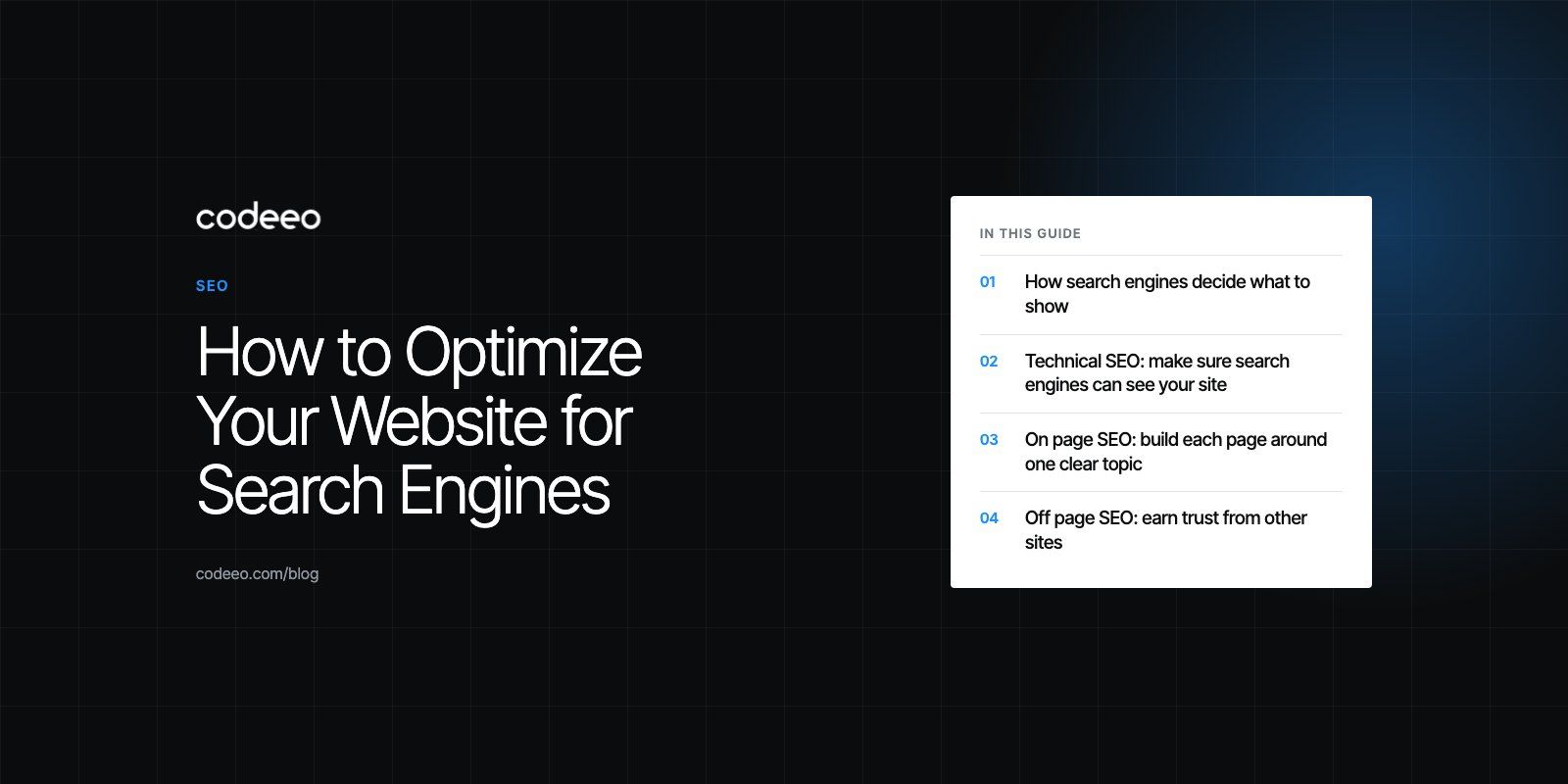
To optimize a website for search engines, make sure search engines can crawl and index every important page, build each page around a clear topic that matches what people search for, and earn trust through useful content and links from relevant sites. Fast, mobile friendly pages and clean site structure support all of this, and Google Search Console tells you what is working.
SEO has three parts that depend on each other: technical health, on page content and off page authority. This guide covers each in a practical order, starting with the foundations most sites get wrong.
How search engines decide what to show
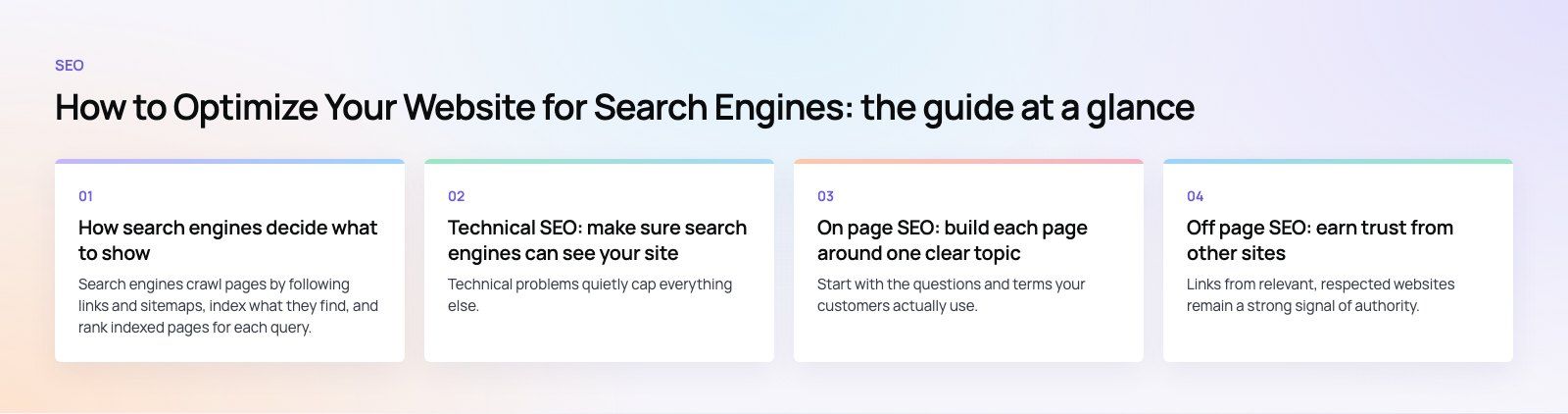
Search engines crawl pages by following links and sitemaps, index what they find, and rank indexed pages for each query. Google's own SEO Starter Guide stresses that the most useful thing you can do is create content people find helpful and make it easy to discover. In practice, ranking comes down to three questions:
| Factor | The question it answers | What you control |
|---|---|---|
| Relevance | Does this page match what the searcher wants? | Topic choice, titles, headings and content depth |
| Quality and trust | Is this source reliable and genuinely helpful? | Original expertise, accuracy, links from respected sites |
| Experience | Will the visitor have a good time on the page? | Speed, mobile layout, readability, no intrusive popups |
Technical SEO: make sure search engines can see your site
Technical problems quietly cap everything else. Fix these first.
Crawling and indexing
- Robots.txt: confirm it does not block pages or resources you want indexed. A leftover rule from a staging site is a surprisingly common cause of lost traffic.
- XML sitemap: list only live, indexable pages that return a 200 status, and submit the sitemap in Google Search Console and Bing Webmaster Tools.
- Noindex and canonical tags: check that important pages are not marked noindex and that canonical tags point to the right version of each page.
- Status codes: fix broken links and redirect chains, and use 301 redirects when URLs change.
Mobile first
Google uses the mobile version of a site's content for indexing and ranking, as its mobile first indexing documentation explains. If content, links or structured data exist on desktop but are hidden or missing on mobile, Google may not see them. Make sure the mobile version carries the same important content.
Speed and Core Web Vitals
Page experience will not rescue weak content, but slow, unstable pages lose visitors and can hold rankings back when competition is close. Compress images, serve modern formats such as WebP, cache pages, trim unused JavaScript and reserve space for images to prevent layout shifts. Our Core Web Vitals service covers this in depth.
Site structure and internal links
Organize pages into a clear hierarchy, so that the home page links to main sections, sections link to detailed pages, and related pages link to each other. Important pages should be reachable within a few clicks. Use descriptive anchor text such as "WordPress maintenance plans" rather than "click here".
Structured data
Schema markup in JSON-LD helps search engines understand what a page is about: an organization, a product, an article or a local business. It can make pages eligible for richer search results. Use only markup that matches visible content on the page.
If you want a professional pass over all of this, a technical SEO review gives you a prioritized fix list.
On page SEO: build each page around one clear topic
Keyword and intent research
Start with the questions and terms your customers actually use. Group keywords by intent: someone searching "what is headless commerce" wants an explanation, while "headless commerce agency" signals they want a provider. Each group deserves its own page, and two pages should not compete for the same intent.
Long, specific phrases often bring less traffic but convert better, because the searcher knows what they want. They are also easier to rank for on a newer site.
Titles, meta descriptions and headings
- Title tag: put the main topic near the start, keep it readable and distinct from other pages.
- Meta description: it does not directly affect ranking, but a clear summary with a reason to click improves click through.
- Headings: one main heading for the page topic, then logical subheadings that a reader could scan to understand the page.
- URL: short, readable and lowercase, using words rather than IDs or parameters.
Content that actually answers the query
Answer the main question early, then go deeper with examples, steps, comparisons and honest trade offs. Write from real experience where you can, since first hand detail is hard to copy and is exactly what search engines try to reward. Avoid keyword stuffing; repeat the main phrase naturally and use related terms where they fit.
Keep content current. Update pages when facts, prices or processes change, and merge thin pages that cover the same topic into one stronger page.
Images and accessibility
Use descriptive file names and alt text that explain what each image shows. Good alt text helps visitors using screen readers and gives search engines context. Compress images and set width and height so they do not cause layout shifts.
Off page SEO: earn trust from other sites
Backlinks that are worth having
Links from relevant, respected websites remain a strong signal of authority. Focus on earning them through content worth citing, such as original data, practical guides and tools, plus partnerships, industry directories and media coverage. Google's spam policies treat buying links or large scale link exchanges as link spam, which can lead to lost rankings.
Local signals
If you serve customers in a city or region, a complete and active Google Business Profile, consistent name, address and phone details across directories, and genuine customer reviews matter a great deal. Our local SEO service focuses on these signals.
Social media and brand mentions
Social shares are not a direct ranking factor, but social media gets content in front of people who may link to it, search for your brand or return later. Treat it as distribution for your best pages.
International and multilingual sites
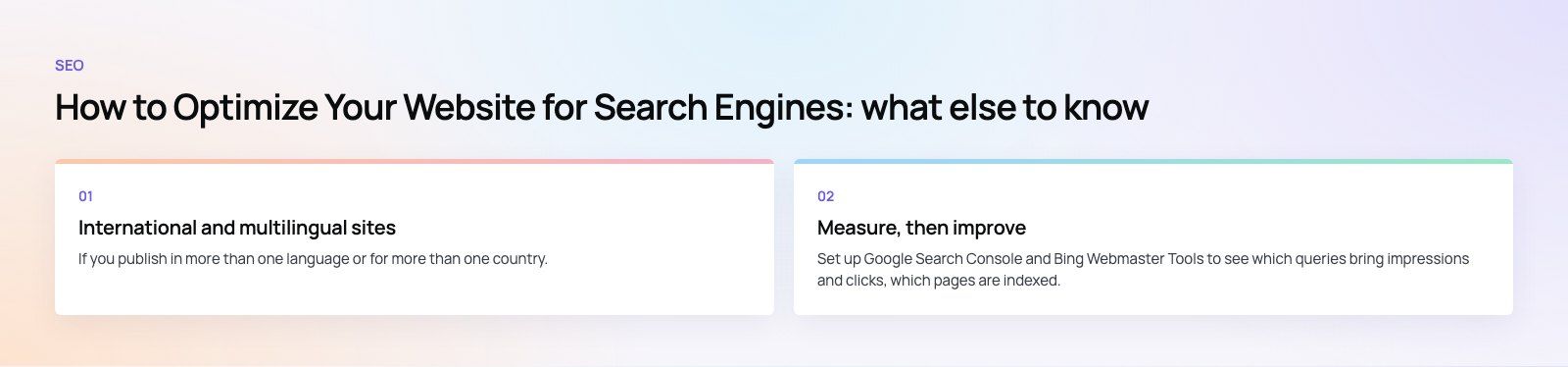
If you publish in more than one language or for more than one country, use hreflang tags so search engines show the right version to each audience, and give every language its own crawlable URL. Translate meaningfully rather than automatically, and research keywords in each language, because people often search differently. Right to left languages such as Arabic also need layouts built for that direction from the start.
Our Diyafah school website is an example of a bilingual Strapi build designed right to left from day one.
Measure, then improve
Set up Google Search Console and Bing Webmaster Tools to see which queries bring impressions and clicks, which pages are indexed, and any crawl or security problems. Use Google Analytics to see what organic visitors do once they arrive and whether they convert.
Review the data monthly. Pages with many impressions but few clicks often need better titles. Pages ranking just below the first page often need deeper content or more internal links. Pages with traffic but no conversions need a clearer next step.
Common SEO mistakes to avoid
- Launching a redesign or new platform without redirecting old URLs, which can wipe out years of rankings. Plan a site migration carefully.
- Publishing many thin pages that target slight keyword variations.
- Blocking CSS or JavaScript in robots.txt so Google cannot render pages properly.
- Buying links or joining link schemes.
- Ignoring mobile layout and speed.
Putting it into practice
Search engine optimization is steady work: fix the technical foundations, build pages around real search intent, earn links through useful content, and refine based on Search Console data. Codeeo has delivered 200+ projects across the UAE and the US and is rated 4.7 from 23 Google reviews. Our digital marketing team handles technical SEO, content and local search together. Contact us to discuss your site.
Frequently asked questions
Technical fixes such as unblocking pages or correcting redirects can show effects within weeks once search engines recrawl the site.
Content and authority work usually takes several months to build, depending on competition, the age of the site and how often you publish. Track impressions and rankings in Search Console, since they tend to move before clicks and leads do.
SEOTechnical SEO vs On-Page SEO: Differences and How They Work TogetherTechnical SEO gets your pages indexed; on-page SEO makes them rank. See what each covers, where they overlap and the order to fix problems in. SEOWordPress SEO Tips: A Practical Checklist to Improve RankingsA practical WordPress SEO checklist: plugin setup, site structure, keyword intent, titles, speed, mobile, schema, monitoring and the mistakes that hold sites back.
 SEOTechnical SEO Best Practices: What Google Actually Asks ForTechnical SEO best practices from Google's own guidance: crawling, indexing, Core Web Vitals, mobile first indexing, HTTPS, structured data, large and international sites.
Tell us what the business needs. We will tell you what to build first.
Schedule a free consultation and get a written recommendation, with costs, before you commit to anything.
Get in touchPROVEN RESULTS
4.7 / 5verified reviews on Google