 InsightsHow Employee Engagement Drives Business PerformanceHow employee engagement affects profit, productivity, absence, retention, customers and innovation, what the evidence says, and how to link it to results.
How Leadership Shapes Employee Engagement and Retention
Why leaders have the biggest influence on employee engagement and retention, and the practices that keep teams motivated and stop good people leaving.
Leadership has more influence on employee engagement and retention than almost any other factor, because managers shape the daily experience of work: how clear goals are, whether effort is noticed, how much trust and autonomy people get, and whether they can see a future in the company. Leaders who share a clear purpose, build trust, recognize good work, develop their people and hand over real ownership tend to keep engaged teams. Leaders who do not tend to lose them.
This article explains the link between engagement and retention, what disengagement costs, and the specific leadership practices that move both.
Why leadership matters so much
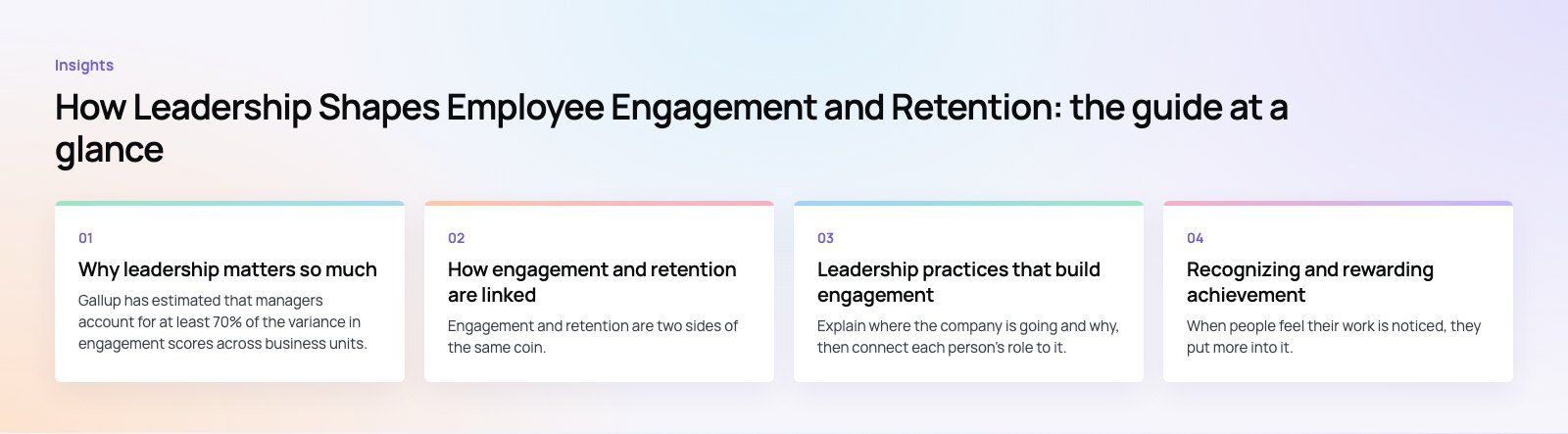
Gallup has estimated that managers account for at least 70% of the variance in engagement scores across business units, a finding from its 2014 research that still shapes how companies think about management. The direct manager decides most of what an employee experiences week to week: workload, feedback, recognition, flexibility and development.
That makes the latest data a concern. Gallup's State of the Global Workplace 2026 report found manager engagement fell from 27% to 22% between 2024 and 2025, and global employee engagement fell to 20%. When managers themselves are disengaged, it is hard for them to engage anyone else.
How engagement and retention are linked
Engagement and retention are two sides of the same coin. Engaged people feel connected to their work, their team and the company's purpose, and that connection gives them a reason to stay. Disengaged people are already halfway out of the door, even if they have not started looking.
Gallup's 2024 Q12 meta-analysis found that top quartile teams for engagement had a median 51% difference in turnover in low turnover organizations and 21% in high turnover ones, compared with bottom quartile teams.
What engaged employees bring
- Higher productivity: focused, motivated people get more done.
- Better customer experience: engaged staff go further for customers.
- More ideas: people who care share suggestions and solve problems before being asked.
- Lower turnover: fewer departures mean lower hiring and training costs and less lost knowledge.
What disengagement costs
- Lower output: disengaged people do what is required and little more.
- Weaker service: customers notice indifference.
- Fewer improvements: people stop suggesting changes they expect to be ignored.
- Turnover: every resignation brings recruitment, onboarding and a dip in team performance.
Leadership practices that build engagement
| Practice | What it looks like | Effect on engagement and retention |
|---|---|---|
| Shared purpose | Explaining goals and how each role contributes | People see why their work matters |
| Trust and respect | Honesty, transparency, listening | People feel safe to speak up and stay |
| Development | Training, mentoring, career paths | People see a future in the company |
| Recognition | Specific, timely appreciation | Effort feels noticed and worthwhile |
| Ownership | Autonomy and decision rights | People feel responsible for outcomes |
| Growing leaders | Leading projects and mentoring others | Confidence and a reason to build a career here |
Share a clear vision and purpose
Explain where the company is going and why, then connect each person's role to it. People who understand how their work contributes are more motivated and make better decisions without waiting to be told. Repeat the message: what feels obvious to leaders after the tenth time is still new to most staff.
Build trust and respect
Trust comes from consistency: doing what you said, sharing bad news as well as good, and admitting mistakes. Respect shows when leaders ask for opinions and act on them, or explain why they did not. Teams with high trust raise problems early, which saves time and money.
Invest in growth and development
Support training, mentoring and clear routes to progress. A conversation about where someone wants to be in two years, followed by real steps to help them get there, is one of the most powerful retention tools a manager has.
Recognizing and rewarding achievement
When people feel their work is noticed, they put more into it. Recognition helps in three ways:
- It lifts morale. Celebrating individual and team wins creates a positive atmosphere.
- It reinforces the right behavior. What gets recognized gets repeated.
- It deepens engagement. Recognition tells people their contribution matters.
Useful forms of recognition include:
- Specific praise in team meetings or company updates.
- Performance related incentives that are clear and fair.
- Extra time off or small, personal rewards.
- Peer to peer recognition, so appreciation does not depend only on the manager.
The best recognition is specific ("the way you handled that client escalation kept the account") rather than generic ("good job").
Giving people ownership
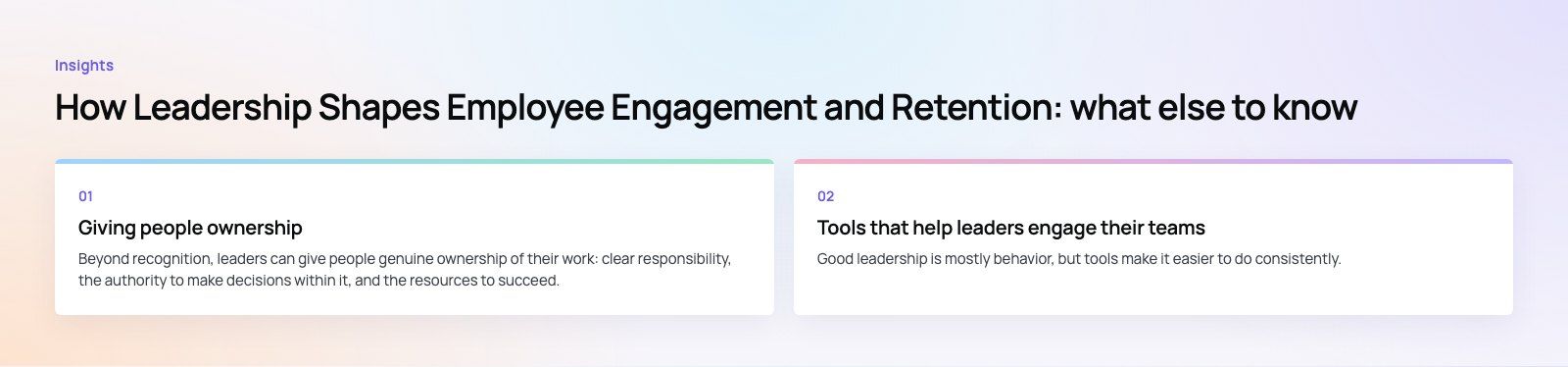
Beyond recognition, leaders can give people genuine ownership of their work: clear responsibility, the authority to make decisions within it, and the resources to succeed.
- Ownership: people with a say in how work is done feel responsible for the result.
- Better problem solving: people closest to a problem often know the fix.
- Better decisions: trust encourages people to share ideas and challenge assumptions.
Letting people lead
Leadership does not need a title. Assigning someone to lead a small project, run a team meeting or mentor a new hire builds leadership skills and confidence. It also creates a pipeline of future managers who already understand the culture, which reduces the risk of hiring managers from outside who do not fit.
Tools that help leaders engage their teams
Good leadership is mostly behavior, but tools make it easier to do consistently. Leaders benefit from:
- A simple way to set and track team goals.
- Channels for quick recognition, ideally visible to the whole team.
- Regular pulse surveys with results broken down by team.
- Dashboards that show engagement, turnover and absence trends together.
Many companies already own most of what they need inside Microsoft 365 but have not set it up for these purposes. Others need a reporting layer in Power BI that joins HR and operations data, or workflow automation on the Power Platform for check ins and approvals.
Common leadership mistakes that drive people away
- Changing priorities without explaining why.
- Taking credit for the team's work.
- Avoiding difficult conversations until they become crises.
- Micromanaging people who have shown they can be trusted.
- Promoting the best individual performer into management without training.
Investing in leadership pays off
Strong leaders create teams where people feel valued and want to stay, which lowers hiring costs, protects knowledge and improves results. Pair leadership development with competitive benefits, a sensible approach to work and life balance, and ongoing learning, and retention becomes a strength instead of a constant worry.
If your managers are held back by scattered tools and data, Codeeo can help. We have delivered 200+ projects across the UAE and the US and build custom software, dashboards and workflows that give leaders a clear view of their teams. Get in touch to talk it through.
Frequently asked questions
Leaders, especially direct managers, shape most of what employees experience every day: clarity of goals, feedback, recognition, workload, flexibility and development.
Gallup estimates managers account for at least 70% of the variance in team engagement scores. A manager who communicates purpose, builds trust, recognizes effort and supports growth tends to lead an engaged team, while one who does not tends to lose people.
InsightsHow Employee Engagement Drives Business PerformanceHow employee engagement affects profit, productivity, absence, retention, customers and innovation, what the evidence says, and how to link it to results. InsightsThe Five Functions of Human Resource Management ExplainedThe five core functions of human resource management: recruitment, training, performance, compensation and employee relations, with practices and pitfalls.
 InsightsPerformance Management and Employee Engagement: A Practical GuideHow to run performance management that raises engagement: frequent check ins, specific recognition, growth plans, a strengths based approach and who owns what.
Tell us what the business needs. We will tell you what to build first.
Schedule a free consultation and get a written recommendation, with costs, before you commit to anything.
Get in touchPROVEN RESULTS
4.7 / 5verified reviews on Google