 Software DevelopmentSQL vs NoSQL Databases: Differences and How to ChooseHow SQL and NoSQL databases differ in data model, schema, scaling and consistency, where each one fits, and five questions to choose for your project.
CodeeoInsightsSoftware Development
Microservices Pros and Cons: When They Fit and When They Don't
The real pros and cons of microservices, how they compare with a monolith, the alternatives, and a practical checklist to decide what fits your product.
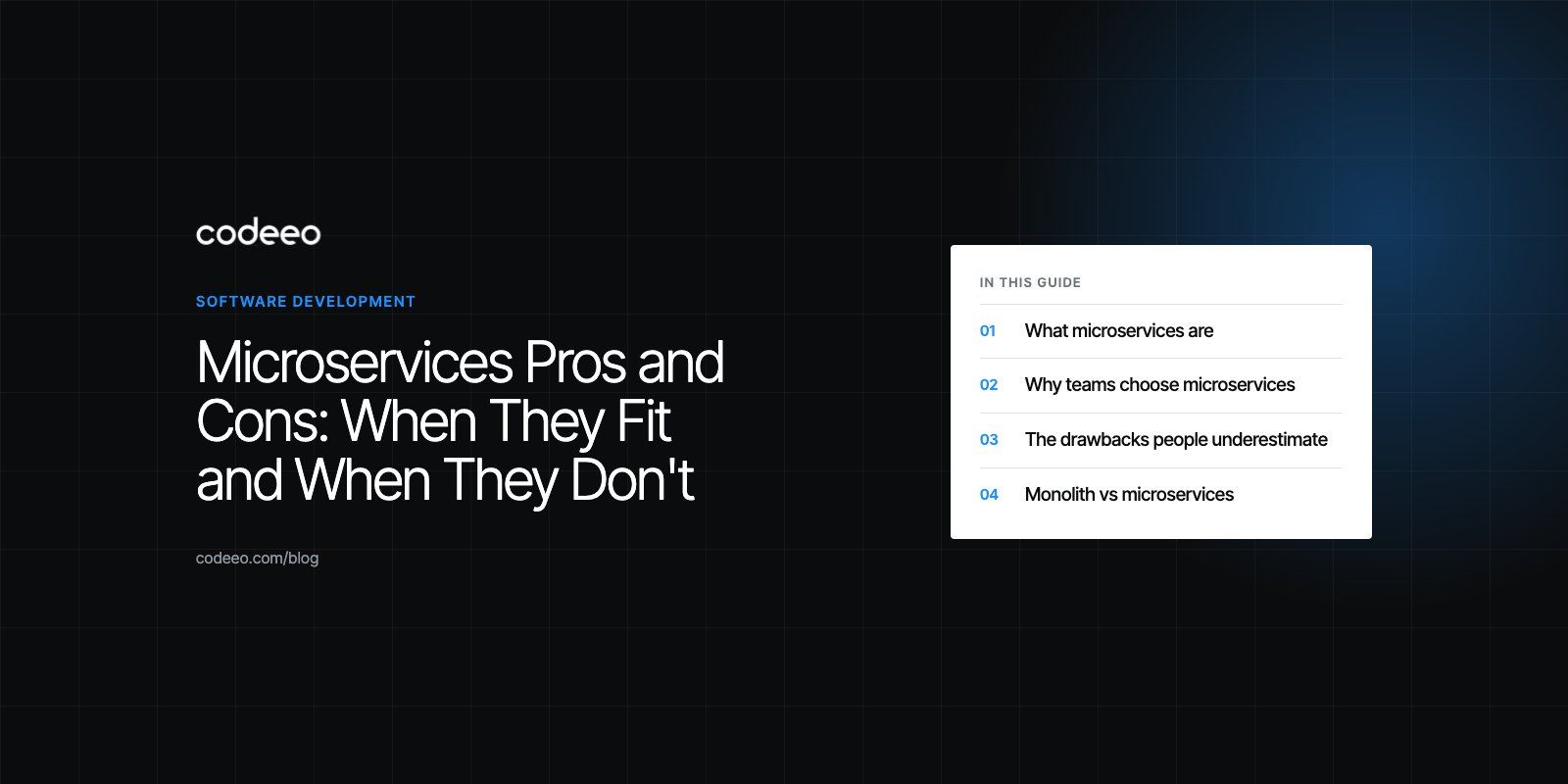
Microservices split an application into small, independently deployable services that talk to each other over APIs. They pay off when several teams need to ship and scale parts of a large product independently, but they add real operational cost, so most products are better served by a well structured monolith until that pressure appears.
This guide sets out what microservices are, the genuine advantages and drawbacks, how they compare with a monolith, and a practical way to decide what fits your product.
What microservices are
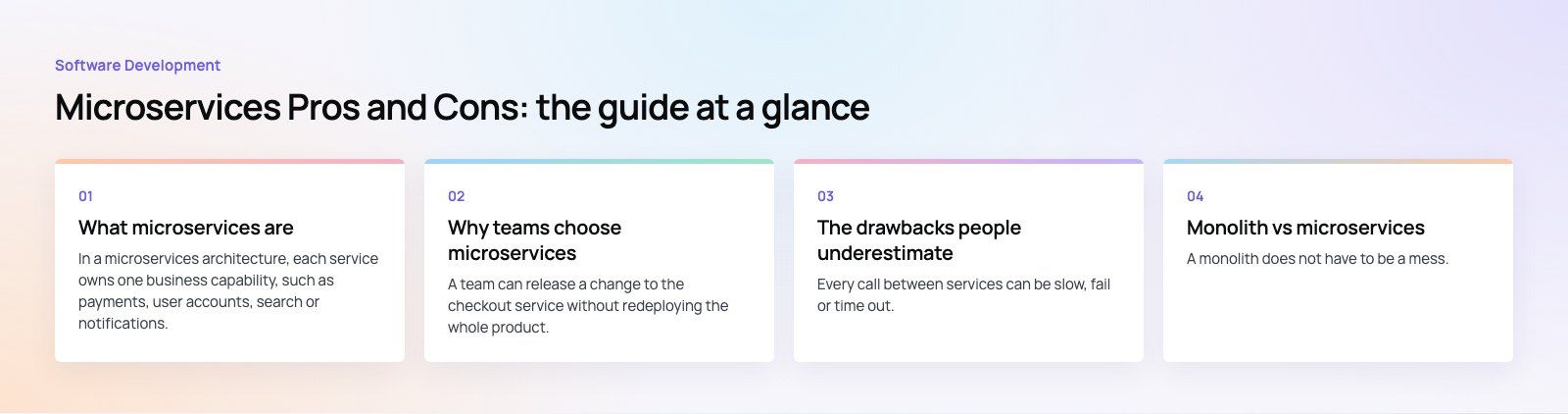
In a microservices architecture, each service owns one business capability, such as payments, user accounts, search or notifications. Each service has its own codebase, is deployed on its own schedule and usually owns its own data. Services communicate through APIs or messages rather than shared memory or a shared database.
The idea is described in detail in Martin Fowler and James Lewis's well known article on microservices, which remains a useful reference. The short version: you trade the simplicity of one deployable unit for independence between parts of the system.
Why teams choose microservices
Independent deployment
A team can release a change to the checkout service without redeploying the whole product. Smaller codebases are easier to understand, test and release, which matters most when many teams work on the same product.
Targeted scaling
In a monolith, a spike in one feature means scaling the entire application. With microservices you scale only the services under load, such as search during a sale or notifications during a campaign.
Fault isolation
If one service fails and the others are designed to handle that failure, the rest of the product keeps working. A broken recommendations service should not stop customers from paying.
Technology choice per service
Each service can use the language, framework or database that suits its job. In practice most teams standardise on a small set of tools, because too much variety makes hiring and maintenance harder.
Clear team ownership
Services aligned with business domains give each team a clear area of responsibility. That makes accountability simpler and lets teams build deep knowledge of their part of the product.
The drawbacks people underestimate
Distributed system complexity
Every call between services can be slow, fail or time out. You need retries, timeouts, circuit breakers and careful API versioning. Debugging a problem that spans five services is harder than reading one stack trace.
Operational overhead
Each service needs its own build pipeline, deployment, monitoring, logging and alerting. Most teams end up running containers on an orchestration platform such as Kubernetes, which is powerful but is itself a system to learn and operate.
Data consistency
When each service owns its data, a single business action, such as placing an order, may touch several databases. You lose simple database transactions and have to design for eventual consistency, which is harder to reason about and test.
Higher cost, especially early
More services means more infrastructure, more tooling and more engineering time spent on plumbing instead of features. For a small team, this overhead can slow delivery rather than speed it up.
Security surface
Every service and every network connection between services is something to secure. Service to service authentication, secrets management and network policies all need attention.
Monolith vs microservices
| Factor | Monolith | Microservices |
|---|---|---|
| Initial build speed | Faster, one codebase | Slower, more setup |
| Deployment | One unit, all or nothing | Each service independently |
| Scaling | Whole application | Per service |
| Failure impact | A bug can take down everything | Failures can be contained |
| Data | One database, simple transactions | Data per service, eventual consistency |
| Operations | Simple to run and monitor | Needs orchestration, tracing, central logging |
| Best for | Small teams, new products | Many teams, large and mature products |
A monolith does not have to be a mess. A modular monolith, where the code is split into clear modules with strict boundaries inside one deployable application, gives you much of the structure of microservices without the network and operational cost. Fowler's Monolith First essay makes the case for starting this way and splitting later.
Is a microservices architecture right for you?
Work through these questions honestly before committing.
How many teams work on the product?
Microservices solve a coordination problem between teams. If you have one team of a handful of developers, that problem barely exists and the overhead outweighs the benefit.
Do parts of the system have very different load patterns?
If one area, such as search, media processing or real time bidding, needs to scale far beyond the rest, splitting that area out can be worth it even in a smaller product.
Do you have the operational maturity?
You need automated CI/CD, infrastructure as code, centralised logging, distributed tracing and on call processes. Without them, microservices tend to fail quietly and expensively.
Are your domain boundaries clear?
If you cannot yet say where payments end and orders begin, you will draw service boundaries in the wrong place, and moving them later is painful. Products that are still finding their shape benefit from staying in one codebase.

Alternatives and middle grounds
Modular monolith
One deployable application with strictly separated modules. It keeps operations simple and makes a later split much easier.
Hybrid approach
Keep the core as a monolith and extract only the parts with a clear reason to stand alone, such as a high load service or a component owned by a separate team.
Event driven architecture
Components communicate by publishing and consuming events. This decouples parts of the system and works well for workflows that do not need an immediate response.
Serverless functions
Cloud functions handle short lived tasks such as image processing, webhooks or scheduled jobs without you managing servers. They pair well with either a monolith or microservices.
Where microservices practice is heading
- Service meshes handle traffic routing, encryption between services and observability outside the application code.
- Better observability through standard tracing and metrics makes cross service debugging less painful, with AI assisted tools helping to spot anomalies.
- Platform engineering gives product teams a paved road for creating and running services, which lowers the overhead per service.
- Right sizing, where teams merge services that were split too finely, is now a common and healthy correction.
Mistakes to avoid
- Splitting by technical layer (a "database service", a "UI service") instead of by business capability.
- Letting several services share one database, which brings back tight coupling without the simplicity of a monolith.
- Creating dozens of tiny services before you have the tooling to run them.
- Treating a rewrite into microservices as a cure for a messy codebase. A messy monolith usually becomes a messy distributed system.
Choosing the right architecture for your product
Architecture should follow the shape of your product and your team, not a trend. Codeeo's team of 80+ across Dubai, Riyadh and Karachi builds custom software and mobile apps on whichever structure fits, and a codebase review is a sensible first step if you are weighing a split. For new products, a product scoping session helps define the domain boundaries before any code is written.
Frequently asked questions
Microservices are a way of building software as a set of small, independent services instead of one large application.
Each service handles one business job, such as payments or user accounts, runs and deploys on its own, and communicates with the other services through APIs. Together the services make up the complete product.
Software DevelopmentSQL vs NoSQL Databases: Differences and How to ChooseHow SQL and NoSQL databases differ in data model, schema, scaling and consistency, where each one fits, and five questions to choose for your project. Software DevelopmentOpen Source Apps: Examples, Licenses and How to Build Your OwnWhat makes an app open source, well known examples, the steps to build your own, how to pick MIT, Apache or GPL, and when to customize instead.
 Software DevelopmentHow an Online HR Portal Improves Employee ExperienceWhat an online HR portal does, how self service improves employee experience, which features matter, and whether to buy, configure or build one.
Tell us what the business needs. We will tell you what to build first.
Schedule a free consultation and get a written recommendation, with costs, before you commit to anything.
Get in touchPROVEN RESULTS
4.7 / 5verified reviews on Google