 Software DevelopmentSQL vs NoSQL Databases: Differences and How to ChooseHow SQL and NoSQL databases differ in data model, schema, scaling and consistency, where each one fits, and five questions to choose for your project.
CodeeoInsightsSoftware Development
Node.js Architecture: How It Works and How to Structure Your App
How the Node.js event loop, non blocking I/O and worker threads work, how to structure a Node.js app in layers, and the practices that keep it fast at scale.
Node.js architecture is built around a single threaded event loop with non blocking input and output, so one process can juggle thousands of open connections while waiting on databases, files and networks. That makes it efficient for APIs, real time features and I/O heavy services. Scaling it well depends on a clean application structure, keeping CPU heavy work off the event loop, and running multiple processes behind a load balancer.
This guide explains how the runtime works, how to structure a Node.js application, and the practices that keep it fast and maintainable as traffic grows.
Why architecture matters in Node.js
Node.js gives developers a lot of freedom. There is no required folder layout, no built in pattern for business logic and no enforced separation between layers. That freedom is useful early on and expensive later, when a single file of route handlers has grown into thousands of lines nobody wants to touch.
Good architecture decides two things: how the runtime is used, so the event loop stays responsive, and how the code is organized, so the team can change it safely.
How the Node.js runtime works
The V8 engine
Node.js runs JavaScript on Google's V8 engine, which compiles code to machine code at runtime. This is a large part of why Node.js performs well for a dynamic language.
The event loop
Your JavaScript runs on one main thread. The event loop takes completed events, such as a finished database query or an incoming request, and runs the callback attached to each one. The official Node.js guide to the event loop describes its phases in detail. The key rule is simple: as long as each callback finishes quickly, the loop keeps serving everyone.
Non blocking I/O and libuv
When code asks for a file, a network call or a database result, Node.js hands the work to the operating system or to a library called libuv and moves on. Some operations, including file system access, DNS lookups, compression and parts of crypto, run on a small libuv thread pool behind the scenes. So "single threaded" describes your JavaScript, not the whole process.
Worker threads
CPU intensive work such as image processing, large calculations or heavy parsing blocks the event loop, because it never pauses to let other callbacks run. For those tasks Node.js provides worker threads, which run JavaScript in parallel without stalling incoming requests.
The request flow in practice
- A user action sends a request to the server.
- The event loop picks it up and runs the matching route handler.
- If the handler only needs data already in memory, it responds straight away.
- If it needs a database, an external API or a file, it starts that operation and returns control to the loop.
- When the result arrives, the callback or awaited promise continues, builds the response and sends it.
Modern code expresses this with promises and async/await rather than nested callbacks, but the mechanics underneath are the same.
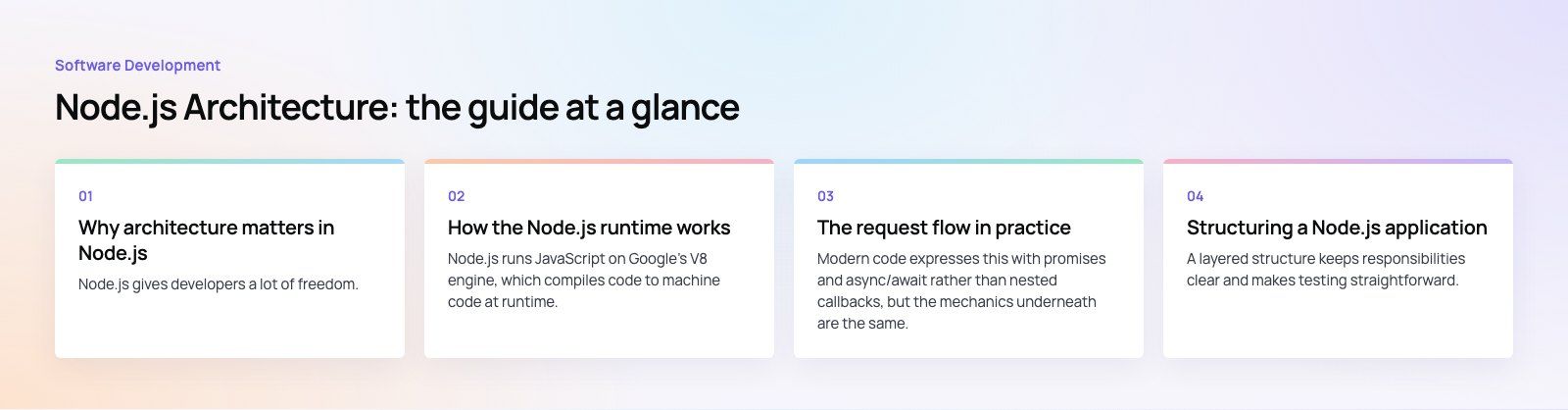
Structuring a Node.js application
A layered structure keeps responsibilities clear and makes testing straightforward.
| Layer | Responsibility | Should not contain |
|---|---|---|
| Routes | Map URLs and methods to controllers | Business rules or database queries |
| Middleware | Authentication, validation, logging, rate limiting, error handling | Feature specific logic |
| Controllers | Read the request, call services, shape the response | Direct database access |
| Services | Business logic and rules | Knowledge of HTTP requests or responses |
| Data access | Queries, repositories, ORM models | Business decisions |
| Configuration | Environment variables and secrets, loaded once | Hard coded credentials |
Group code by feature, such as orders, users and payments, with the layers inside each feature. That keeps related files together and makes it easier to split a feature into its own service later.
Middleware as a pipeline
Frameworks such as Express, Fastify and NestJS pass each request through a chain of middleware functions. Put cross cutting concerns there, including authentication, input validation, request logging and a central error handler, so individual routes stay small.
Useful design patterns
- Module pattern to keep each file focused and its internals private.
- Dependency injection so services receive their database client or mailer, which makes them easy to test.
- Observer pattern through Node's EventEmitter for decoupled reactions to events.
- Repository pattern to hide the database behind a clean interface.
Monolith, modular monolith or microservices
Node.js works well for microservices because each service is small and starts quickly. That does not mean every project should start with them. A modular monolith, one deployable application with strict boundaries between features, is usually the better first step. It avoids network calls, distributed tracing and separate deployments until you actually need them. When one feature has very different scaling or release needs, split it out.
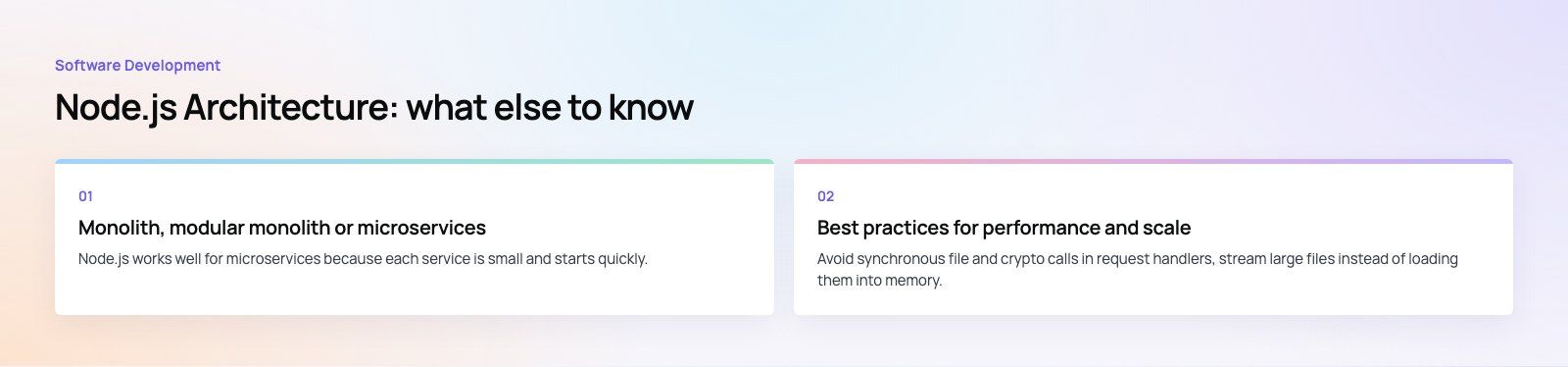
Best practices for performance and scale
Keep the event loop free
Avoid synchronous file and crypto calls in request handlers, stream large files instead of loading them into memory, and move CPU heavy jobs to worker threads or a background queue.
Cache deliberately
Cache expensive query results and external API responses in memory or in a store such as Redis, with clear expiry rules. Use HTTP cache headers for responses that can be shared.
Optimize database access
Most slow Node.js apps are slow in the database. Add the right indexes, avoid one query per row, use connection pooling and paginate large results.
Scale horizontally
Run several Node.js processes, one per CPU core with the cluster module or a process manager, and several instances behind a load balancer. Keep the application stateless by storing sessions and uploads outside the process so any instance can serve any request.
Monitor everything
Track response times, error rates, memory use and event loop lag. Tools such as PM2 help manage processes, and OpenTelemetry based monitoring gives traces across services.
Treat security as part of the design
Validate all input, use parameterized queries, keep secrets in environment variables or a vault, enforce HTTPS, set rate limits and keep dependencies patched. The Node.js security best practices page is a solid checklist. Run on a long term support release from the Node.js release schedule.
When Node.js is the wrong fit
Node.js is a weak choice for services that are mostly heavy computation, such as video encoding or large scale numerical work, unless that work is moved to workers or a separate service in another language. It shines for APIs, real time chat and notifications, streaming, backends for mobile apps and server rendered web front ends.
If you have an existing Node.js codebase that has become hard to change, a codebase review is a quick way to find the structural problems worth fixing first.
Codeeo's team of 80+ across Dubai, Riyadh and Karachi builds Node.js APIs and backends for web and mobile products, such as the Spirit Check app. See our custom software development service or hire dedicated developers for your team.
Frequently asked questions
The event loop is the mechanism that lets Node.js handle many operations on a single JavaScript thread.
It repeatedly checks for completed events, such as finished database queries, timers or incoming requests, and runs the callback for each one. Because slow input and output happen in the background, the loop stays free to serve other requests as long as each callback finishes quickly.
Software DevelopmentSQL vs NoSQL Databases: Differences and How to ChooseHow SQL and NoSQL databases differ in data model, schema, scaling and consistency, where each one fits, and five questions to choose for your project. Software DevelopmentOpen Source Apps: Examples, Licenses and How to Build Your OwnWhat makes an app open source, well known examples, the steps to build your own, how to pick MIT, Apache or GPL, and when to customize instead.
 Software DevelopmentHow an Online HR Portal Improves Employee ExperienceWhat an online HR portal does, how self service improves employee experience, which features matter, and whether to buy, configure or build one.
Tell us what the business needs. We will tell you what to build first.
Schedule a free consultation and get a written recommendation, with costs, before you commit to anything.
Get in touchPROVEN RESULTS
4.7 / 5verified reviews on Google