 Software DevelopmentSQL vs NoSQL Databases: Differences and How to ChooseHow SQL and NoSQL databases differ in data model, schema, scaling and consistency, where each one fits, and five questions to choose for your project.
CodeeoInsightsSoftware Development
Node.js vs Django: Which Back End Should You Choose?
Node.js vs Django compared on architecture, security, development speed, scalability and performance, with clear guidance on which back end fits your project.
Choose Node.js when your back end is mostly about handling many simultaneous connections, real-time features and JavaScript across the whole stack. Choose Django when you want a structured Python framework with an admin panel, an ORM, authentication and strong security defaults built in, which suits data heavy and content heavy products. Both are mature and production ready, so the better pick usually comes down to the workload and your team's skills.
Below we compare them on architecture, security, development speed, scalability, performance and ecosystem, then match each to the projects it fits best.
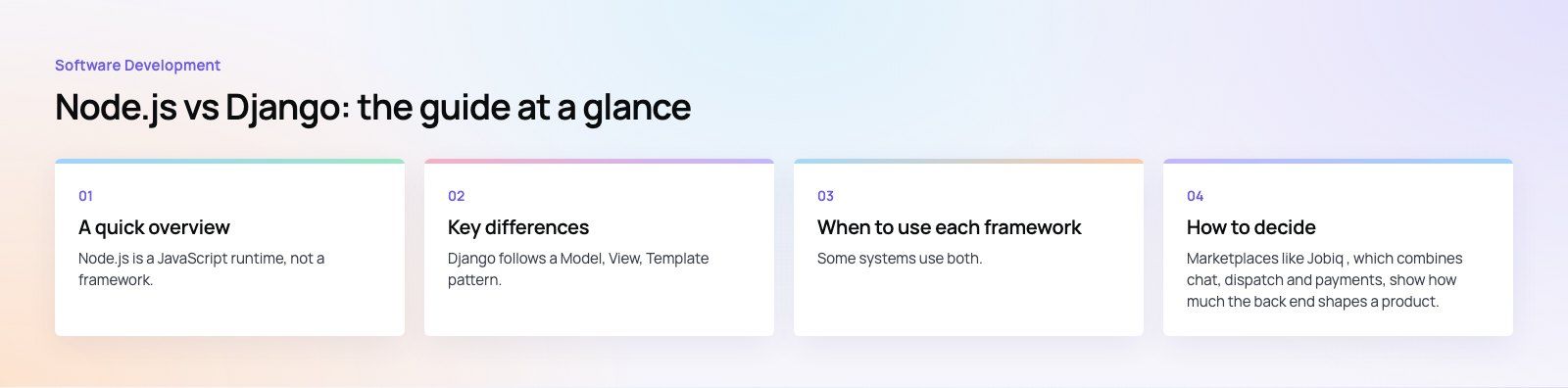
A quick overview
Node.js
Node.js is a JavaScript runtime, not a framework. It runs JavaScript on the server using an event driven, non-blocking model, as described on the Node.js project site. Developers add frameworks such as Express, Fastify or NestJS to get routing, middleware and structure. Because the runtime is minimal, a Node.js back end is assembled from packages chosen by the team.
Django
Django is a high level Python web framework. The Django project describes it as encouraging rapid development and clean, pragmatic design. It follows a "batteries included" approach: an ORM, migrations, authentication, an automatic admin interface, forms and templating all come in the box.
| Aspect | Node.js | Django |
|---|---|---|
| Type | JavaScript runtime, frameworks added on top | Full Python web framework |
| Language | JavaScript or TypeScript | Python |
| Concurrency model | Single event loop, non-blocking I/O | Request per worker, with async support for some views |
| Built-in features | Minimal, chosen from packages | ORM, admin, auth, forms, migrations |
| Strengths | Real-time apps, APIs, streaming | Data models, admin tools, content, rapid CRUD |
| Learning curve | Easy start, harder to structure at scale | More upfront concepts, consistent once learned |
Key differences
Architecture
Django follows a Model, View, Template pattern. Models define data and map to database tables, views hold request logic and templates render HTML. Many teams use Django REST Framework on top to build JSON APIs. The structure is the same across Django projects, which makes it easy for a new developer to find their way around.
Node.js has no fixed architecture. A small Express API is a handful of files, while NestJS adds modules, controllers and dependency injection similar to larger frameworks. This flexibility is powerful, but each team must make and document its own structural decisions.
Security
Django ships with protection against common attacks, including cross-site scripting, cross-site request forgery, SQL injection and clickjacking. The Django security documentation explains each one. Developers have to switch these protections off deliberately.
Node.js security depends on the framework and packages you choose. Secure Node.js apps are common, but they rely on the team adding the right middleware, validating input and keeping dependencies patched. The large package ecosystem also means more third-party code to audit.
Development speed
For applications built around data models, Django is often faster to a first working version. Defining a model gives you database tables, migrations and an admin screen to manage records with very little extra code.
Node.js is quick for APIs, prototypes and real-time features, especially when the front end team already writes JavaScript or TypeScript. Time goes into choosing and wiring libraries for things Django provides by default, such as authentication and admin tools.
Complexity
Django asks you to learn its conventions up front, but then stays predictable as the project grows. Node.js is easy to start, yet large codebases can become inconsistent without strong conventions, linting and TypeScript.
Scalability
Both scale horizontally by running more instances behind a load balancer. Node.js handles large numbers of concurrent, mostly idle connections efficiently, which suits chat, notifications and live updates. It fits naturally with microservices, where each small service runs its own process.
Django scales well for typical web traffic by adding application workers, caching and database tuning. Long lived connections such as WebSockets need Django Channels or a separate service, which adds moving parts.
Performance
Node.js performs very well on I/O bound work, such as calling databases and other APIs, because the event loop never sits waiting. It is weaker at CPU heavy tasks on the main thread, which block every other request until they finish.
Django performance is usually limited by database queries rather than Python itself. Careful query design, caching and background workers such as Celery for slow jobs keep Django apps fast. Python's data and machine learning libraries also make it easy to run analysis close to the data.
In practice, database design, caching and hosting affect speed far more than the choice between these two.
Cost and hiring
Neither has license costs. The cost difference comes from development time and hiring. JavaScript developers are plentiful, and one language across front end and back end can reduce team size. Python developers are also widely available and often bring data skills. Django's built-in features can reduce custom code, which lowers maintenance over time.
Community and ecosystem
Node.js has the npm registry, a very large package ecosystem that covers almost any integration you might need. Django has a smaller but well curated ecosystem and benefits from the wider Python community in data science, automation and AI.
When to use each framework
Choose Node.js for
- Real-time products: chat, live tracking, collaborative tools and notifications
- APIs serving web and mobile apps, especially with a JavaScript or TypeScript front end
- Microservices and lightweight integration services
- Streaming data and event driven systems
- Server-side rendering for React based front ends
Choose Django for
- Data driven applications with many related models, such as booking, inventory or records systems
- Content platforms and internal tools that benefit from the built-in admin
- Products that need strong security defaults with a small team
- Projects that sit close to data analysis, reporting or machine learning in Python
- Fast MVPs where a working admin and database layer save weeks
Using both
Some systems use both. A Django service might own the core data and admin, while a Node.js service handles real-time messaging and notifications. That split adds operational overhead, so it only makes sense when each part clearly benefits.

How to decide
- Describe the workload. Many live connections point to Node.js. Many data models and admin screens point to Django.
- Check your team. A strong JavaScript team will ship faster on Node.js, and a Python team will ship faster on Django.
- List what you would build from scratch. If you need authentication, admin and permissions on day one, Django gives you most of it.
- Think about integrations. Check that the payment providers, CRMs and services you rely on have maintained libraries in your chosen language.
- Plan for maintenance. Pick conventions, testing and dependency updates as part of the decision, not after launch.
Marketplaces like Jobiq, which combines chat, dispatch and payments, show how much the back end shapes a product. If you want help choosing, a product scoping session maps your features to the right stack. Codeeo has delivered 200+ projects across the UAE and the US, and our custom software team builds back ends for web and mobile apps, or you can add dedicated developers to your own team.
Frequently asked questions
For I/O heavy work with many concurrent connections, such as chat or live updates, Node.js usually handles more requests with fewer resources because of its non-blocking event loop.
For typical database driven pages, the difference is small and depends far more on query design, caching and hosting. CPU heavy work is a weak spot for Node.js unless it is moved to worker threads.
Software DevelopmentSQL vs NoSQL Databases: Differences and How to ChooseHow SQL and NoSQL databases differ in data model, schema, scaling and consistency, where each one fits, and five questions to choose for your project. Software DevelopmentOpen Source Apps: Examples, Licenses and How to Build Your OwnWhat makes an app open source, well known examples, the steps to build your own, how to pick MIT, Apache or GPL, and when to customize instead.
 Software DevelopmentHow an Online HR Portal Improves Employee ExperienceWhat an online HR portal does, how self service improves employee experience, which features matter, and whether to buy, configure or build one.
Tell us what the business needs. We will tell you what to build first.
Schedule a free consultation and get a written recommendation, with costs, before you commit to anything.
Get in touchPROVEN RESULTS
4.7 / 5verified reviews on Google