 InsightsHow Employee Engagement Drives Business PerformanceHow employee engagement affects profit, productivity, absence, retention, customers and innovation, what the evidence says, and how to link it to results.
How Performance Management Drives Employee Engagement
How to turn performance management into an engagement tool: shared goals, continuous feedback, timely recognition, development and the right measures.
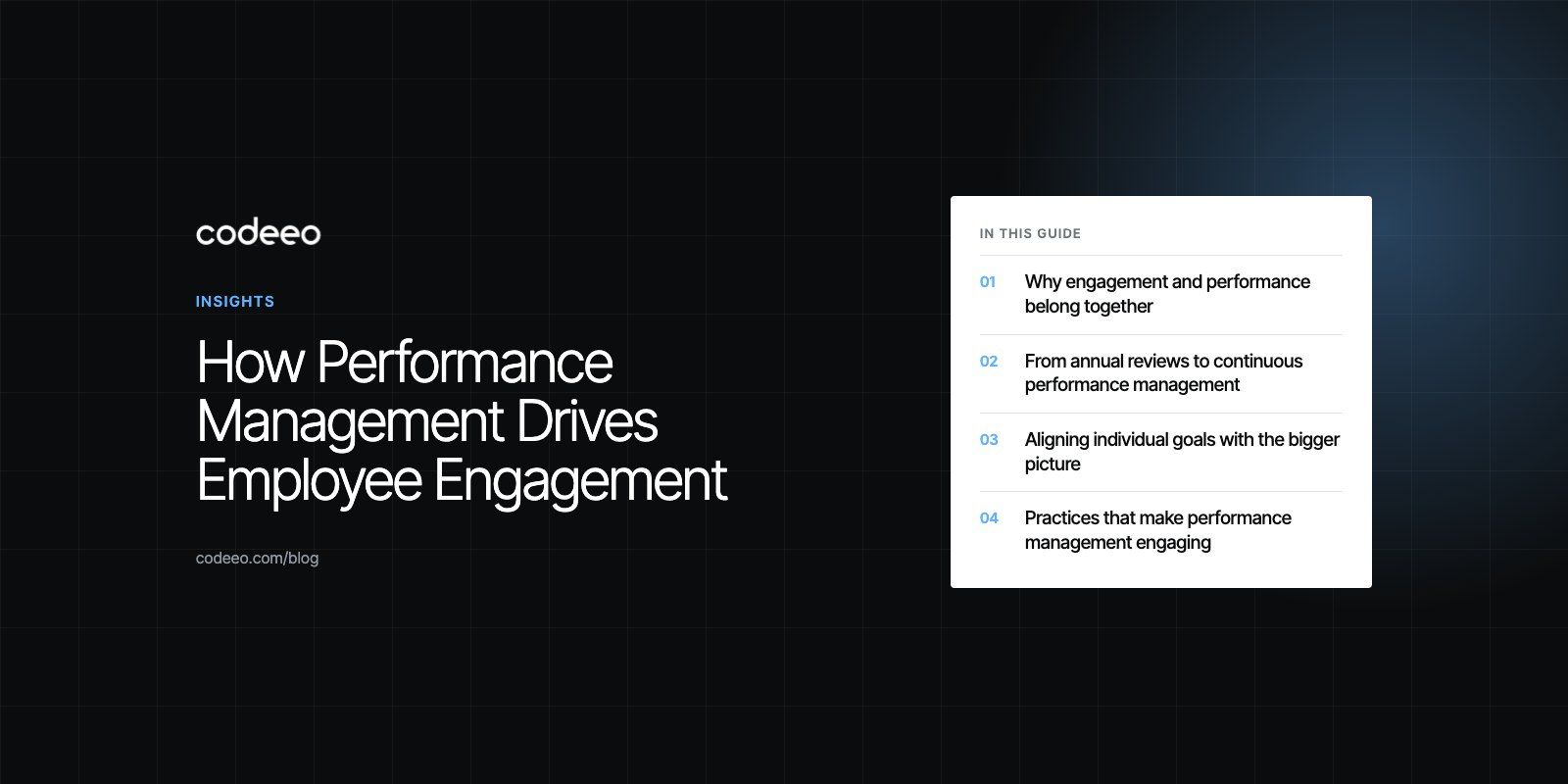
Performance management raises employee engagement when it stops being a once a year judgment and becomes a regular conversation about clear goals, progress and growth. The formula is simple: set goals people helped shape and can connect to the company's direction, give feedback often, recognize good work quickly and invest in each person's development. Done this way, performance management becomes one of the strongest engagement tools a company has.
This article explains how the two connect, the practices that make the biggest difference, what disengagement costs, and how to measure whether your approach is working.
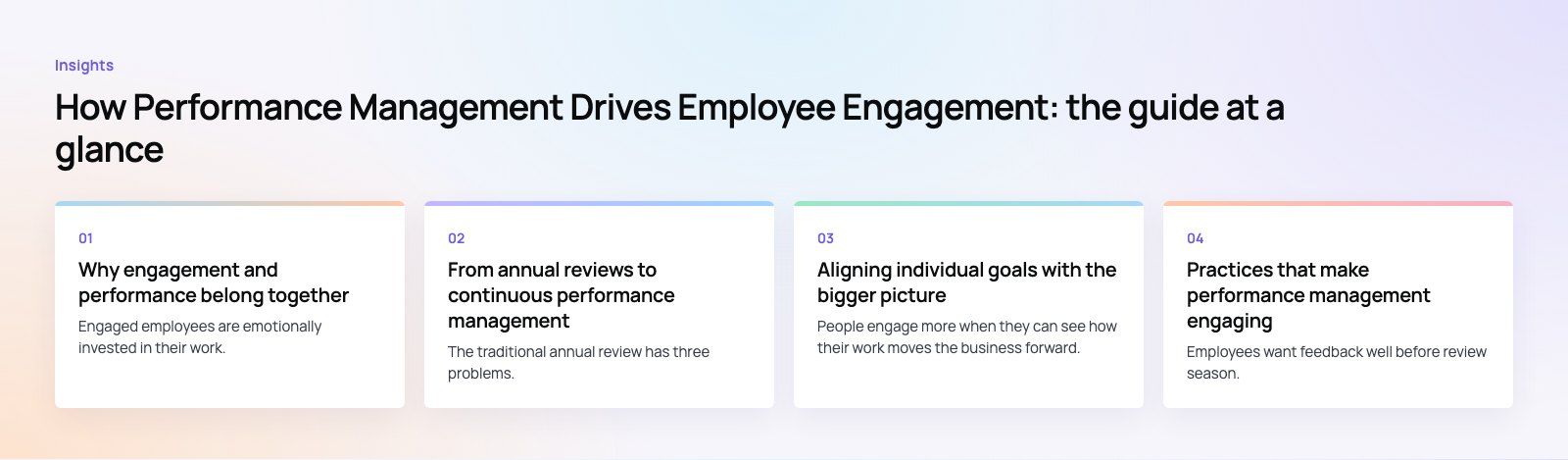
Why engagement and performance belong together
Engaged employees are emotionally invested in their work. They understand what good looks like, care about the result and put in effort beyond the minimum. Performance management is the system that defines what good looks like and tracks progress toward it. When the system is fair and useful, it feeds engagement. When it feels like a bureaucratic ritual, it drains it.
The commercial link is well documented. Gallup's 2024 Q12 meta-analysis of more than 180,000 teams found that, compared with the bottom quartile, teams in the top quartile for engagement showed median differences of 23% in profitability, 18% in sales productivity and 78% in absenteeism, along with lower turnover.
From annual reviews to continuous performance management
The traditional annual review has three problems. Feedback arrives months after the work it refers to. Managers rely on memory, so recent events dominate. And because pay and promotion often hang on a single meeting, both sides go in defensive.
| Element | Annual review model | Continuous model |
|---|---|---|
| Goal setting | Set once, often top down | Set together, revisited each quarter |
| Feedback | Once or twice a year | Weekly or fortnightly one to ones |
| Recognition | Saved for the review | Given close to the moment |
| Development | A line on the form | A plan reviewed with the manager |
| Employee role | Receives a rating | Shapes goals and reports progress |
| Effect on engagement | Often negative or neutral | Usually positive when managers are trained |
Continuous does not mean constant. It means short, regular check ins, a quarterly look at goals, and a fuller review once or twice a year that summarizes conversations that have already happened.
Aligning individual goals with the bigger picture
People engage more when they can see how their work moves the business forward. Picture a marketer who sets a personal goal of mastering social advertising while the company's plan for the year depends on email and partnerships. The skill is valuable, but the effort does not land where the company needs it, and the person may feel overlooked when results are reviewed.
Cascade goals from the top
Start with a small number of company objectives. Break them into team objectives, then individual goals. Everyone should be able to trace a line from their own work to a company priority.
Set goals together
Goals handed down in silence get compliance, not commitment. Ask each person what they think they can contribute and how their strengths fit. People own goals they helped write.
Use SMART goals
Specific, measurable, achievable, relevant and time bound goals remove ambiguity. "Improve customer service" becomes "reduce average first reply time on support tickets to under four hours by the end of the quarter."
Check in regularly
Short one to one meetings let managers spot blockers early and adjust goals when priorities change, so nobody spends three months on work that no longer matters.
Practices that make performance management engaging
Open, two way feedback
Employees want feedback well before review season. Encourage managers to give it close to the moment and to ask for it in return. Feedback that only flows downward feels like surveillance.
Recognition that is specific and timely
Recognition is a strong motivator when it names what the person did and why it mattered. Public praise in team meetings, peer recognition channels and small gestures all help. Many HR platforms now let colleagues send quick shout outs to each other, which spreads recognition beyond the manager.
Separate development from pay conversations
When the same meeting decides salary and discusses weaknesses, people focus on the money and hide the weaknesses. Holding growth conversations separately makes them more honest.
Train managers
Most of the engagement effect of performance management depends on the manager running it. Training managers to coach, set goals and handle difficult conversations is often a better investment than a new review form.
Investing in your people
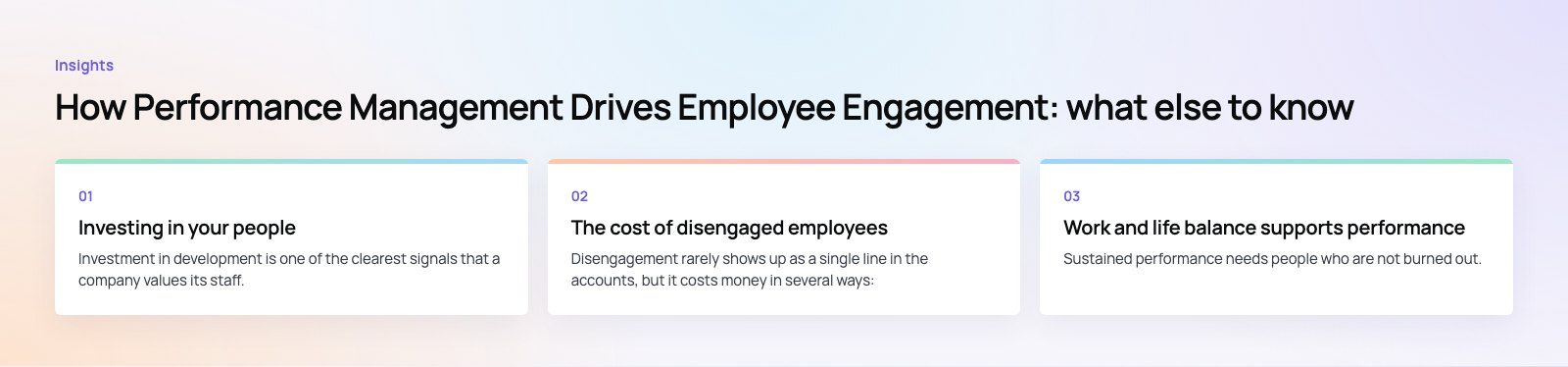
Investment in development is one of the clearest signals that a company values its staff.
- Training and development: workshops, online courses and support for qualifications keep skills current and show commitment to people's futures.
- Mentoring: pairing experienced colleagues with newer ones speeds up learning and builds connections across teams.
- Career development plans: working with each person on where they want to go, and what it takes to get there, gives them a reason to stay.
- Personal recognition: marking work anniversaries and personal milestones shows people are seen as individuals, not just headcount.
Technology can help here. A learning platform tracks courses and progress, while an internal app or portal can bring goals, feedback and recognition into one place staff actually open. If your current tools make this harder, a custom software build or a well configured Power Platform workflow can close the gap.
The cost of disengaged employees
Disengagement rarely shows up as a single line in the accounts, but it costs money in several ways:
- Lower productivity: disengaged people do what is required and little more.
- More absence: unmotivated staff miss more days, which disrupts teams and adds cover costs.
- Higher turnover: people who are not engaged leave sooner, and every departure brings hiring and training costs plus lost knowledge.
- Weaker customer experience: customers can usually tell when the person serving them does not care.
The scale is large. Gallup's State of the Global Workplace 2026 report found global engagement fell to 20% in 2025, which means most employees in most companies are not engaged.
Work and life balance supports performance
Sustained performance needs people who are not burned out. Practical steps include:
- Flexible schedules or remote options where the role allows.
- Actively encouraging people to take their leave.
- Clear norms on after hours messages.
- Wellbeing support, such as fitness programs or access to mental health resources.
How to measure whether it is working
Track a handful of measures before and after you change your approach:
- Engagement survey scores, broken down by team and manager.
- Goal completion rates and the share of goals linked to company objectives.
- Frequency of one to one meetings actually held.
- Voluntary turnover, especially among high performers.
- Internal promotion and transfer rates.
Pulling these from separate HR, survey and payroll tools is often the hardest part. A Power BI dashboard that joins them gives leaders a single view and makes trends obvious.
Codeeo builds the internal tools and reporting that make continuous performance management practical, from goal tracking apps to leadership dashboards. With 200+ projects delivered across the UAE and the US, our team can help you scope what you need. Start with a product scoping session.
Frequently asked questions
It is an approach that uses performance management to raise engagement rather than only to rate people.
It combines goals that employees help set and can link to company priorities, frequent feedback, timely recognition and genuine investment in development. The aim is for the process itself to motivate people, so that better engagement and better performance reinforce each other over time.
InsightsHow Employee Engagement Drives Business PerformanceHow employee engagement affects profit, productivity, absence, retention, customers and innovation, what the evidence says, and how to link it to results. InsightsThe Five Functions of Human Resource Management ExplainedThe five core functions of human resource management: recruitment, training, performance, compensation and employee relations, with practices and pitfalls.
 InsightsPerformance Management and Employee Engagement: A Practical GuideHow to run performance management that raises engagement: frequent check ins, specific recognition, growth plans, a strengths based approach and who owns what.
Tell us what the business needs. We will tell you what to build first.
Schedule a free consultation and get a written recommendation, with costs, before you commit to anything.
Get in touchPROVEN RESULTS
4.7 / 5verified reviews on Google