 InsightsHow Employee Engagement Drives Business PerformanceHow employee engagement affects profit, productivity, absence, retention, customers and innovation, what the evidence says, and how to link it to results.
Project Management Checklist: Every Phase From Kickoff to Closure
A practical project management checklist for every phase, from initiation and planning to monitoring and closure, with ways to adapt it to your project.
A project management checklist is a list of the decisions and tasks every project needs at each phase: initiation, planning, execution, monitoring and closure. Working through it makes sure nothing obvious is missed, such as an unnamed decision maker, an unestimated dependency or a launch with no sign off. The checklist below is a general framework you can copy and adapt to any project size.
It is written with software, website and digital projects in mind, but the phases apply to almost any piece of work with a deadline, a budget and more than one person involved.
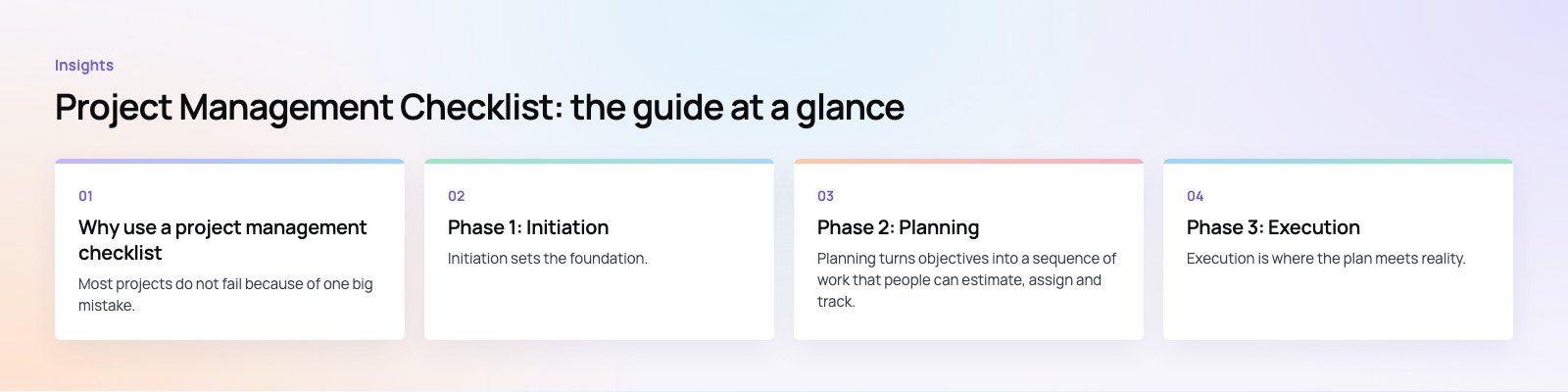
Why use a project management checklist
Most projects do not fail because of one big mistake. They drift because small things were assumed rather than agreed: who approves designs, what "done" means, which features are in the first release. A checklist turns those assumptions into explicit items that someone has to tick off.
- It gives every stakeholder the same picture of what happens next.
- It makes gaps visible early, when they are cheap to fix.
- It speeds up the next project, because the team starts from a proven list instead of a blank page.
Phase 1: Initiation
Initiation sets the foundation. Skipping it is the most common reason projects change direction halfway through.
Define the problem and the objectives
Write down, in one or two sentences, what problem the project solves and what success looks like. Then turn that into objectives that are specific, measurable, achievable, relevant and time bound (SMART). "Improve the website" is not an objective. "Launch a new quote request flow on the website by the end of the quarter and track submissions in the CRM" is.
Identify stakeholders
List everyone who is affected by the project or can affect it: sponsors, end users, internal teams, vendors and, where relevant, regulators. For each one, record their role, what they expect and how they prefer to be kept informed. This stakeholder register is short work that prevents long arguments later.
Initiation checklist
- Problem statement written and agreed
- SMART objectives and success measures defined
- Project sponsor and final decision maker named
- Stakeholder register created
- High level scope, budget envelope and target date agreed
- Known constraints and assumptions recorded
Phase 2: Planning
Planning turns objectives into a sequence of work that people can estimate, assign and track. For software and app work, a short product scoping exercise at this stage often saves weeks later.
Build a work breakdown structure
A work breakdown structure (WBS) splits the project into deliverables, then into tasks small enough to estimate with confidence. A good rule is that no task should be so large that nobody can say whether it is half done. Mind mapping tools, spreadsheets or any project management tool will do the job.
Map dependencies and estimate durations
For each task, ask what must finish before it can start. Then estimate how long it will take. The three point estimate is a practical method: record an optimistic, a most likely and a pessimistic duration, and use a weighted average. It forces the team to think about risk instead of quoting the best case.
Create the schedule
Lay the tasks out on a timeline with milestones. A Gantt chart shows dependencies and the critical path clearly. Agile teams may prefer a release plan made of sprints, with a backlog ordered by priority. The Scrum Guide is the official description of how sprints, backlogs and reviews fit together if you take that route.
Planning checklist
- Work breakdown structure complete
- Dependencies mapped and critical path identified
- Task estimates recorded, with assumptions
- Schedule or release plan with milestones published
- Roles and responsibilities assigned (a RACI chart works well)
- Budget broken down by phase or deliverable
- Definition of done agreed for each deliverable
Phase 3: Execution
Execution is where the plan meets reality. The two things that matter most are clear communication and the right people on the right tasks.
Set up one project system
Pick one place where tasks, files and decisions live. It matters less which tool you choose than that everyone uses the same one. Scattered spreadsheets, chat threads and email chains are where requirements get lost.
Allocate resources
Match tasks to people based on skills and availability, not just who is free. Watch for single points of failure: if one person holds all the knowledge about a critical system, plan for cover. When internal capacity runs short, dedicated developers or other specialist support can fill gaps without disrupting the core team.
Agree a communication plan
Decide who gets what update, how often and through which channel. A typical pattern is a short daily check in for the delivery team, a weekly status note for stakeholders and a monthly review with the sponsor.
Execution checklist
- Project tool set up and shared with everyone involved
- Team onboarded, with access to all systems they need
- Communication plan published
- Change request process agreed
- Decision log started
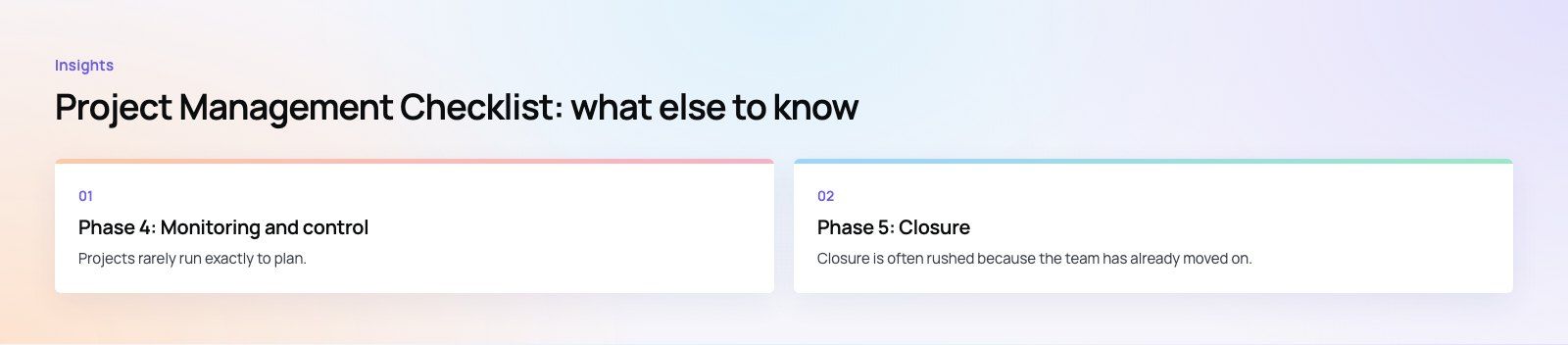
Phase 4: Monitoring and control
Projects rarely run exactly to plan. This phase is about spotting deviations early and correcting course before they become expensive.
Manage risks actively
Keep a risk register: each risk, its likelihood, its impact, its owner and the plan to reduce it. Typical risks in digital projects include unclear requirements, third party integrations that behave differently from their documentation, late content and key people leaving. Review the register in a short team session every couple of weeks.
Track progress against the baseline
Compare actual progress with the plan you agreed: tasks completed, milestones hit, budget spent. Small slips are normal. A consistent pattern of slips means the estimates or the scope need to be revisited openly, not absorbed quietly by the team working longer hours.
Control scope
Every new request should go through the change process: what it adds, what it costs in time and money, and what it pushes back. Scope creep is one of the most common reasons projects run late.
Monitoring checklist
- Risk register reviewed on a set schedule
- Progress compared with baseline every week
- Budget spend tracked against plan
- Change requests logged, assessed and approved or rejected
- Quality checks and testing built into each milestone
- Regular team meetings to unblock work
Phase 5: Closure
Closure is often rushed because the team has already moved on. It is worth doing properly, because it is where the organization learns.
Confirm the outcomes
Check each deliverable against the objectives and success measures set during initiation. Get formal sign off from the sponsor.
Hand over and close admin
Hand over documentation, credentials and support arrangements to whoever owns the result next. Close contracts, reconcile the budget and archive project files where they can be found later.
Run a retrospective
Hold a short, blame free review: what went well, what did not, and what to change next time. Write the lessons down and feed them back into your checklist template.
Closure checklist
- Deliverables accepted and signed off
- Documentation and access handed over
- Support and maintenance arrangements confirmed
- Contracts closed and budget reconciled
- Retrospective held and lessons recorded
- Checklist template updated
Adapting the checklist to your project
| Project type | What to emphasize | What to lighten |
|---|---|---|
| Small internal project | Clear objective, one owner, a simple task list | Formal stakeholder register and detailed reporting |
| Website build or redesign | Content ownership, approvals, launch and redirect plan | Heavy upfront estimation of every task |
| App or custom software | Scoping, dependencies, testing, release planning | Rigid fixed schedules for later phases |
| Multi vendor program | Contracts, communication plan, risk register, change control | Very little: every phase matters here |
Whichever method you use, keep the Agile Manifesto idea in mind that working results and responding to change matter more than following a plan to the letter. The checklist is there to support judgment, not replace it.
Putting it to work
A checklist is only useful if it is used at the start of each phase and reviewed at the end. Codeeo has a team of 80+ across Dubai, Riyadh and Karachi and has delivered 200+ projects across the UAE and the US. If you are planning a website, app or software build and want a delivery partner that works from a clear plan, see our custom software development service or browse our case studies.
Frequently asked questions
A useful checklist covers five phases.
Initiation sets objectives and names stakeholders. Planning builds the work breakdown, estimates and schedule. Execution sets up tools, people and communication. Monitoring tracks progress, risks and scope changes. Closure confirms outcomes, hands over and captures lessons. Each phase should end with a short list of items that must be complete before moving on.
InsightsHow Employee Engagement Drives Business PerformanceHow employee engagement affects profit, productivity, absence, retention, customers and innovation, what the evidence says, and how to link it to results. InsightsThe Five Functions of Human Resource Management ExplainedThe five core functions of human resource management: recruitment, training, performance, compensation and employee relations, with practices and pitfalls.
 InsightsPerformance Management and Employee Engagement: A Practical GuideHow to run performance management that raises engagement: frequent check ins, specific recognition, growth plans, a strengths based approach and who owns what.
Tell us what the business needs. We will tell you what to build first.
Schedule a free consultation and get a written recommendation, with costs, before you commit to anything.
Get in touchPROVEN RESULTS
4.7 / 5verified reviews on Google