 InsightsHow Employee Engagement Drives Business PerformanceHow employee engagement affects profit, productivity, absence, retention, customers and innovation, what the evidence says, and how to link it to results.
Project Management Consultancy: How It Improves Delivery
What a project management consultancy does, the bottlenecks it fixes, how an engagement works and how to choose a partner that leaves your team stronger.
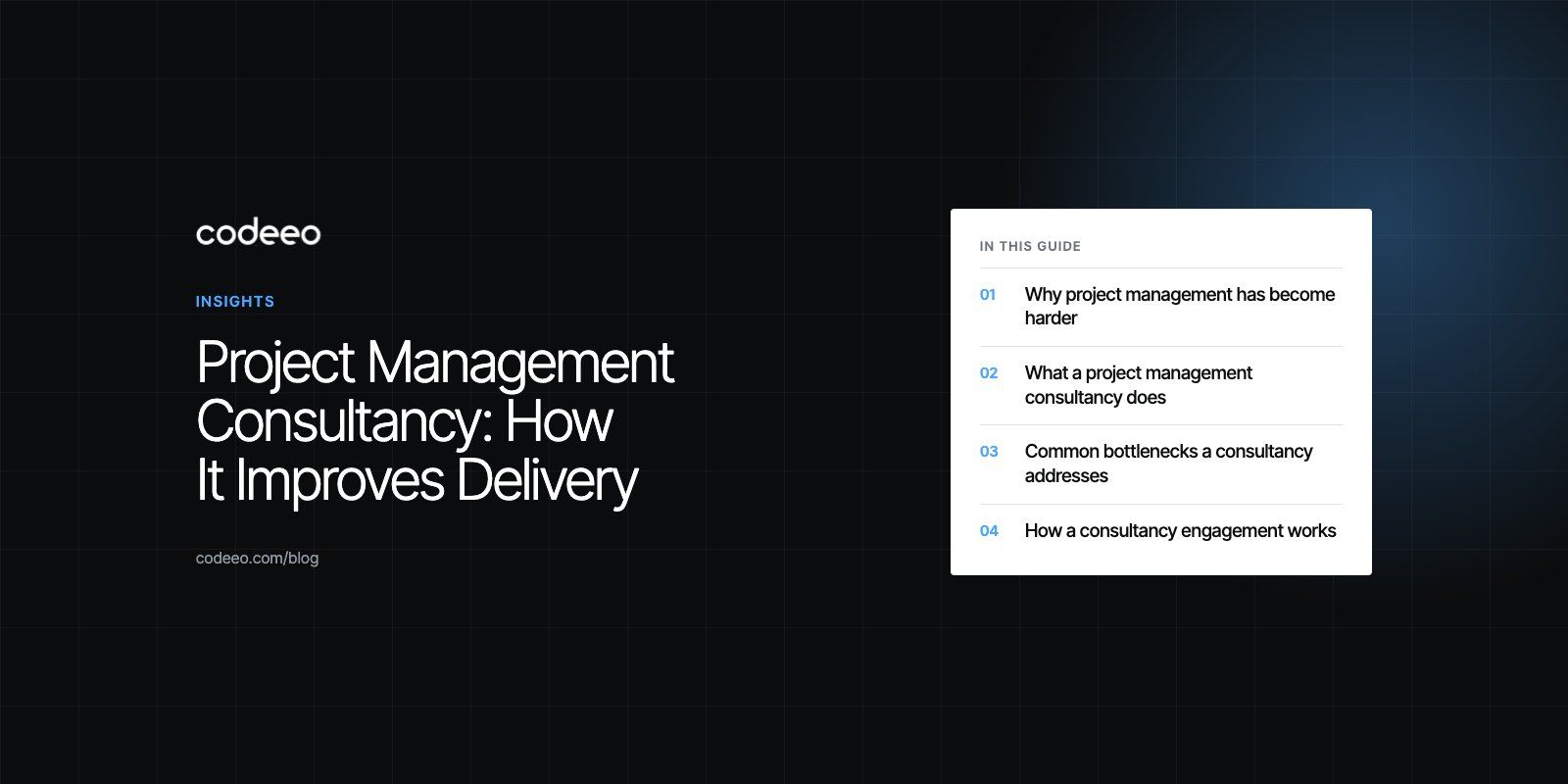
A project management consultancy helps an organization deliver projects more reliably by assessing how work is currently planned, staffed and tracked, finding the bottlenecks, and putting better methods and tools in place. Consultants bring an outside view and experience from many projects, then help your team adopt practices that cut delays, rework and budget overruns. The aim is lasting improvement in how your own people run projects, not a dependency on the consultant.
This guide covers why project management has become harder, the problems a consultancy typically solves, how an engagement works, what improves and how to choose the right partner.
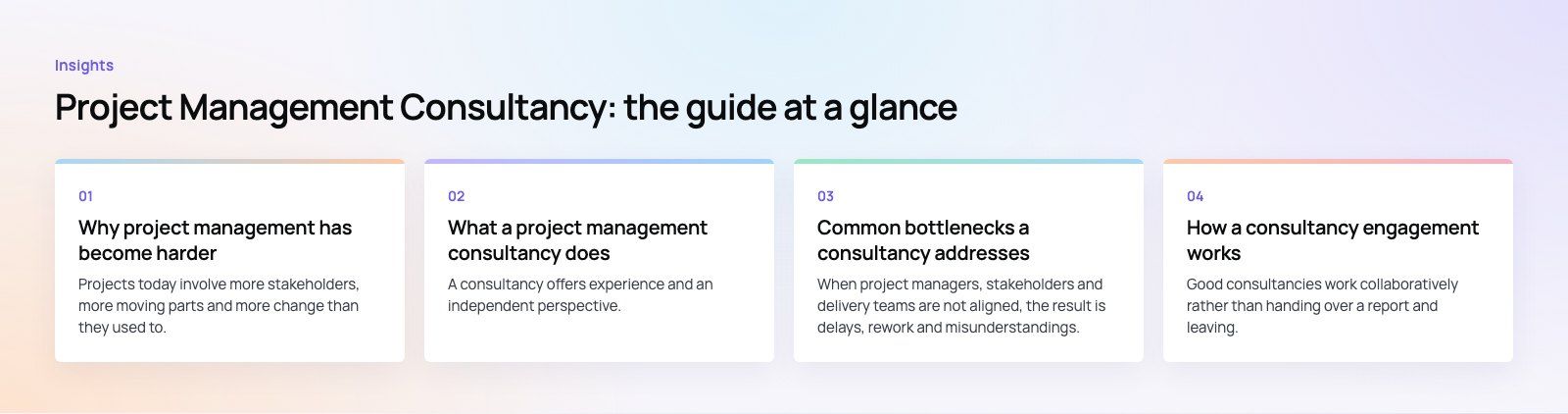
Why project management has become harder
Projects today involve more stakeholders, more moving parts and more change than they used to. Teams are often spread across offices, time zones and remote setups. Technology changes during the life of a project, and requirements shift as markets move.
Rigid, document heavy approaches struggle in that environment. So do informal approaches that worked when the company was small. Software and digital projects feel this most, because scope is hard to pin down and dependencies between teams are easy to miss. That is why many organizations bring in outside help to reset how projects are run.
What a project management consultancy does
A consultancy offers experience and an independent perspective. Internal teams are often too close to their own processes to see where time and money leak away. Consultants have seen similar problems across many organizations and know which fixes tend to work.
Typical services include:
- Assessing project management maturity and current practices.
- Designing or improving planning, reporting and governance processes.
- Introducing or refining methodologies such as Waterfall, Agile or a hybrid.
- Selecting and setting up project management software.
- Rescuing projects that are late, over budget or stalled.
- Training project managers and teams, and coaching leaders.
- Setting up a project management office to standardize practices across the organization.
Common bottlenecks a consultancy addresses
Poor communication
When project managers, stakeholders and delivery teams are not aligned, the result is delays, rework and misunderstandings. Decisions get made in one meeting and never reach the people who need them.
Scope creep
Uncontrolled changes to scope stretch timelines and budgets. Without a clear change process, small requests add up until the original plan no longer describes the project.
Resource allocation problems
Overloaded specialists, idle teams and people assigned to work outside their skills all lead to missed deadlines and lower quality. The problem is often invisible until a project slips.
Decisions without data
When progress, effort and risk are not measured, decisions rely on instinct. Problems surface late, when they are expensive to fix.
Weak risk management
Risks that nobody records are risks nobody manages. Teams react to issues instead of preparing for them.
How a consultancy engagement works
Good consultancies work collaboratively rather than handing over a report and leaving. A typical engagement follows these steps:
- Discovery. Consultants interview stakeholders, review active and recent projects, and analyze timelines, resourcing and outcomes.
- Process mapping. They document how work actually flows today, from request to delivery, and where it stalls.
- Diagnosis. Findings are prioritized by impact and effort, so the organization knows what to fix first.
- Improvement plan. Together with your team, they design changes to methods, roles, tools and governance that fit your size and culture.
- Implementation. Consultants help roll out the changes, often starting with a pilot project.
- Handover. Training, templates and coaching leave your team able to run the new approach without outside help.
Key areas a consultancy improves
Project planning and execution
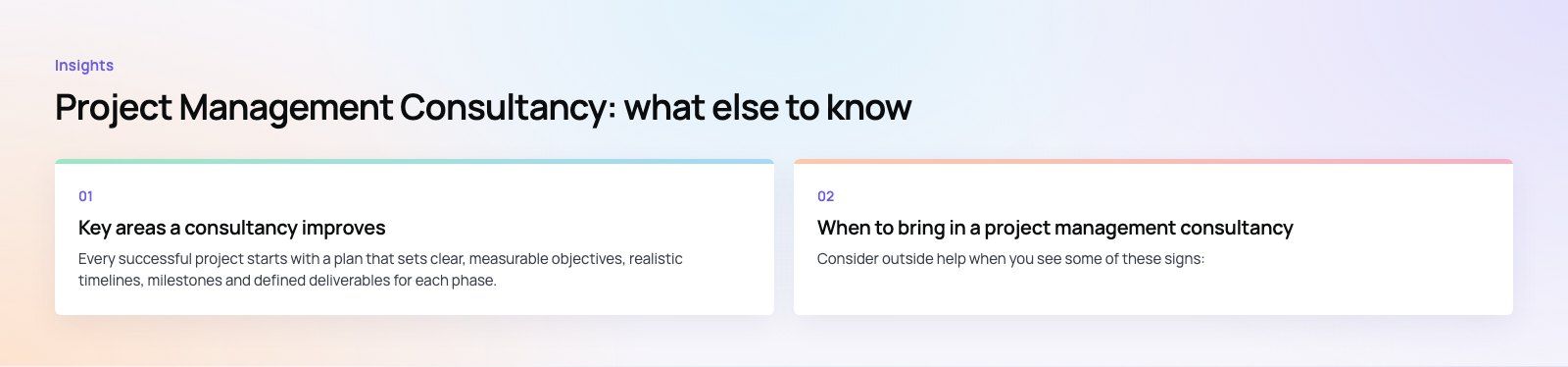
Every successful project starts with a plan that sets clear, measurable objectives, realistic timelines, milestones and defined deliverables for each phase. Consultants help choose the right approach for each type of work. Waterfall suits projects with fixed, well understood requirements. Agile methods, built on the principles in the Manifesto for Agile Software Development, suit work where requirements are expected to change and value should be delivered in small increments. Many organizations use a hybrid.
Team collaboration and resource management
Consultants assess workload, skills and project demand to put the right people on the right tasks. They often recommend project management software for task tracking, capacity planning and real time collaboration, which matters most when teams are distributed.
Communication and governance
Clear reporting rhythms, defined decision rights and agreed communication channels keep clients, team members and managers informed. Status reports become short and consistent rather than long and inconsistent.
Risk management
A practical risk register, regular risk reviews and contingency plans help teams spot problems early and limit their impact when they occur.
Reporting and data
Dashboards that pull from project tools give leaders a reliable view of progress, budget and risk across the portfolio, so decisions rest on facts rather than impressions.
The benefits of better project efficiency
| Area | What improves |
|---|---|
| Productivity | Clearer priorities and smoother workflows mean projects finish sooner with the same people |
| Cost control | Less rework, fewer overruns and better resource use reduce wasted spend |
| Client satisfaction | Predictable delivery and clear communication build trust and repeat work |
| Team morale | Realistic plans and fewer emergencies reduce burnout and improve collaboration |
| Adaptability | Teams that are not constantly firefighting have time to try new ideas and respond to change |
| Risk | Problems are found earlier and handled with a plan rather than a scramble |
| Reputation | Consistent delivery strengthens the brand with clients, partners and job candidates |
| Scalability | Standard processes let the organization take on larger and more complex projects |
When to bring in a project management consultancy
Consider outside help when you see some of these signs:
- Several projects in a row have finished late or over budget.
- Leaders cannot get a clear picture of project status without chasing people.
- Each team runs projects differently and handoffs keep failing.
- You are about to start a large program, such as a system migration or digital product launch, without in-house experience at that scale.
- A key project is in trouble and needs an independent assessment.
- You are adopting Agile or a new tool and want it to stick.
How to choose the right consultancy
- Relevant experience. Ask for examples in your industry and type of project, such as software delivery, construction or organizational change.
- Method neutrality. Be wary of a consultancy that applies one framework to every client. The approach should fit your work.
- Knowledge transfer. Ask how they will train your people and when the engagement ends.
- Clear outcomes. Agree up front on what success looks like, such as on time delivery rates or reporting quality.
- Cultural fit. Consultants must work well with your team, or the changes will not last.
- References. Speak to past clients about what changed after the consultants left.
Mistakes to avoid
- Buying tools before fixing process. Software amplifies whatever process you already have, good or bad.
- Changing everything at once. Start with a pilot, learn and then expand.
- Leaving leadership out. If executives keep bypassing the new process, nobody else will follow it.
- Ending without a handover. Without training and ownership, teams drift back to old habits.
For software and digital programs, much of the gain comes from scoping work properly before it starts. Codeeo's product scoping sessions do exactly that, our custom software teams plan and deliver against clear milestones, and dedicated teams or dedicated developers can add delivery capacity. Reporting across projects can be built with Power BI, drawing on experience from 200+ projects delivered across the UAE and the US.
Frequently asked questions
It is a specialist service that helps organizations improve how they plan, run and deliver projects.
Consultants assess current practices, identify bottlenecks such as poor communication, scope creep or weak resource planning, and introduce better methods, tools and governance. Good consultancies also train internal teams so improvements last after the engagement ends, rather than leaving the organization dependent on outside help.
InsightsHow Employee Engagement Drives Business PerformanceHow employee engagement affects profit, productivity, absence, retention, customers and innovation, what the evidence says, and how to link it to results. InsightsThe Five Functions of Human Resource Management ExplainedThe five core functions of human resource management: recruitment, training, performance, compensation and employee relations, with practices and pitfalls.
 InsightsPerformance Management and Employee Engagement: A Practical GuideHow to run performance management that raises engagement: frequent check ins, specific recognition, growth plans, a strengths based approach and who owns what.
Tell us what the business needs. We will tell you what to build first.
Schedule a free consultation and get a written recommendation, with costs, before you commit to anything.
Get in touchPROVEN RESULTS
4.7 / 5verified reviews on Google