 SEOHow to Optimize Your Website for Search EnginesA practical guide to optimizing a website for search engines: technical health, mobile first indexing, on page content, earning links and measuring results.
SEO Best Practices to Improve Website Rankings Across Your Site
A site-wide guide to SEO best practices: technical foundations, keyword and intent mapping, content, links and measurement, in the order that works.
To improve website rankings, make sure search engines can crawl and index every important page, match each page to one clear search intent, write content that answers that intent better than the pages already ranking, and earn links from sites your audience trusts. Then measure what happens in Google Search Console and repeat. SEO best practices are less about tricks and more about doing these basics consistently across the whole site.
This guide works at the level of the whole website rather than a single page. It covers the order to tackle things in, what each area involves, and the mistakes that quietly hold sites back.
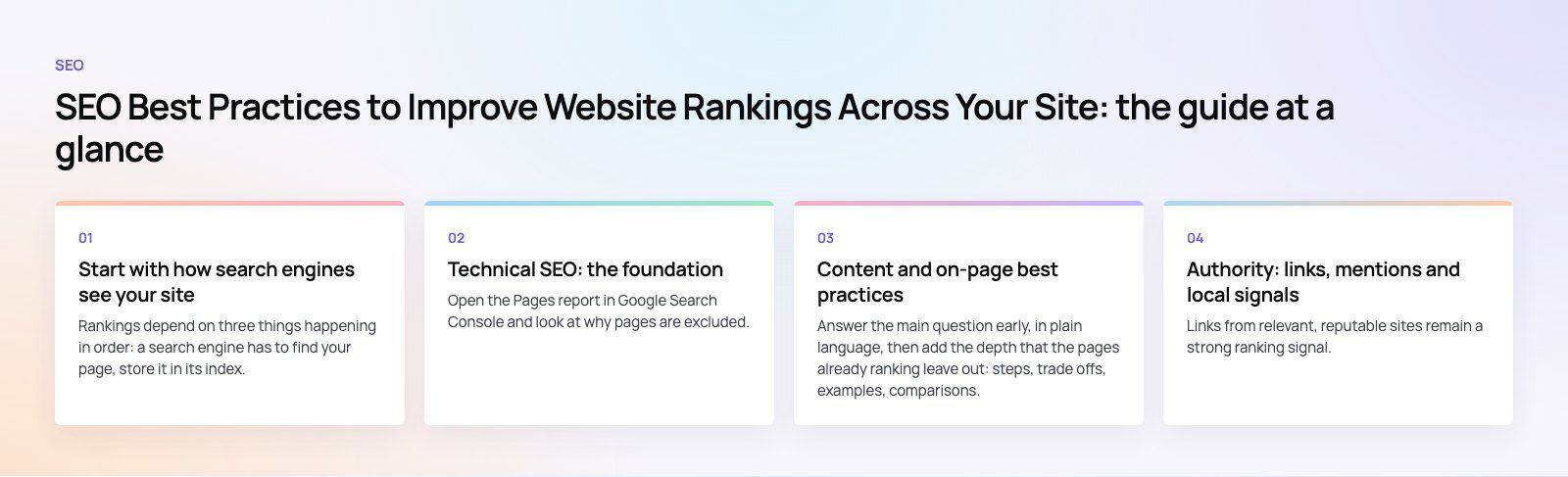
Start with how search engines see your site
Rankings depend on three things happening in order: a search engine has to find your page, store it in its index, and then decide it is the best answer for a query. Most sites lose ground at the first two steps without noticing. Google explains the full process in its SEO Starter Guide, and it is worth reading once before spending money on anything else.
A practical way to think about best practice is as four layers, each depending on the one beneath it:
| Layer | What it covers | Typical problem when it is missing |
|---|---|---|
| Technical foundation | Crawling, indexing, speed, mobile, HTTPS, site structure | Good pages that never appear in results |
| Keyword and intent mapping | Which page targets which search, and why | Several pages competing for the same query |
| Content and on-page signals | Titles, headings, body copy, internal links, structured data | Pages that rank on page three and stay there |
| Authority | Links, mentions, reviews, local listings | Strong content outranked by better known sites |
Fixing the layers in this order saves effort. Building links to a page Google cannot index wastes every one of them.
Technical SEO: the foundation
Crawling and indexing
Open the Pages report in Google Search Console and look at why pages are excluded. Common causes are a stray noindex tag left over from a staging site, robots.txt rules that block whole folders, canonical tags pointing at the wrong URL, and redirect chains. Your XML sitemap should list only live, indexable pages that return a 200 status.
Site structure
Important pages should be reachable within a few clicks of the homepage, grouped under clear sections, with URLs that read like folders a person would understand. Orphan pages, which no other page links to, are hard for crawlers to find and rarely rank.
Speed and Core Web Vitals
Google measures real user experience through Core Web Vitals. According to web.dev (2026), a good experience means Largest Contentful Paint within 2.5 seconds, Interaction to Next Paint of 200 milliseconds or less, and Cumulative Layout Shift of 0.1 or less, measured at the 75th percentile of page loads. The usual culprits are oversized images, heavy third party scripts, render blocking fonts and slow hosting. Our Core Web Vitals service focuses on exactly these fixes.
Mobile and security
Google indexes the mobile version of your pages, so content hidden or trimmed on mobile may as well not exist. Every page should load over HTTPS, and mixed content warnings should be cleared.
Keyword research and intent mapping
Find what your audience actually searches
Tools such as Google Keyword Planner, Semrush or Ahrefs show search demand, but the most reliable source is often your own Search Console data: it lists the queries already bringing impressions. Sales and support teams are another rich source, because the questions customers ask on calls are usually the questions they type into search.
Match each keyword to intent
Search the keyword yourself and look at what ranks. If the results are guides, a sales page will struggle. If the results are service pages, a blog post will struggle. The format that already ranks is the format Google believes answers the query.
Build a keyword map
Assign one primary topic to each page and record it in a simple spreadsheet. This prevents keyword cannibalization, where two of your own pages split the signals for the same query and neither ranks well. When you find overlap, merge the weaker page into the stronger one and redirect it.
Content and on-page best practices
Write for the question, then for the crawler
Answer the main question early, in plain language, then add the depth that the pages already ranking leave out: steps, trade offs, examples, comparisons. Google's guidance on helpful content rewards pages written for people first. Thin pages that exist only to target a keyword variation tend to drag down the whole site.
Titles, descriptions and headings
- Put the main topic near the start of the title tag and keep it readable.
- Write meta descriptions that tell the searcher what they will get. They do not affect rankings directly, but they affect clicks.
- Use one clear page heading and organize the rest with H2 and H3 headings that describe each section.
- Use descriptive alt text on images that carry meaning.
Internal links
Internal links tell search engines which pages matter and how topics relate. Link from strong, well visited pages to the pages you want to rank, using anchor text that describes the destination. A guide on site structure should link to your services page on structure, and the service page should link back.
Structured data
Schema markup for organizations, articles, products, FAQs and local businesses helps search engines understand a page and can make it eligible for richer results. Validate it with Google's Rich Results Test before relying on it.
Keep content fresh where it matters
Pages that mention prices, regulations, versions or dates go stale. Review them on a schedule and update the substance, not just the date.
Authority: links, mentions and local signals
Earn links rather than buy them
Links from relevant, reputable sites remain a strong ranking signal. The safest ways to earn them are useful assets people want to cite, such as original data, tools, calculators and detailed guides, plus genuine relationships with partners, suppliers and industry associations. Paid link schemes and private blog networks breach Google's spam policies and can trigger manual actions.
Local SEO
If you serve customers in a specific city, your Google Business Profile, consistent name, address and phone details across directories, and genuine reviews often matter more than backlinks. Our local SEO team works on these signals for service businesses.
Measuring and tracking SEO performance
Measure what search actually delivers, not vanity numbers:
- Google Search Console: impressions, clicks, average position and click through rate by query and page, plus indexing and Core Web Vitals reports.
- Google Analytics 4: organic sessions, engagement and, most importantly, conversions such as form submissions and calls.
- Rank tracking: useful for trends on priority keywords, but treat single day positions as noise.
Review monthly. When a page gains impressions but not clicks, rewrite its title and description. When it ranks in positions 8 to 20, improve the content and add internal links. When it loses ground, check whether a competitor published something more complete or whether the intent of the search changed.
A practical order of work
- Run a technical crawl and fix indexing blockers first.
- Build the keyword map and resolve cannibalization.
- Improve the ten pages closest to page one, since they move fastest.
- Fix speed and mobile issues on your highest value templates.
- Publish new content only where the map shows a genuine gap.
- Build authority through partners, listings and assets worth linking to.
- Measure, then repeat the cycle each quarter.
If you want an outside view of where your site stands, a technical SEO review is a sensible first step before committing to a longer program.
Mistakes that hold rankings back
- Publishing volume over value. Dozens of near identical pages dilute the site and can be treated as low quality.
- Redesigning without redirects. A new site that changes URLs without mapping old ones loses years of earned signals overnight.
- Ignoring the mobile version. Desktop audits miss problems that real visitors and Google both see.
- Chasing keywords with the wrong intent. A service page will not rank for a query where every result is a how to guide.
- Stopping after launch. SEO compounds. Sites that review and improve every quarter steadily pull ahead of sites that optimized once.
SEO works best when it is built into the site rather than added afterward. Our digital marketing team runs technical fixes, content planning and measurement together, and our web development team builds sites with these foundations in place from the first release. Across 200+ projects delivered in the UAE and the US, the pattern is the same: the sites that rank are the ones that keep improving.
Frequently asked questions
Technical fixes such as removing an accidental noindex tag can show results within weeks, once Google recrawls the affected pages.
Content and authority work usually takes several months to show steady gains, because search engines need time to recrawl, reassess and compare your pages with competitors. Competitive topics take longer than niche ones. Track impressions in Search Console first, since they rise before clicks and rankings do.
SEOHow to Optimize Your Website for Search EnginesA practical guide to optimizing a website for search engines: technical health, mobile first indexing, on page content, earning links and measuring results. SEOTechnical SEO vs On-Page SEO: Differences and How They Work TogetherTechnical SEO gets your pages indexed; on-page SEO makes them rank. See what each covers, where they overlap and the order to fix problems in.
 SEOWordPress SEO Tips: A Practical Checklist to Improve RankingsA practical WordPress SEO checklist: plugin setup, site structure, keyword intent, titles, speed, mobile, schema, monitoring and the mistakes that hold sites back.
Tell us what the business needs. We will tell you what to build first.
Schedule a free consultation and get a written recommendation, with costs, before you commit to anything.
Get in touchPROVEN RESULTS
4.7 / 5verified reviews on Google