 SEOHow to Optimize Your Website for Search EnginesA practical guide to optimizing a website for search engines: technical health, mobile first indexing, on page content, earning links and measuring results.
How to Build an SEO Friendly Website Structure
How to organize pages, internal links, URLs, sitemaps and robots.txt so search engines can crawl every page and visitors find what they need fast.
An SEO friendly website structure groups pages into a clear hierarchy, keeps every important page within a few clicks of the home page, links related pages to each other, and uses short descriptive URLs that mirror that hierarchy. That lets search engines find and understand every page, spreads authority from your strongest pages to the rest, and helps visitors reach what they came for quickly.
Structure is easiest to get right before a site is built and hardest to fix afterwards. This guide covers the main structure types, the technical pieces that help search engines crawl your site, and the practical steps to plan or repair an architecture.
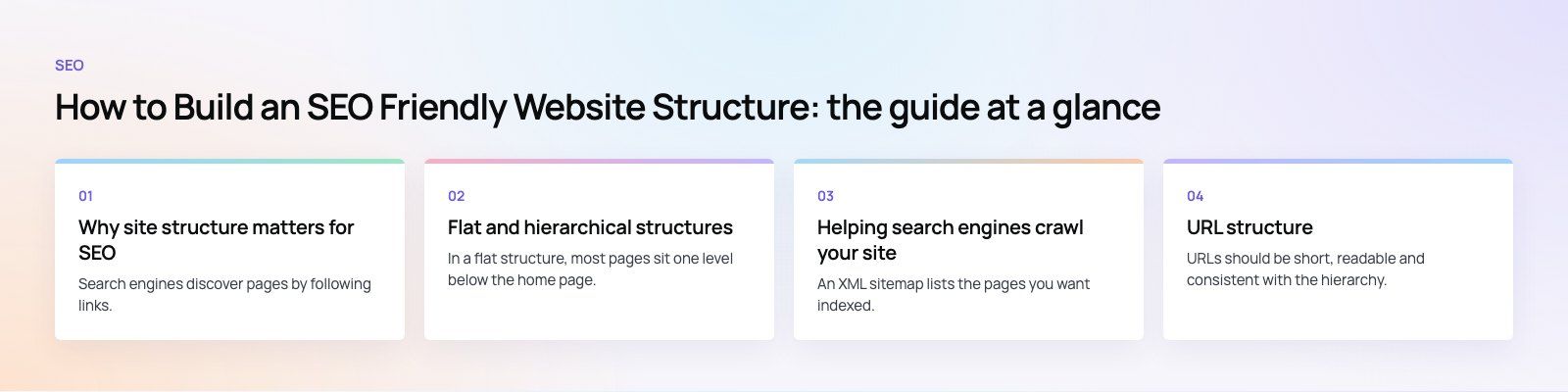
Why site structure matters for SEO
Search engines discover pages by following links. If a page is buried deep, or linked from nowhere, it may be crawled rarely or not at all. Structure also tells search engines which pages matter most and how topics relate to each other.
- Crawlability. A clear structure means crawlers reach every important page efficiently.
- Topical relevance. Grouping related pages signals what each section of the site is about.
- Link equity. Internal links pass authority from strong pages, such as the home page, to the pages you want to rank.
- User experience. Visitors find what they need with fewer clicks, which keeps them on the site.
Google's own SEO starter guide recommends organizing a site so that related content is grouped and easy to navigate. It is one of the few SEO fundamentals that has not changed in years.
Flat and hierarchical structures
Flat structure
In a flat structure, most pages sit one level below the home page. It is simple and works for small sites with a handful of pages, such as a local service business. As the site grows, a flat structure becomes a long, unsorted list: menus get crowded, and nothing signals which pages belong together.
Hierarchical structure
A hierarchical structure, sometimes called a silo or hub and spoke model, starts with the home page, branches into main categories, then into subcategories and individual pages. Most business sites, online stores and content sites use some version of it, because it scales and makes topics obvious.
| Structure | Best for | Strengths | Weaknesses |
|---|---|---|---|
| Flat | Small sites with few pages | Simple, every page close to the home page | Becomes disorganized as the site grows |
| Hierarchical | Business sites, stores, blogs | Clear topics, scales well, focused link equity | Pages can end up buried if the hierarchy is too deep |
| Hybrid | Growing sites | Hierarchy for organization, shortcuts to key pages | Needs discipline to stay tidy |
The best practical answer is usually a shallow hierarchy: clear categories, but no important page more than about three clicks from the home page.
Helping search engines crawl your site
XML sitemaps
An XML sitemap lists the pages you want indexed. It helps search engines discover pages, especially new ones or those with few internal links. Include only canonical, indexable pages that return a 200 status, keep it updated automatically, and submit it in Search Console. Google's sitemap documentation notes that it ignores the priority and changefreq values, so do not spend time tuning them; an accurate lastmod date is more useful.
Robots.txt
The robots.txt file tells crawlers which areas they should not crawl, such as admin sections, internal search results or endless filter combinations. Use it to save crawl effort, not to hide pages. Google's robots.txt guide is clear that it is not a way to keep a page out of search results; use a noindex tag for that.
Internal linking
Internal links are the backbone of structure. Every page should be reachable through normal navigation or contextual links, and no important page should be an orphan with no links pointing to it.
- Link from category pages to their subpages, and from subpages back up.
- Link between related pages in the body text, using descriptive anchor text rather than "click here".
- Link from your strongest pages, often the home page and popular articles, to pages you want to rank.
- Use breadcrumbs so both visitors and crawlers see where a page sits in the hierarchy.
URL structure
URLs should be short, readable and consistent with the hierarchy. A good URL tells a person what the page is about before they click.
- Use lowercase letters and hyphens between words.
- Include the main topic of the page, without stuffing keywords.
- Reflect the hierarchy where it helps, for example a service page inside a services folder.
- Avoid dates, session IDs and long parameter strings in URLs you want indexed.
- Do not change URLs without reason. When you must, add permanent redirects from the old address.
User experience signals that support structure
Mobile friendly design
Google uses the mobile version of a page for indexing, so your mobile navigation must expose the same structure and links as desktop. A menu that hides whole sections on phones hides them from search too.
Fast loading
Slow pages frustrate visitors and waste crawl resources. Speed and structure work together: a lean, well organized site is usually also a fast one.
Clear navigation
Keep the main menu focused on your core categories. Use plain labels people actually search for, not clever internal names.
Content structure on each page
Structure applies inside pages too. Use one main heading, then H2 and H3 subheadings that follow a logical order. Short paragraphs, lists and tables make content easier to scan for people and easier to interpret for search engines. Clean, semantic HTML, with real headings, lists and links rather than styled boxes, helps crawlers understand the page and keeps it accessible.
How to plan or fix your site structure
- Research keywords and topics. Group related searches into themes. Each theme becomes a category or hub page.
- Map pages to topics. Give each page one clear purpose, and avoid two pages targeting the same search.
- Sketch the hierarchy. Home page, categories, subpages. Check that nothing important is more than about three clicks deep.
- Plan internal links from hubs to spokes, between related spokes and back up to hubs.
- Set URL rules before building, and keep them consistent.
- Crawl the site with an SEO crawler to find orphan pages, broken links, redirect chains and deep pages.
- Watch Search Console for pages that are discovered but not indexed, which often points to weak internal linking.

Tools for analyzing site structure
- Google Search Console shows indexing status, crawl issues, sitemaps and internal links.
- Google Analytics shows how visitors move through the site and where they leave.
- SEO crawlers map every page, its click depth, its links and its status code.
Common structure mistakes
- Orphan pages that no other page links to.
- Hierarchies so deep that key pages sit five or more clicks from the home page.
- Several pages competing for the same topic.
- Faceted navigation creating thousands of thin, near duplicate URLs.
- Redesigns or migrations that change URLs without redirects.
Structure is not a one time task. Review it whenever you add a new section, launch a range of pages or see indexing drop.
If you are planning a new site or a migration, our web development team builds the structure, URLs and internal links in from the first sitemap, and our site migration work protects rankings with full redirect mapping. A technical SEO review will show where an existing site's structure is holding it back, and our digital marketing team can build on the result. The HMS case study shows a content managed site organized around several distinct sections.
Frequently asked questions
It is a way of organizing pages so that search engines and visitors can easily find and understand them.
In practice that means a shallow hierarchy of categories and pages, clear internal links between related content, descriptive URLs that reflect the hierarchy, and a sitemap listing every page you want indexed. No important page should be more than a few clicks from the home page.
SEOHow to Optimize Your Website for Search EnginesA practical guide to optimizing a website for search engines: technical health, mobile first indexing, on page content, earning links and measuring results. SEOTechnical SEO vs On-Page SEO: Differences and How They Work TogetherTechnical SEO gets your pages indexed; on-page SEO makes them rank. See what each covers, where they overlap and the order to fix problems in.
 SEOWordPress SEO Tips: A Practical Checklist to Improve RankingsA practical WordPress SEO checklist: plugin setup, site structure, keyword intent, titles, speed, mobile, schema, monitoring and the mistakes that hold sites back.
Tell us what the business needs. We will tell you what to build first.
Schedule a free consultation and get a written recommendation, with costs, before you commit to anything.
Get in touchPROVEN RESULTS
4.7 / 5verified reviews on Google