 Software DevelopmentSQL vs NoSQL Databases: Differences and How to ChooseHow SQL and NoSQL databases differ in data model, schema, scaling and consistency, where each one fits, and five questions to choose for your project.
CodeeoInsightsSoftware Development
Software Development Trends Worth Acting On in 2026
The software development trends that matter in 2026, from AI and cloud native to cross-platform apps, FinOps and supply chain security, and when to act.
The software development trends that matter most in 2026 are AI built into both the product and the development process, cloud native architecture, cross-platform apps, progressive web apps, tighter cost and carbon control in the cloud, and a much stronger focus on software supply chain security. None of these is new, but each has moved from experiment to normal practice. The useful question for a business is not which trend is exciting but which one changes what you should build next.
This guide walks through each trend, what it means in practice and when it is worth acting on.
The trends at a glance
| Trend | What it changes | Act on it when |
|---|---|---|
| AI in products and in development | New features such as search, summaries and assistants; faster coding and testing | You have repetitive text, support or data tasks, or a team writing a lot of routine code |
| Cloud native architecture | Containers, managed services and automated deployment | You release often or traffic varies a lot |
| Cross-platform mobile | One codebase for iOS and Android | You need both platforms and most screens are standard |
| Progressive web apps | App-like experience in the browser | Users visit occasionally and an app store install is a barrier |
| FinOps and GreenOps | Cloud cost and energy treated as engineering metrics | Your cloud bill is growing faster than usage |
| Supply chain security | Tracking every dependency in the software you ship | Always, and especially in regulated sectors |
| Python and data tooling | Faster data, automation and machine learning work | You have data you are not using yet |
1. AI inside products and inside the development process
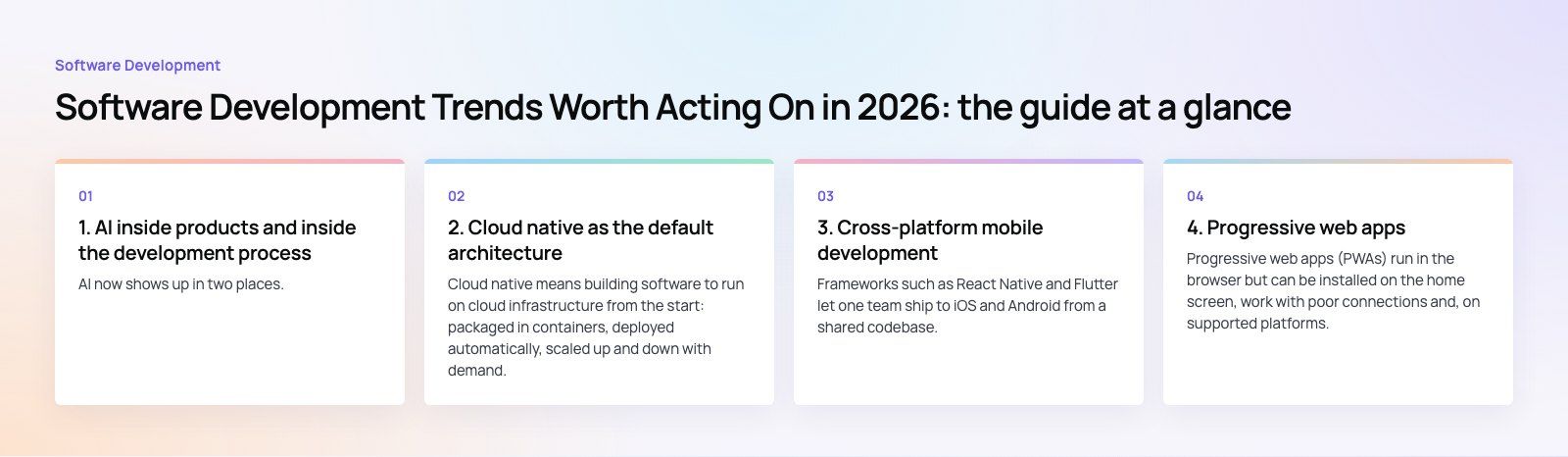
AI now shows up in two places. The first is the product itself: natural language search, document summaries, support assistants, recommendations and agents that complete multi step tasks. The second is the way software is built: code suggestions, test generation, documentation and code review support.
The practical lessons so far are fairly consistent. AI features work best on narrow, well defined jobs with clear data behind them. They need guardrails, logging and human review for anything with financial or legal consequences. And AI-assisted coding speeds up routine work but does not replace design decisions, code review or testing. A short product scoping exercise is a sensible way to test whether an AI feature is worth building.
Where to start
- Pick one workflow with a lot of repetitive reading or writing, such as support tickets or document intake.
- Measure the current time and error rate before you build, so you can tell whether the AI version is better.
- Keep a human approval step until the results are proven.
2. Cloud native as the default architecture
Cloud native means building software to run on cloud infrastructure from the start: packaged in containers, deployed automatically, scaled up and down with demand, and split into services where that genuinely helps. Kubernetes is the most common platform for running containers at scale, and its official overview is a good plain introduction.
The trend in 2026 is less about adopting microservices everywhere and more about choosing the right level of complexity. Many teams have learned that a well structured single application on managed cloud services is easier to run than dozens of small services. Split a system only where parts need to scale or release independently.
3. Cross-platform mobile development
Frameworks such as React Native and Flutter let one team ship to iOS and Android from a shared codebase. For most business apps, with forms, lists, accounts, payments and notifications, cross-platform delivery is now the sensible default because it reduces duplicated work and keeps both versions in step.
Native development still makes sense for apps that depend heavily on device hardware, advanced graphics or the very latest platform features. If you are unsure which approach suits your product, a platform fit review sets out the trade offs, and our mobile app development page explains how we approach both.
4. Progressive web apps
Progressive web apps (PWAs) run in the browser but can be installed on the home screen, work with poor connections and, on supported platforms, send push notifications. Google's web.dev guide to PWAs documents the capabilities and how to build them.
PWAs are a strong fit when people use your product occasionally, when you want one codebase for web and mobile, or when asking for an app store download would lose users. They are a weaker fit when you need deep device access or a strong presence in the app stores.
5. FinOps and GreenOps
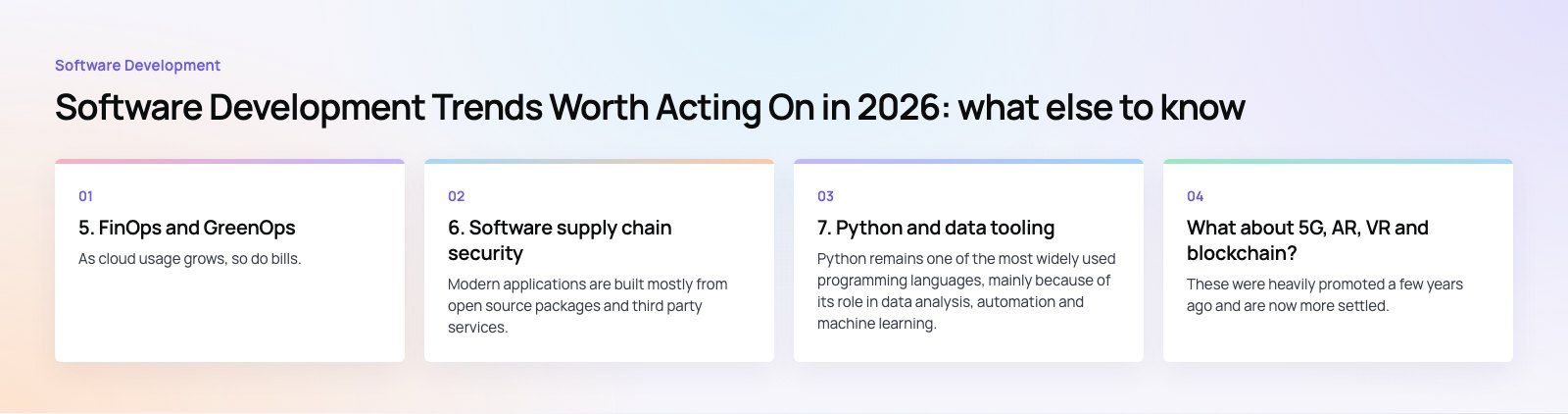
As cloud usage grows, so do bills. FinOps is the practice of making cloud cost a shared responsibility between engineering, finance and product teams, with clear visibility of who spends what and why. The FinOps Foundation defines the practice and its principles.
GreenOps applies the same thinking to energy use and carbon. In practice the two overlap heavily: switching off idle environments, right sizing servers, caching more and moving less data all cut both cost and emissions. The quickest wins usually come from simply tagging resources so every cost has an owner.
6. Software supply chain security
Modern applications are built mostly from open source packages and third party services. That makes every dependency a possible entry point for attackers. The trend is toward knowing exactly what is inside the software you ship, keeping a software bill of materials (SBOM), scanning dependencies automatically, signing builds and locking down CI/CD pipelines.
For most teams the starting point is straightforward: turn on automated dependency alerts, remove packages you no longer use, require code review on every change and restrict who can deploy to production. A codebase review is a quick way to find outdated dependencies and gaps in your pipeline.
7. Python and data tooling
Python remains one of the most widely used programming languages, mainly because of its role in data analysis, automation and machine learning. For businesses, the trend is not the language itself but what it makes practical: pulling data out of systems that do not talk to each other, automating reports, and preparing the clean data that any AI feature needs.
If you are planning AI work, the data preparation step usually takes longer than the model work. Getting your data into shape is the trend that makes most of the others possible.
What about 5G, AR, VR and blockchain?
These were heavily promoted a few years ago and are now more settled. Faster mobile networks help real time and media heavy apps, but most business software does not need to change because of them. AR and VR have found steady uses in training, retail product previews and property tours, though they remain specialist projects. Blockchain is useful where several parties need a shared record none of them controls, such as some supply chain and asset tracking cases, and is rarely the right answer for ordinary business data. Treat all three as tools for specific problems rather than general trends to follow.
How to decide which trends to act on
- Start from a business problem. Slow processes, poor customer experience or rising costs are better starting points than a technology name.
- Check your foundations. AI features need clean data; cloud native needs automated deployment; security needs basic hygiene first.
- Run a small pilot. Prove the value on one workflow or one product area before committing a large budget.
- Measure before and after. Decide in advance what improvement would justify a wider rollout.
- Plan for maintenance. Every new technology adds something to update, monitor and secure.
Building with these trends in mind
Trends only matter when they solve a real problem in your product or operations. Codeeo has delivered 200+ projects across the UAE and the US, and our team of 80+ across Dubai, Riyadh and Karachi builds web, mobile and back office software with these practices as standard. If you are planning a new system or modernizing an old one, our custom software development team can help you choose what to adopt now and what to leave for later.
Frequently asked questions
AI is the most visible trend, both as features inside products and as assistance for developers writing and testing code.
Its value depends on clear, narrow use cases and good data. For most businesses, the quieter trends such as cloud cost control and supply chain security deliver more dependable returns, and they are worth doing alongside any AI project.
Software DevelopmentSQL vs NoSQL Databases: Differences and How to ChooseHow SQL and NoSQL databases differ in data model, schema, scaling and consistency, where each one fits, and five questions to choose for your project. Software DevelopmentOpen Source Apps: Examples, Licenses and How to Build Your OwnWhat makes an app open source, well known examples, the steps to build your own, how to pick MIT, Apache or GPL, and when to customize instead.
 Software DevelopmentHow an Online HR Portal Improves Employee ExperienceWhat an online HR portal does, how self service improves employee experience, which features matter, and whether to buy, configure or build one.
Tell us what the business needs. We will tell you what to build first.
Schedule a free consultation and get a written recommendation, with costs, before you commit to anything.
Get in touchPROVEN RESULTS
4.7 / 5verified reviews on Google