 InsightsHow Employee Engagement Drives Business PerformanceHow employee engagement affects profit, productivity, absence, retention, customers and innovation, what the evidence says, and how to link it to results.
Web 1.0 vs Web 2.0 vs Web 3.0 vs Web 4.0 vs Web 5.0 Explained
Web 1.0 to Web 5.0 explained in plain terms: what each stage of the web means, how they compare, and what the shift means for business websites now.
Web 1.0 was the read only web of static pages, Web 2.0 is the social and interactive web most of us still use every day, and Web 3.0 describes a smarter or more decentralized web that is only partly here. Web 4.0 and Web 5.0 are not finished stages at all. They are labels people use for what might come next, such as AI agents that act for us and immersive spatial experiences. For a business, the practical lesson is that each stage added a new expectation from users, and your website has to meet all of them at once.
This guide explains each stage in plain terms, compares them side by side, and shows what the shift means for the websites and apps companies build today.
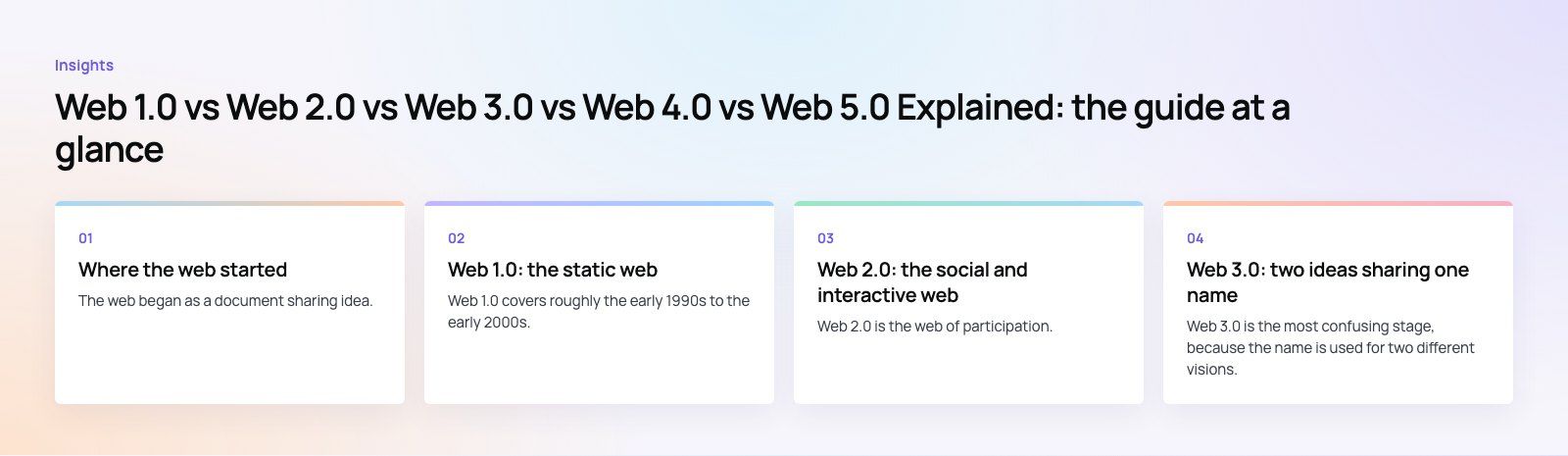
Where the web started
The web began as a document sharing idea. Tim Berners-Lee wrote his first proposal for it at CERN in March 1989, and by the end of 1990 the first web server and browser were running there, according to CERN's own short history of the web. CERN then released the software into the public domain in 1993, which is a large part of why the web spread so quickly.
The version numbers came later. Nobody launched "Web 1.0". People applied the label looking back, once the web of the mid 2000s felt different enough to need a name of its own. That matters, because it means these stages overlap. Static pages, social platforms and AI features all exist on the web at the same time.
Web 1.0: the static web
Web 1.0 covers roughly the early 1990s to the early 2000s. Sites were mostly static HTML pages written by a small number of publishers and read by everyone else. Connections were slow, images were small and interaction usually stopped at a link, a guestbook or a simple contact form.
What defined it
- One way communication: the site owner published and visitors read.
- Pages built by hand in HTML, often with little separation between content and layout.
- Directories and early search engines as the main way to find anything.
- Very basic online selling, usually a catalog with an order form or a phone number.
Even so, Web 1.0 changed how information moved. A small business could suddenly be found by people far outside its town, which had never been possible before.
Web 2.0: the social and interactive web
Web 2.0 is the web of participation. From the mid 2000s, sites became applications. Users wrote reviews, uploaded photos and videos, commented, shared and built profiles. Blogs, wikis, social networks, marketplaces and streaming services grew from this model.
What made it possible
- Browser technologies that let a page update without a full reload, so sites could feel like software.
- Content management systems that let non technical teams publish without touching code.
- Smartphones and app stores, which moved much of the web into people's pockets.
- Open APIs, so services could plug into one another for payments, maps, sign in and messaging.
The trade off was concentration. A few large platforms came to hold most of the content and most of the data, which is the problem later ideas of the web try to answer.
Web 3.0: two ideas sharing one name
Web 3.0 is the most confusing stage, because the name is used for two different visions.
The semantic web
The first meaning comes from Berners-Lee himself: a web where data carries meaning that machines can read. Instead of a page simply showing the words "opening hours", the page states in a structured way that this is a business, these are its hours and this is its address. Much of this vision quietly arrived. Structured data, knowledge graphs and the rich results you see in search engines all depend on it.
The decentralized web
The second meaning, often written "Web3", refers to a web built on blockchains, where users hold their own digital assets and identities through wallets instead of trusting one platform. Cryptocurrencies, tokens and decentralized apps belong here. Adoption is real in some niches, such as payments and digital ownership, but most everyday web activity still runs on conventional platforms.
For most businesses, the semantic meaning matters far more today. Clear, structured content helps search engines and AI assistants understand what you offer, and that has a direct effect on whether people find you.
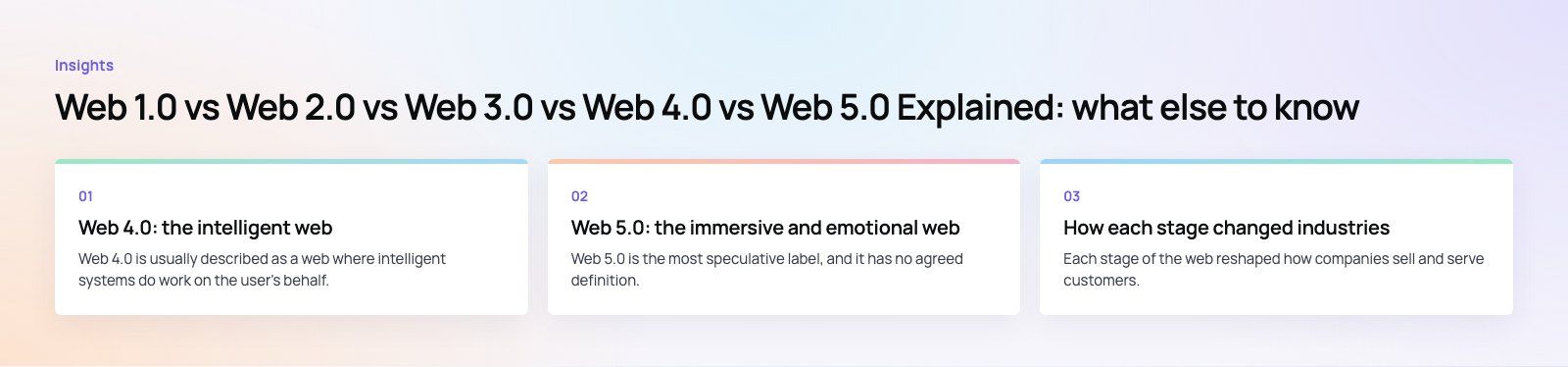
Web 4.0: the intelligent web
Web 4.0 is usually described as a web where intelligent systems do work on the user's behalf. Instead of searching, comparing and booking by hand, a person asks an assistant and the assistant finds options, fills forms and reports back. Connected devices, sensors and machine learning feed it the context it needs.
Parts of this are already visible. AI assistants answer questions directly, recommendation engines shape what people see on shopping and streaming sites, and chat interfaces sit on top of customer service, banking and travel. The open question is how much of the web will be used by software agents rather than by people looking at screens.
What it changes for websites
- Content has to be clear enough for an AI system to summarize and cite accurately.
- Key actions, such as checking availability or placing an order, benefit from clean APIs that other systems can call.
- Trust signals, such as accurate business details and real reviews, carry more weight when a machine is choosing on someone's behalf.
Web 5.0: the immersive and emotional web
Web 5.0 is the most speculative label, and it has no agreed definition. Some writers use it for an immersive web where augmented and virtual reality blend digital content with the physical world. Others use it for a web that reads emotion and responds to it, or for a model where people keep full control of their own identity and data across every service.
Mixed reality headsets and spatial computing platforms show where the immersive version could go, but they remain a small share of how people use the web. It is worth watching, not worth rebuilding your business around today.
Web 1.0 to Web 5.0 compared
| Stage | Common name | How users take part | Typical technology | Status |
|---|---|---|---|---|
| Web 1.0 | Static web | Read pages | Hand coded HTML, directories | Historical, though static pages still exist |
| Web 2.0 | Social web | Read, write and share | CMS, APIs, mobile apps, social platforms | The dominant web today |
| Web 3.0 | Semantic or decentralized web | Read, write and own | Structured data, knowledge graphs, blockchains | Partly in use |
| Web 4.0 | Intelligent web | Delegate tasks to agents | AI models, connected devices, automation | Emerging |
| Web 5.0 | Immersive or emotional web | Experience and interact in space | AR, VR, spatial computing | Speculative |
How each stage changed industries
Each stage of the web reshaped how companies sell and serve customers. A few examples show the pattern.
Retail and ecommerce
Web 1.0 put catalogs online. Web 2.0 brought reviews, social selling and mobile checkout. The intelligent web adds personalized recommendations and assistants that compare products for the shopper. If you sell online, our notes on retail and ecommerce cover what a modern store needs.
Finance
Online banking, mobile wallets and digital onboarding all came from the interactive web. Fraud detection and personalized advice are where AI is now doing the heavy work, which is why fintech products lean so hard on data and security.
Healthcare and education
Appointment booking, telemedicine and patient portals grew out of Web 2.0. Online classes, learning platforms and shared coursework did the same for schools and universities, and both sectors are now testing AI tutors and assistants on top.
Real estate and travel
Listings, virtual tours and online booking moved the first steps of buying, renting and travelling onto the web. Immersive tours are an early sign of what a Web 5.0 version could look like.
What this means for your website in 2026
You do not need to pick a stage. A good business website today quietly combines all of them.
- Fast, readable pages. The Web 1.0 basics still matter most. Pages should load quickly and say clearly who you are and what you do.
- Interaction where it helps. Forms, booking, accounts, reviews and chat are the Web 2.0 layer customers expect.
- Structured content. Schema markup and clean information architecture are the practical side of the semantic web, and they help both search engines and AI assistants.
- Systems that connect. APIs and integrations with your CRM, payments and inventory prepare you for a web where software agents act on behalf of customers.
- Room to grow. A modern, maintainable stack makes it easier to add AI features or new channels when they prove useful, rather than rebuilding from scratch.
One issue we often see is a site that chases a trend, such as a chatbot or a 3D effect, while the basics are weak. Slow pages and unclear content cost more customers than a missing headline feature ever will.
Codeeo has delivered more than 200 projects across the UAE and the US, from content sites to marketplaces and apps. If you want a site built for the web as it works now, with room for what comes next, see our web development services or start with a website audit.
Frequently asked questions
Web 1.0 was a read only web of static pages published by a few site owners.
Web 2.0 made the web interactive, so users could write, share and build communities on platforms. Web 3.0 aims to make data meaningful to machines, through the semantic web, or to give users ownership of their data and assets, through blockchain based services. Most sites today mix all three.
InsightsHow Employee Engagement Drives Business PerformanceHow employee engagement affects profit, productivity, absence, retention, customers and innovation, what the evidence says, and how to link it to results. InsightsThe Five Functions of Human Resource Management ExplainedThe five core functions of human resource management: recruitment, training, performance, compensation and employee relations, with practices and pitfalls.
 InsightsPerformance Management and Employee Engagement: A Practical GuideHow to run performance management that raises engagement: frequent check ins, specific recognition, growth plans, a strengths based approach and who owns what.
Tell us what the business needs. We will tell you what to build first.
Schedule a free consultation and get a written recommendation, with costs, before you commit to anything.
Get in touchPROVEN RESULTS
4.7 / 5verified reviews on Google