 InsightsHow Employee Engagement Drives Business PerformanceHow employee engagement affects profit, productivity, absence, retention, customers and innovation, what the evidence says, and how to link it to results.
What Is Human Resource Management? Functions, Benefits and Trends
What human resource management is, why it matters, its core functions, what an HRMS adds and the trends shaping HR, explained in plain language.
Human resource management (HRM) is the way an organization attracts, hires, develops, pays, supports and keeps its people so they can do their best work toward the company's goals. It covers everything from recruitment and onboarding to training, performance, pay, employee relations and compliance. Done well, HRM turns a group of individuals into an engaged, capable workforce; done badly, it shows up as high turnover, slow hiring and avoidable disputes.
This guide explains what HRM includes, why it matters, its core functions, how an HR management system supports the work, and the trends shaping HR now.
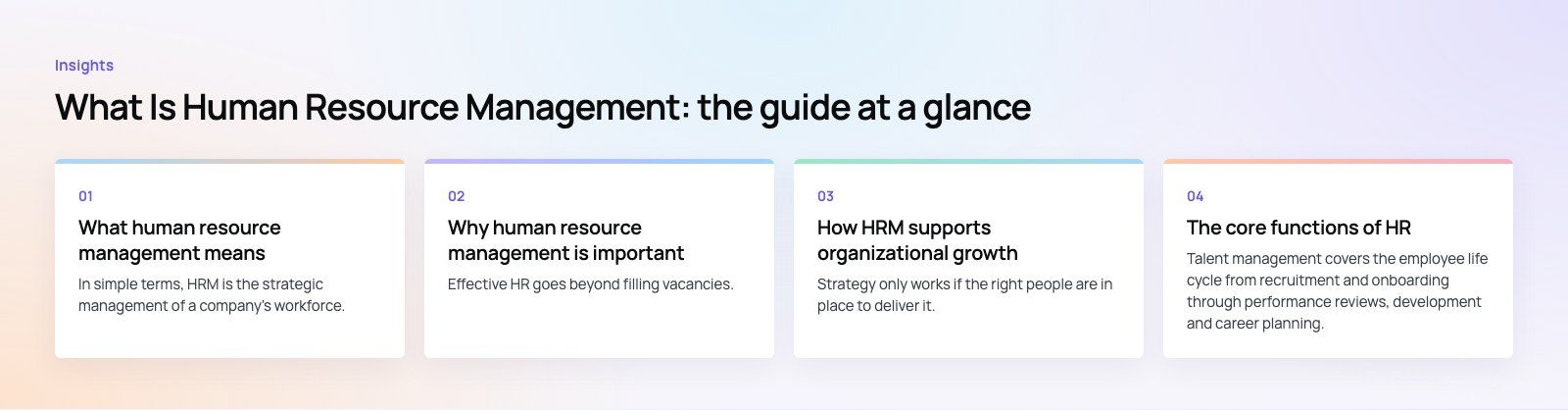
What human resource management means
In simple terms, HRM is the strategic management of a company's workforce. It treats people as a resource to be developed rather than a cost to be minimized. The work spans the whole employee life cycle:
- Attract: employer brand, job design and sourcing.
- Hire: screening, interviewing, selection and offers.
- Onboard: contracts, equipment, induction and first goals.
- Develop: training, coaching and career paths.
- Manage and reward: performance, pay, benefits and recognition.
- Retain or exit: engagement, succession, and fair, well handled departures.
HRM is often confused with personnel administration. Administration keeps records and processes payroll. HRM includes that work but adds strategy: deciding what capabilities the business needs and how to build them.
Why human resource management is important
It drives engagement and retention
Effective HR goes beyond filling vacancies. Engagement programs, development opportunities and a positive culture keep people committed. Engaged employees are more likely to stay, which avoids the disruption and hidden costs of constant replacement hiring.
It creates a productive, healthy workplace
Clear policies, fair benefits, safe working conditions and attention to wellbeing support both output and health. People who feel secure and well treated tend to do better work.
It attracts strong candidates
Candidates compare employers before they apply. A clear employer brand, a respectful hiring process and a well organized onboarding experience make your company a place people want to join.
It protects the business
Employment law, contracts, working hours and data protection all fall under HR. Getting them right reduces the risk of disputes, penalties and reputational damage.
How HRM supports organizational growth
Strategy only works if the right people are in place to deliver it. HRM connects the two in several ways:
- Building the workforce: hiring people whose skills match where the business is heading.
- Investing in people: training that keeps skills current as roles and technology change.
- Raising engagement: people who feel valued contribute more ideas and effort.
- Encouraging collaboration: a culture where teams share knowledge rather than compete.
- Improving performance: clear goals and regular feedback that support continuous improvement.
The core functions of HR
Talent management
Talent management covers the employee life cycle from recruitment and onboarding through performance reviews, development and career planning. Its goal is to hire well and then keep and grow the people who perform.
Workforce administration
This is the day to day engine: payroll inputs, benefits, leave, attendance and records. When it runs smoothly, HR professionals have time for strategic work.
Employee self service
Modern HR gives employees direct access to payslips, leave balances, personal details, policies and training enrollment. Self service cuts routine requests to HR and gives people control over their own information.
Reporting and analytics
HR data on engagement, turnover, absence and training effectiveness supports better decisions and shows the impact of HR programs. Reports are most useful when they combine data from recruitment, payroll and performance rather than looking at each in isolation.
Security and compliance
HR holds some of the most sensitive data in any company: identity documents, salaries, health and disciplinary records. This function covers access control, privacy, record retention and compliance with labor law. Organizations handling data on people in the European Union, for example, must follow the General Data Protection Regulation.
Integration with other systems
HR data feeds payroll, finance, IT access and recruitment. Connecting these systems avoids double entry, reduces errors and makes payroll more accurate and timely.
What an HR management system adds
A human resource management system (HRMS) is software that brings HR functions into one place. Running a modern workforce on spreadsheets and email is possible for a handful of people, but it becomes slow and error prone as the team grows. An HRMS offers several strategic advantages.
| Advantage | What it looks like in practice |
|---|---|
| Efficiency | Automated payroll inputs, leave approvals and timekeeping replace manual forms |
| Better decisions | One data set for headcount, turnover, performance and skills gaps |
| Simpler talent management | Recruitment, onboarding, reviews and development plans in one workflow |
| Engagement | Self service portals give employees control over their information and requests |
| Compliance | Consistent records, deadline tracking and audit trails |
Choosing between off the shelf and custom
Most companies start with an established HR platform and connect it to their finance and identity systems. Some combine HR with an ERP such as Odoo or Business Central so people costs sit next to the rest of the accounts. Where workforce management is part of the product, for example shift based or field teams, a custom software layer often fits better.
Our Distinct case study describes a healthcare workforce platform with shifts, bookings, incident reports, reviews and rewards, a good example of HR processes built into an operational product.
Trends and challenges shaping HRM
Artificial intelligence
AI is taking on routine tasks such as screening applications, answering policy questions and drafting job descriptions. It also supports talent analytics. The challenge is using it fairly and transparently, with people reviewing important decisions.
Employee experience
Organizations are paying more attention to wellbeing, flexibility, recognition and growth opportunities, because these shape whether good people stay.
Flexible and contract work
More work is done by freelancers, contractors and part time staff. HR has to manage blended teams with different contracts, onboarding needs and rules.
Cybersecurity
As HR data becomes fully digital, it becomes a target. Strong access controls, encryption and staff awareness are now part of HR's responsibility, not only IT's.
Data driven HR
Dashboards built in tools such as Power BI let HR leaders report on turnover, hiring and engagement with live numbers, which earns HR a stronger voice in strategic decisions.
If your HR processes still run on spreadsheets and disconnected tools, Codeeo can help you design and build the systems behind them. Our team of 80+ across Dubai, Riyadh and Karachi works on HR integrations, workforce apps and reporting; get in touch to talk through what you need.
Frequently asked questions
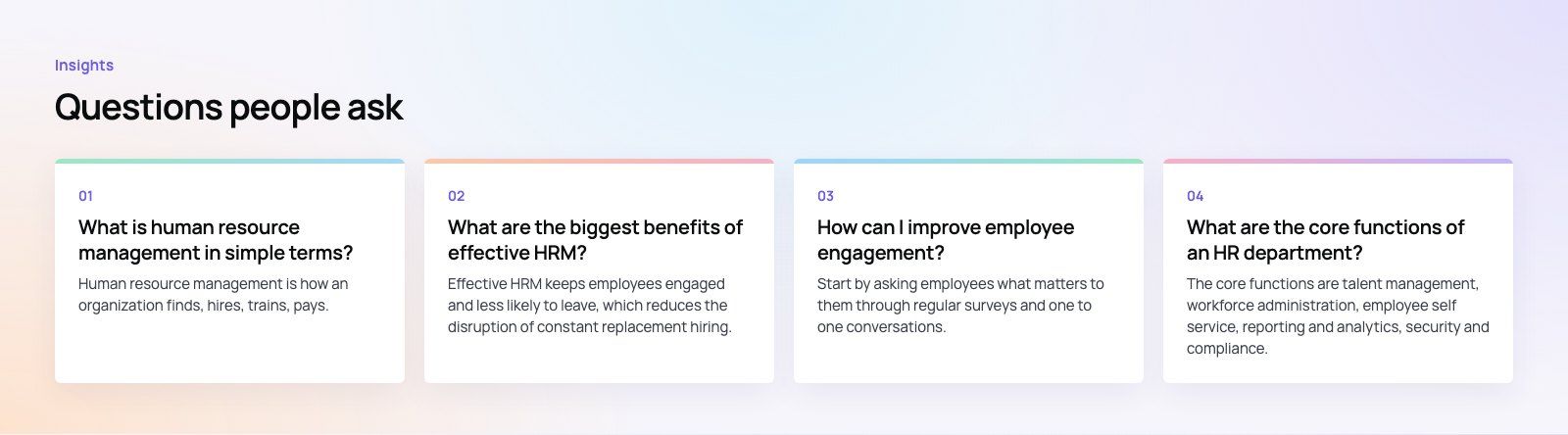
Human resource management is how an organization finds, hires, trains, pays, supports and keeps its employees so they can help the business reach its goals.
It covers recruitment, onboarding, training, performance reviews, compensation, employee relations and compliance with employment law. Unlike basic personnel administration, it also plans which skills the business will need in the future and how to build them.
InsightsHow Employee Engagement Drives Business PerformanceHow employee engagement affects profit, productivity, absence, retention, customers and innovation, what the evidence says, and how to link it to results. InsightsThe Five Functions of Human Resource Management ExplainedThe five core functions of human resource management: recruitment, training, performance, compensation and employee relations, with practices and pitfalls.
 InsightsPerformance Management and Employee Engagement: A Practical GuideHow to run performance management that raises engagement: frequent check ins, specific recognition, growth plans, a strengths based approach and who owns what.
Tell us what the business needs. We will tell you what to build first.
Schedule a free consultation and get a written recommendation, with costs, before you commit to anything.
Get in touchPROVEN RESULTS
4.7 / 5verified reviews on Google