 Software DevelopmentSQL vs NoSQL Databases: Differences and How to ChooseHow SQL and NoSQL databases differ in data model, schema, scaling and consistency, where each one fits, and five questions to choose for your project.
CodeeoInsightsSoftware Development
Why Businesses Outsource Software Development, and How to Do It Well
The real reasons businesses outsource software development, when it is the wrong call, the main engagement models and how to keep control of code and quality.
Businesses outsource software development to get skilled people working on a product quickly, without the time and fixed cost of hiring a full in house team. It works best when you keep ownership of the product decisions, choose the right engagement model and treat the outside team as a partner with clear goals, not a ticket queue.
This guide covers the real reasons to outsource, when it is the wrong choice, the main engagement models, how to pick a partner and how to keep control of quality, security and your code.
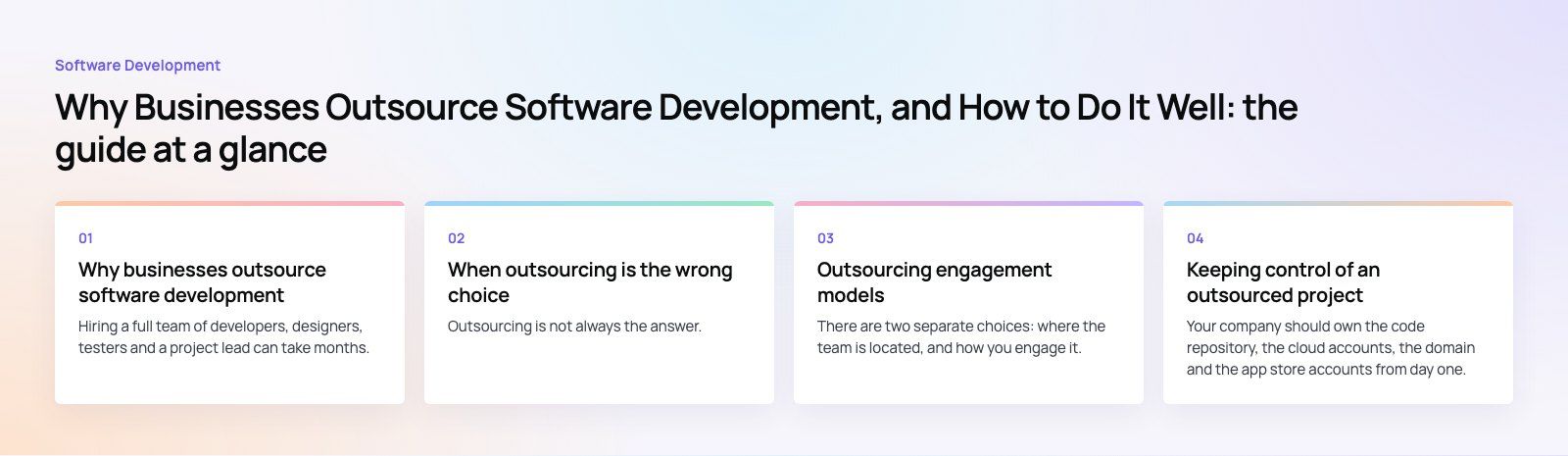
Why businesses outsource software development
Speed to start
Hiring a full team of developers, designers, testers and a project lead can take months. An established outside team can usually begin within weeks, which matters when a market window or a funding milestone is close.
Access to skills you do not have
Few companies need a full time mobile developer, a cloud engineer, a UX designer and a QA specialist all year round. Outsourcing gives you access to those skills for the stages where you need them, including specialist areas such as payments, healthcare data or ERP integration.
Flexible capacity
Product work comes in waves: a heavy build phase, a quieter maintenance phase, then another push for a new feature. An outside team can grow and shrink with that rhythm in a way a permanent team cannot.
Lower fixed cost
Salaries are only part of the cost of an in house team. Recruitment, benefits, equipment, licences, office space, training and management time all add up. Outsourcing turns much of that into a variable cost tied to the work being done.
Focus for your own team
When delivery is handled externally, your internal people can stay focused on customers, sales, operations and product direction rather than managing a growing engineering function.
When outsourcing is the wrong choice
Outsourcing is not always the answer. Think twice if:
- Software is your core product and you need deep, long term technical ownership inside the company. In that case, outsource to accelerate, but plan to build an internal team alongside.
- You already have a strong team with the right skills and enough capacity.
- You cannot give the partner a decision maker who is available every week. Outsourced projects fail more often from slow decisions than from slow code.
- Your requirements are a moving target with no one owning them. Any team, internal or external, struggles without a clear product owner.
Outsourcing engagement models
There are two separate choices: where the team is located, and how you engage it.
By location
Onshore partners are in your own country. Communication is easy, but the cost is usually highest. Nearshore partners are in a nearby country with a similar time zone, which keeps meetings simple. Offshore partners are further away, often with lower rates, and need more deliberate planning for overlap hours and communication.
By engagement type
| Model | How it works | Best for | Watch out for |
|---|---|---|---|
| Fixed scope project | Agreed scope, timeline and deliverables | Well defined builds such as a website or MVP | Change requests when scope shifts |
| Dedicated team | A team works only on your product, managed by you or jointly | Ongoing products with a long roadmap | Needs a strong product owner on your side |
| Staff augmentation | Individual developers join your existing team | Filling specific skill gaps | You manage the people and the process |
| Managed delivery | The partner owns planning, delivery and support | Companies without technical leadership | Less day to day control |
Many companies start with a fixed scope project to test a partner, then move to a dedicated team once trust is established.
How to choose an outsourcing partner
- Look at real, relevant work. Ask for case studies in a similar domain or of a similar size, and ask what the team would do differently today.
- Meet the people who will do the work. The sales team is not the delivery team. Speak to the lead developer and project manager before signing.
- Check how they communicate. Ask how often you will see working software, what reporting you will get and which tools they use.
- Ask about quality practices. Code reviews, automated tests, staging environments and a release process should all be standard.
- Read the contract carefully. Intellectual property, code ownership, confidentiality, warranty periods and exit terms should all be explicit.
- Start small. A paid discovery phase or a product scoping exercise shows how a team thinks before you commit to a full build.
Keeping control of an outsourced project
Own the code and the accounts
Your company should own the code repository, the cloud accounts, the domain and the app store accounts from day one. The partner gets access; you hold the keys.
Insist on short delivery cycles
Working software every one or two weeks lets you spot misunderstandings early, when they are cheap to fix.
Agree on security standards
Ask the partner to build against a recognised baseline such as the OWASP Application Security Verification Standard, and to explain how they handle secrets, access control and personal data. If you handle personal data of EU residents, the GDPR sets requirements for any processor you use.
Keep documentation current
Architecture notes, setup instructions and decision records make it possible to change partners or bring work in house later without starting over.
Trends shaping software outsourcing
- AI assisted development. Coding assistants and automated testing tools change how teams work. Ask partners how they use these tools and how they review AI generated code.
- Partnerships over transactions. More companies want a long term technical partner who understands their business rather than the cheapest bid for each project.
- Security and data residency. Data protection rules increasingly shape where data may be stored and who may access it, so these questions now come early in partner selection.
- Time zone overlap. Teams with a few hours of daily overlap move faster than those working entirely asynchronously, which keeps nearshore and distributed models popular.
Common mistakes
- Choosing on price alone and paying for it later in rework.
- Handing over a vague brief and expecting the partner to fill in the product decisions.
- Letting the partner hold the only copy of the code or the only admin access.
- Skipping testing and acceptance criteria to save time.
- Waiting until the end of the project to review the work.
Working with Codeeo
Codeeo is a team of 80+ across Dubai, Riyadh and Karachi and has delivered more than 200 projects across the UAE and the US, from custom software to mobile apps and web platforms. If you are weighing whether to outsource, we can talk through scope, engagement models and how ownership would work in practice.
Frequently asked questions
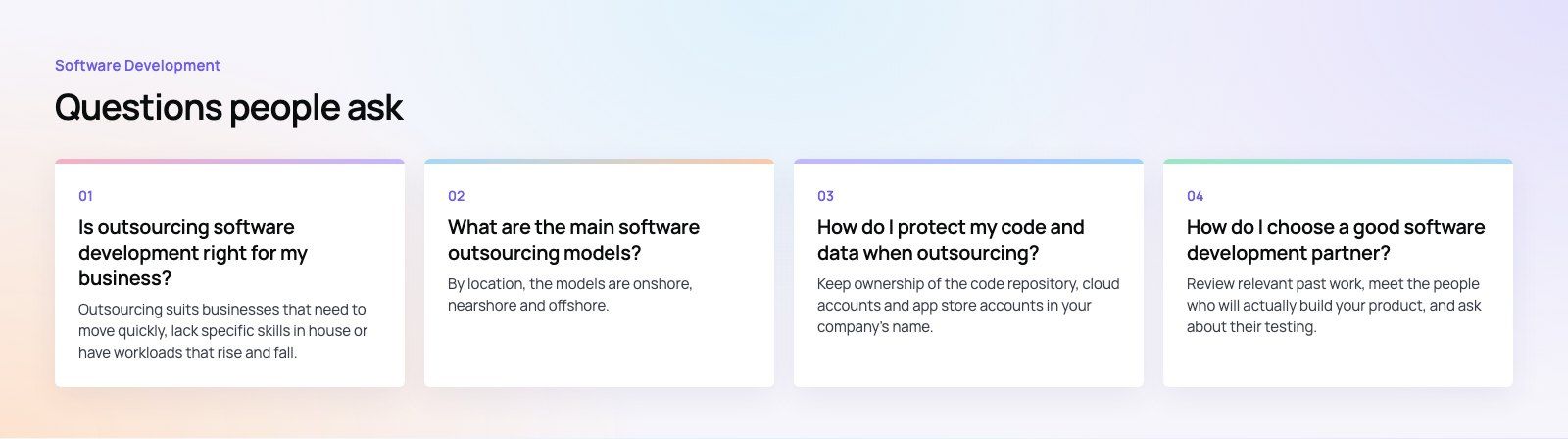
Outsourcing suits businesses that need to move quickly, lack specific skills in house or have workloads that rise and fall.
It is less suitable when software is your core product and you need deep internal ownership, or when nobody on your side can make product decisions each week. Many companies outsource to start fast and build an internal team over time.
Software DevelopmentSQL vs NoSQL Databases: Differences and How to ChooseHow SQL and NoSQL databases differ in data model, schema, scaling and consistency, where each one fits, and five questions to choose for your project. Software DevelopmentOpen Source Apps: Examples, Licenses and How to Build Your OwnWhat makes an app open source, well known examples, the steps to build your own, how to pick MIT, Apache or GPL, and when to customize instead.
 Software DevelopmentHow an Online HR Portal Improves Employee ExperienceWhat an online HR portal does, how self service improves employee experience, which features matter, and whether to buy, configure or build one.
Tell us what the business needs. We will tell you what to build first.
Schedule a free consultation and get a written recommendation, with costs, before you commit to anything.
Get in touchPROVEN RESULTS
4.7 / 5verified reviews on Google