 Web DevelopmentBusiness Website Design DubaiWhat a business website in Dubai should do, template vs custom builds, what drives cost and time, platforms, SEO and conversion, and choosing an agency in Business Bay.
Best Website Designing Company in Dubai
How to choose a website designing company in Dubai: business goals, the right platform, SEO and conversion, costs and timelines, and support after launch.
Searching for the best website designing company in dubai means finding a partner that can turn business goals into a fast, easy-to-use, and scalable digital product. The right team should handle design, development, SEO, speed, integrations, and long-term support, not just make a homepage look polished. Codeeo builds and maintains custom software and web apps for companies of all sizes and is trusted by over 200 companies, so it is a practical choice for teams that want reliable delivery and creative web solutions.
Summary
This guide shows how to choose a Dubai web design partner based on business goals, tech needs, SEO, conversion, and support. Strong sites need strategy, growth-ready tech, upkeep, and steady improvement. Codeeo is a practical option for web design, custom software, containers, and dedicated development support.
What should you expect from a leading Dubai web design partner?
A strong Dubai web design partner should help you define what the site must achieve before the team talks about color, layout, or platform. That means knowing your audience, conversion goals, product or service, internal workflows, and the role the site plays in sales, support, hiring, or brand work. Professional web design is not only visual; it is a clear process that links user experience, technical choices, content, analytics, and upkeep.
In Dubai, a site often has to speak to local buyers, regional decision-makers, international customers, and mobile users at the same time. A top design firm should know how to handle that mix without making the site feel crowded. The result should look credible, load fast, guide action, and grow with the business.
The best web agency for one company may not fit another. A startup may need a lean marketing site and a clear launch path. A larger business may need multilingual pages, custom workflows, CRM links, secure portals, or cloud-ready infrastructure. The right partner shapes the project around those needs instead of forcing every client into the same template.
Great websites begin with business clarity
Before wireframes or development begin, the project should answer a few business questions. Who is the site for? What decision should the visitor make? What information reduces doubt? What action matters most: booking a call, buying a product, asking for a quote, downloading a resource, or opening an account?
This discovery stage is where many successful website development dubai projects stand out. When strategy is clear, design choices get easier. Navigation can focus on the pages that matter most. Calls to action can match the buyer journey. Content can answer real objections instead of repeating generic sales lines.
A practical discovery process usually looks at:
- Audience segments: local customers, regional buyers, partners, investors, job seekers, or returning clients.
- Business goals: lead generation, eCommerce revenue, day-to-day efficiency, brand repositioning, or customer self-service.
- Current friction: slow pages, unclear messaging, weak mobile use, poor SEO structure, old tech, or hard content updates.
- Technical needs: integrations, payment gateways, dashboards, user roles, booking systems, cloud hosting, APIs, or custom back-office tools.
- Success signals: conversions, qualified inquiries, product sales, fewer support requests, stronger engagement, or easier internal management.
This is also where a dubai digital agency should be honest about what your website does not need. Not every company needs a complex custom platform from day one. Sometimes the right answer is a focused WordPress build, a Shopify store, or a phased plan that starts with the highest-impact pages.
Custom design beats generic templates when the stakes are high
Template-based websites can work for small, simple launches, but they often become limiting when a company needs uniqueness, speed, or deeper function. A template may look good at first, yet it can make your brand feel generic if the content structure, layout, and user path are not shaped for your market. In real estate, healthcare, logistics, professional services, retail, and tech, that lack of fit can cost trust.
Custom professional web design gives your team more control over how people move through the site. You can show the proof points buyers care about, simplify complex services, support multilingual content, and build conversion paths for different user types. It also helps the site line up with your offline reputation, sales process, and customer hopes.
Creative web solutions are not about extra animation or visual noise. They solve real communication and usability problems in a way that feels distinctive. A real estate company may need property search and lead routing. A healthcare provider may need service pages that feel calm, accessible, and easy to use. A logistics business may need tracking, quote requests, and links to internal systems. A retailer may need product filtering, payment options, inventory logic, and campaign landing pages.
A capable web design dubai team will know when to use proven patterns and when to build something custom. Users should not have to relearn the internet to use your site. They should quickly see why your business is relevant, credible, and easy to work with.
How do you choose the right agency for your stage of growth?
Choose the agency that fits your business stage, tech needs, and in-house capacity, not just the one with the flashiest portfolio. A young company may want speed, flexible scope, and launch help. A larger company may need deeper architecture, docs, security thinking, integrations, and post-launch support. The best website designing company in dubai for your business is the one that can support your next stage, not just your current brief.
A useful way to compare partners is to match their strengths to your likely project type:
| Business situation | What to prioritize | Why it matters |
|---|---|---|
| Startup or new brand | Lean scope, clear messaging, fast launch, scalable foundation | You need momentum without adding too much too early. |
| Growing service business | SEO-ready structure, lead generation, CRM or form workflows, strong UX | The site must turn visitors into qualified conversations. |
| eCommerce brand | Product architecture, checkout flow, payments, analytics, speed | Small UX issues can hurt sales and repeat purchases. |
| Enterprise or multi-location company | Custom development, integrations, governance, security, cloud readiness | The site may need to connect with existing systems and serve many teams. |
| Software or platform company | Product thinking, dashboards, user roles, APIs, DevOps, ongoing iteration | The site may be part of a larger digital product system. |
When reviewing a Dubai web design company, look beyond screenshots. Ask how they handle discovery, user paths, revisions, and content updates after launch. A pretty site your team cannot maintain will create drag.
You should also ask who will actually work on the project. A polished sales process is not the same as a skilled delivery team. Strong agencies are clear about project management, design reviews, development milestones, testing, deployment, and support.
Technology choices should follow the job to be done
There is no single perfect stack for every website. The right choice depends on your content needs, growth needs, integrations, team skills, security, and budget. A good agency explains the trade-offs in plain language instead of pushing one platform for every case.
For content-led sites, WordPress can be a practical option because teams can manage pages, articles, and landing pages without much technical help. For eCommerce, Shopify may suit businesses that want a managed commerce base, while more custom stores may need deeper work. For web apps or complex front ends, frameworks such as React or Angular may be useful. Back-end needs may call for Node.js or Laravel, while cloud hosting may use AWS or Azure.
The key is not to chase trendy tools. The key is to choose tech that supports speed, security, upkeep, and future change. If your business expects user accounts, advanced search, booking flows, quote systems, dashboards, or integrations, those plans should shape the architecture from the start.
Codeeo is especially relevant when a project moves beyond a brochure site into custom software, web apps, or ongoing product work. If your product runs in containers or needs Kubernetes or OpenShift support, Codeeo's team can help shape the right architecture; our guide to OpenShift vs Kubernetes explains the choice.
The strongest sites are built for search and conversion together
SEO should not be added after launch. If search matters, the site structure, page order, internal links, metadata, content model, speed, and tech setup should be planned early. A site can look great and still underperform if search engines cannot read it or users cannot find what they need.
For Dubai companies, local and regional relevance matters too. Service pages should explain what you offer in plain words. Location pages should feel useful, not stuffed with place names. The phrase web design dubai should appear only when it truly helps describe the service or market. The same goes for dubai web design or website development dubai: they should add clarity, not get in the reader's way. Our local SEO team plans this structure with the build.
Conversion is the other half of the job. Once a visitor lands on the site, the next step should be obvious. That might mean a sticky inquiry button, a short quote form, clearer service packages, stronger proof points, comparison content, product picks, or a booking flow with fewer distractions.
A practical SEO and conversion checklist includes:
- Clear page intent: every important page should answer one buyer question or support one action.
- Fast mobile experience: mobile users should be able to read, compare, and contact you without friction. See our Core Web Vitals service.
- Logical navigation: menus should reflect how customers think, not just how the company is set up.
- Search-friendly content: headings, URLs, metadata, and body copy should be clear and natural.
- Trust signals: case studies, client logos, reviews, certifications, team information, or process notes can reduce doubt.
- Measurement setup: analytics, conversion tracking, and event tracking help your team see what works after launch.
- Post-launch improvement: search and conversion usually get better through steady testing, not one-time publishing.
What should costs, timelines, and technology decisions look like?
Costs and timelines should reflect complexity, not vague promises. A basic site may take a few weeks, while a corporate website, eCommerce build, or custom web app can take several months depending on content, integrations, approvals, testing, and launch needs. Pricing can vary a lot, so it is more useful to compare scope, process, quality, ownership, support, and long-term value than to choose only on the lowest quote.
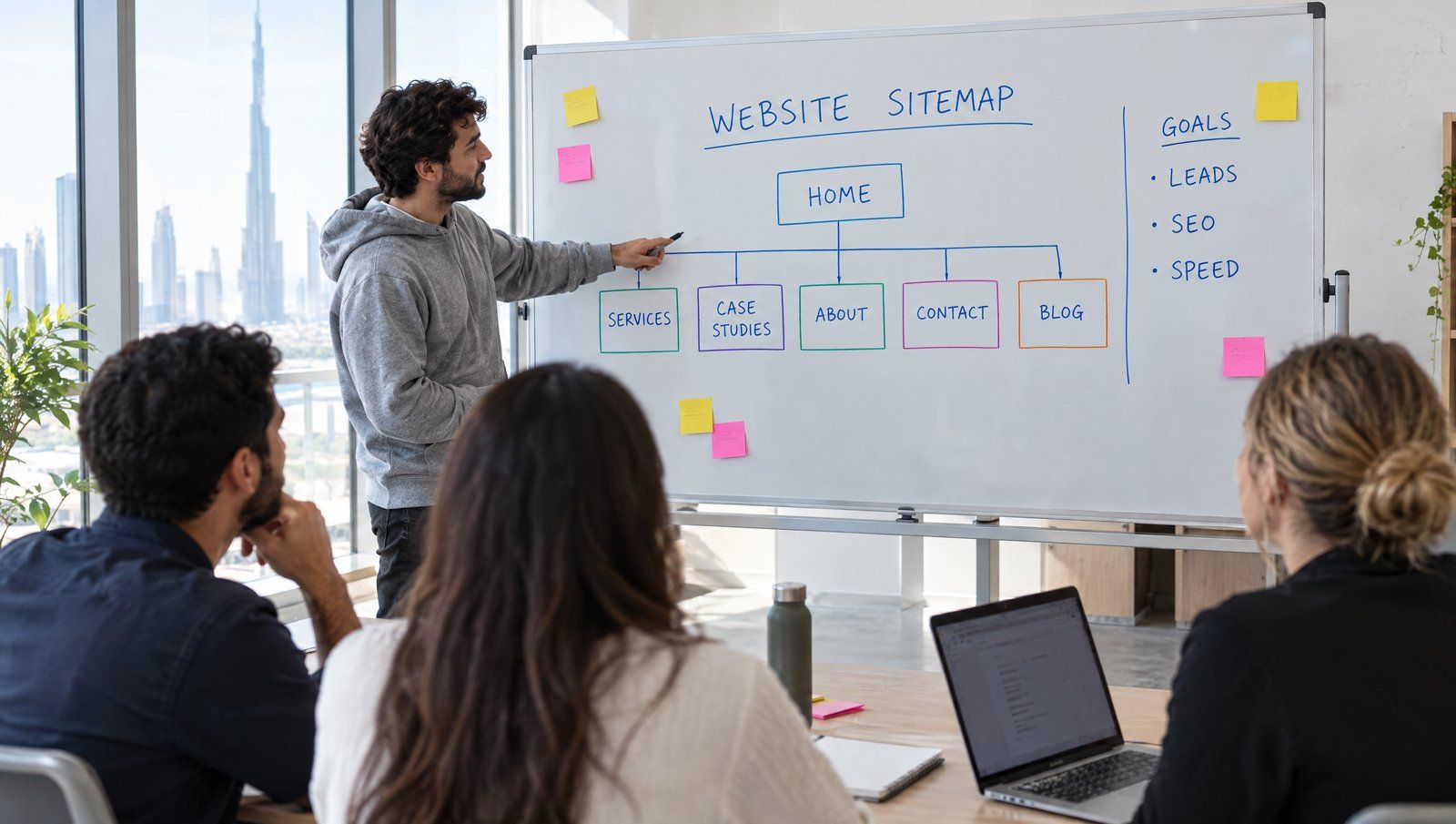
For a simple site, common stages include discovery, sitemap planning, content prep, UI design, development, testing, launch, and training. Larger builds may also need technical architecture, API planning, data migration, role-based access, performance tuning, security review, and staged releases. Each layer adds time because it adds choices, links, and quality checks.
A basic site might be finished in about three to five weeks when content is ready and approvals move fast. Corporate and eCommerce sites often need eight to twelve weeks. More complex enterprise platforms, marketplaces, portals, or custom apps may take several months, especially when integrations, user roles, or compliance rules are involved.
Budget talks should be just as clear. Costs vary widely depending on features, integrations, and support. Instead of asking only how much a website costs, ask what is included, what is not, how changes are handled, and what happens after launch.
A practical evaluation framework for shortlisting agencies
A polished portfolio helps, but it should not be the only factor. The best review blends creative quality with delivery discipline and technical depth. You are not just buying screens; you are choosing a partner that will read your business, build a digital asset, and support it when real users arrive.
Use this framework when comparing agencies:
- Strategic fit: Do they ask about business goals, target users, sales process, and success metrics before they propose solutions?
- Design maturity: Can they explain how their design choices improve clarity, trust, and conversion rather than only aesthetics?
- Technical capability: Can they handle the required CMS, eCommerce platform, web app framework, integrations, hosting, and security needs?
- Industry understanding: Have they worked with similar levels of complexity, even if not the exact same sector?
- Project management: Do they provide clear milestones, responsibilities, review cycles, and communication routines?
- Content and SEO readiness: Do they plan structure, copy, metadata, and speed before launch?
- Post-launch support: Can they maintain, improve, secure, and extend the website after it goes live?
- Ownership and handover: Will you receive access, documentation, training, and a setup you can maintain?
This kind of review helps you find a truly capable dubai digital agency instead of being swayed by surface style. It also makes proposals easier to compare because you can see which team understands the full project life cycle. You can see how Codeeo approaches this in our case studies, such as Modon Holding, Diyafah and EGO Sustainable.
Post-launch support is where long-term value appears
A website launch is not the finish line. Once users start using the site, your team may find new content needs, conversion gaps, search chances, speed issues, or workflow fixes. A reliable partner should support updates, watch technical health, fix bugs, improve pages, and add features over time.
This matters even more for growing businesses. Your site may need new landing pages, campaign tracking, product groups, integrations, language versions, dashboards, or automation after launch. If the first build was rushed or poorly documented, every future change becomes harder and more expensive.
Codeeo's value is not limited to launch. Because Codeeo builds and maintains custom software and web apps, the team can support businesses that need ongoing development capacity, not just a one-time design project. If you need extra hands on an existing cluster or codebase, you can hire dedicated developers from Codeeo to join your team and keep work moving without starting over.
That flexibility helps both in-house teams and companies that rely fully on an external partner. Sometimes you need a full project team; sometimes you need specialist developers who can work inside your current process. The key is having the right support when the website or app becomes business-critical.
Trends shaping modern web design in Dubai
Dubai's digital market still rewards sites that are fast, clear, mobile-first, and built around user intent. Buyers compare choices quickly, and a weak site can make a capable company look less trustworthy than it is. Modern web design is moving toward cleaner layouts, better content, stronger personalisation, and tighter links between marketing and technology.
AI-assisted workflows are also shaping how teams plan content, study behavior, support customers, and test variations. That does not mean every site needs heavy AI features. It means businesses should be open to smarter search, better suggestions, chat support, content flows, and data-led choices where they truly help the user.
Mobile-first design still matters. Many visitors will find your company from search, social, messaging apps, ads, or referrals on a phone. If the mobile version is slow, cramped, confusing, or missing key actions, the desktop view cannot make up for the loss.
Security and growth are also more visible in web decisions. Companies that expect to expand should think about hosting, access control, backups, updates, deployment flows, and monitoring before problems appear. This is where a team with custom software and architecture experience can give stronger advice than a purely visual studio.
Signs you have found the right partner
The right partner will leave you clearer, not more confused. They will challenge assumptions politely, explain trade-offs, and help you focus on the work that matters most. They will not promise every feature right away, and they will not hide complexity behind vague words.
You are likely speaking with a strong agency when they can:
- Explain the difference between a marketing website, an eCommerce site, and a custom web app.
- Recommend a platform based on your goals rather than their convenience.
- Show how content, UX, development, SEO, and analytics connect.
- Discuss speed, security, growth, and maintenance early.
- Provide a realistic delivery process with milestones and responsibilities.
- Support your internal team after launch instead of disappearing once the invoice is paid.
A strong agency also knows that the site has to serve both the visitor and the business. It should help customers decide, but it should also help your team manage content, track performance, and improve operations. That mix is what turns a website from a digital brochure into a useful business asset.
Key takeaways before you start your project
If you are planning a new website or updating an old one, start with the business result rather than the design style. A great-looking site that does not generate leads, explain your offer, or support your operations will still miss the mark. A successful project connects strategy, user experience, technology, content, search visibility, and ongoing support.
Keep these points in mind:
- The best partner is the one that fits your business stage, technical needs, and growth plans.
- Custom design is most valuable when your site must set your brand apart, convert visitors, or support complex workflows.
- SEO and conversion should be planned before launch, not treated as an afterthought.
- Technology decisions should be based on upkeep, growth, integrations, and team needs.
- Post-launch support matters because websites and web apps need iteration, security, updates, and optimisation.
- Codeeo can support both web design and deeper software needs, including custom apps, container architecture, and dedicated developers for existing systems.
Choosing a web partner in Dubai is not just a buying decision. It is a decision about how your business will present itself, capture demand, serve customers, and grow online. If you want a team that can discuss your website, web app, existing cluster, or future product architecture in practical terms, contact Codeeo to review your setup and find the right path forward.
Frequently asked questions
Start with business clarity before design choices.
Define the target audience, the main action users should take, the information they need to make a decision, and the role the website will play in sales, support, hiring, or brand positioning. That makes later decisions about navigation, content, SEO, technology, and conversion much more practical.
Web DevelopmentBusiness Website Design DubaiWhat a business website in Dubai should do, template vs custom builds, what drives cost and time, platforms, SEO and conversion, and choosing an agency in Business Bay. Web DevelopmentInclusive Web Design: Principles, WCAG 2.2 Checks and Tools for 2026What inclusive web design means in 2026, the seven principles behind it, the WCAG 2.2 checks that matter most, useful accessibility tools and the laws to know.
 Web DevelopmentHeadless CMS vs Traditional CMS: Which Should You Choose?How a headless CMS differs from a traditional CMS like WordPress, where each is stronger for SEO, editors and channels, and how to choose in 2026.
Tell us what the business needs. We will tell you what to build first.
Schedule a free consultation and get a written recommendation, with costs, before you commit to anything.
Get in touchPROVEN RESULTS
4.7 / 5verified reviews on Google