 SEOTechnical SEO Audit: A Step by Step Guide for 2026A practical technical SEO audit in seven steps, using current Search Console reports and the Core Web Vitals thresholds Google publishes today.
SEO for Law Firms in Dubai
Article 35 of Cabinet Resolution No. 8 of 2025 names a website as one of four ways a UAE lawyer may promote themselves, which makes practice area pages, verifiable credentials and jurisdiction clarity the work that matters.
SEO for law firms in Dubai is shaped by regulation before it is shaped by technique. Article 35 of Cabinet Resolution No. 8 of 2025, the executive regulations of Federal Decree-Law No. 34 of 2022, lists exactly four ways a lawyer may promote themselves, and a website for the lawyer or the law firm is one of them. Article 34 sets out what may not be said anywhere. Inside those limits, the firms that get found are the ones with a separate page for each practice area, credentials a reader can check, and an honest statement of which courts their people can appear in.
Key takeaways
- Article 35 of Cabinet Resolution No. 8 of 2025, issued 10 February 2025, permits four methods of self-promotion: an external sign at the firm and its building, the firm’s letterhead and stationery, a website for the lawyer or firm, and social media channels belonging to the lawyer or firm.
- Article 34(3) prohibits using social media or any other means to promote a lawyer or firm by publishing or implying false, misleading or fabricated information, which makes unverifiable superlatives a regulatory matter rather than a question of taste.
- Article 34(1) prohibits seeking promotion or solicitation through intermediaries, which is worth reading closely before paying a directory for referred enquiries.
- Article 34(2) limits the titles shown on printed materials and firm signage to academic qualifications, professional experience, and the level of court the lawyer may argue before.
- Onshore UAE courts, the DIFC Courts and the ADGM Courts are three separate jurisdictions, and ADGM states that it directly applies English common law.
- The DIFC Courts publish their Register of Practitioners, so registration is a credential a prospective client can verify independently.
What the rules let a Dubai firm publish
Start with Article 35, because it decides where effort belongs. The permitted methods are a sign at the entrance of the firm and the building it sits in, the firm’s letterhead and stationery, a website, and the firm’s own social media channels. A website is named directly, which is why organic search is the natural channel for a UAE law firm: the asset you are allowed to build is the asset search engines read.
Article 34 then constrains the content. It prohibits promotion that conflicts with the professional traditions, dignity and prestige of the profession, promotion or solicitation through intermediaries, and any insinuation of influence or of actual or alleged connections. It prohibits displaying titles on printed materials or firm signage beyond academic qualifications, professional experience and the level of court the lawyer can argue before. It prohibits false, misleading or fabricated information on social media or by any other means, and it requires compliance with the media content standards in force in the UAE.
Two practical readings follow. The first is that claims such as “the leading commercial litigator in Dubai” are not merely weak copy: they are the sort of statement Article 34 is aimed at, and they are impossible to support. The second is that the permitted list in Article 35 does not mention paid advertising of any kind. That silence is not the same as a prohibition, and a firm should take its own advice from the Competent Department before committing a budget to paid search, but it is a reason to treat organic visibility as the dependable route rather than the cheap one.
These are federal rules. The regulations define the Competent Authority as the local Department of Economic Development or the relevant authority in the free zone, so a firm licensed in a free zone should confirm how its own authority applies them.
Practice area pages carry the rankings
Clients do not search for “law firm”. They search for the problem: an unpaid invoice, a terminated employment contract, a construction claim, a shareholder dispute, a travel ban, a divorce where the parties hold different nationalities. Each of those is a separate page, written to answer that problem, with the firm’s relevant experience below the answer.
One issue we often see on UAE legal sites is a single services page listing fourteen practice areas in one sentence each. It gives a search engine one weak page where it could have fourteen specific ones, and it gives the reader nothing to judge. A page on debt recovery that explains the steps, the court involved, the documents needed and what usually goes wrong will outrank a list, because it answers the question the searcher typed.
Depth should follow the value of the matter, not a word count target. A page on commercial litigation deserves more detail than one on notarisation. Where a practice area is genuinely small for the firm, a short honest page is better than a padded one.
Onshore, DIFC and ADGM are three different searches
This is the distinction most legal websites in Dubai blur, and it costs them the clients who know what they are looking for. A business with a DIFC-incorporated counterparty searches differently from one suing an onshore LLC, and the two need different pages.
| Forum | Law applied | Who may appear |
|---|---|---|
| Onshore UAE courts | UAE federal and emirate-level law | Advocates registered to practise and argue before the relevant court level |
| DIFC Courts | DIFC law, a common law system | Practitioners entered in the Register of Practitioners, with rights of audience under Part II |
| ADGM Courts | English common law, applied directly | Practitioners admitted under the ADGM Courts’ own requirements |
If the firm has people registered with the DIFC Courts, that belongs on a DIFC page in plain language. If it does not, the site should not imply otherwise, which is where Article 34(3) and ordinary commercial honesty point the same way. A page that says clearly which forums the firm appears in will convert better than one that gestures at everything.
Credentials a client can actually verify
The DIFC Courts’ Register of Practitioners has two parts. Part I is in the name of a law firm and allows the firm to issue and conduct proceedings before the DIFC Courts, with a list of the practitioners it authorises to do so. Part II can only be in the name of an individual and is what grants rights of audience. An applicant for Part II declares either at least five years of post-qualification experience as an advocate in courts, arbitrations or tribunals granting full rights of audience, or at least two years for limited rights of audience, and must show the right to conduct litigation in the jurisdiction where they qualified, sufficient command of English, and sufficient knowledge of the common law system and DIFC procedure.
That detail matters for a website because it is checkable. The register is published by the DIFC Courts, so a client can confirm what a bio page claims. Under the federal regulations, lawyers are entered on one of three rolls, for trainee lawyers, practising lawyers and non-practising lawyers, which is a second verifiable status rather than an adjective.
Google’s guidance on creating helpful content asks site owners whether it is self-evident who authored the content, and states that it strongly encourages adding accurate authorship information such as bylines where readers would expect it. It also says that of experience, expertise, authoritativeness and trust, “trust is most important”. For a law firm, the lawyer biography is where those two things meet: qualifications, admissions, court levels, languages, reported matters by type. Keep the descriptions inside what Article 34(2) allows and the page is both compliant and more persuasive than a superlative would have been.
Arabic and English are two audiences, not one page
A Dubai firm serving both onshore and international clients is working two different search markets. The terms are not translations of each other, and running English pages through machine translation produces copy that reads as foreign to an Arabic-speaking client and adds little for search engines. Our guide to Arabic keyword research covers how the two query sets diverge, and the practical mechanics of serving both versions are in our note on hreflang for Arabic and English UAE sites.
Decide early whether Arabic is a full parallel site or a smaller set of the pages that matter most. For many firms the honest answer is the second, covering the practice areas where onshore clients actually arrive, written by someone who practises in Arabic rather than by a translation vendor.
Local search and the map listing
A substantial share of legal enquiries in Dubai begin with a map result, and that listing is governed by the address, category, hours and name on the business profile rather than by the website. Keep the firm name on the profile the same as the licensed name, because mismatches between the licence, the signage and the listing are what cause verification problems later. Firms with offices in more than one emirate need one listing per office with its own page on the site, not a single page serving both.
Structured data helps the listing and the page agree. Our write-up on schema markup for UAE local businesses covers the markup involved. Where a firm wants this handled as a programme rather than a one-off, that is the scope of our local SEO service in Dubai.
Where legal marketing budgets get wasted
Paid directory placements that sell referred enquiries are the first item to examine, and not only on cost. Article 34(1) prohibits seeking promotion or solicitation through intermediaries, so the arrangement deserves a careful read before it is signed, whatever the commercial case.
The second is the duplicated location page. Twenty near-identical pages differing only in the emirate name add nothing a reader could not get from one page, and they are the pattern search engines treat as filler. One strong page per office and per practice area is worth more than forty thin ones.
The third is any claim of outcome. Promised outcomes, success rates and win percentages are unverifiable to a reader, difficult to substantiate, and sit directly against the prohibition on misleading information in Article 34(3). Describing the type of matter, the forum and the issue involved carries the same weight without the exposure.
A sensible order of work
For a firm starting from a brochure site, the order that tends to produce results fastest is: correct the jurisdiction statements so every page is accurate about the forums the firm appears in; build one page per practice area that genuinely earns the work; write proper lawyer biographies with verifiable credentials; fix the business profile and the office pages; then add Arabic where the client base justifies it. Technical work such as site speed and crawlability matters, but a fast site with nothing specific to say will not outrank a slower one that answers the question.
Review the practice area pages roughly twice a year against what the firm now actually does. Legal sites go stale in a particular way: a partner leaves, a practice area winds down, and the page carries on ranking for work the firm no longer wants.
If your firm’s site is a brochure and you want to know which practice areas are reachable and what is holding the pages back, our technical SEO audit looks at the structure, the indexing and the content gaps, and returns a prioritised list rather than a score.
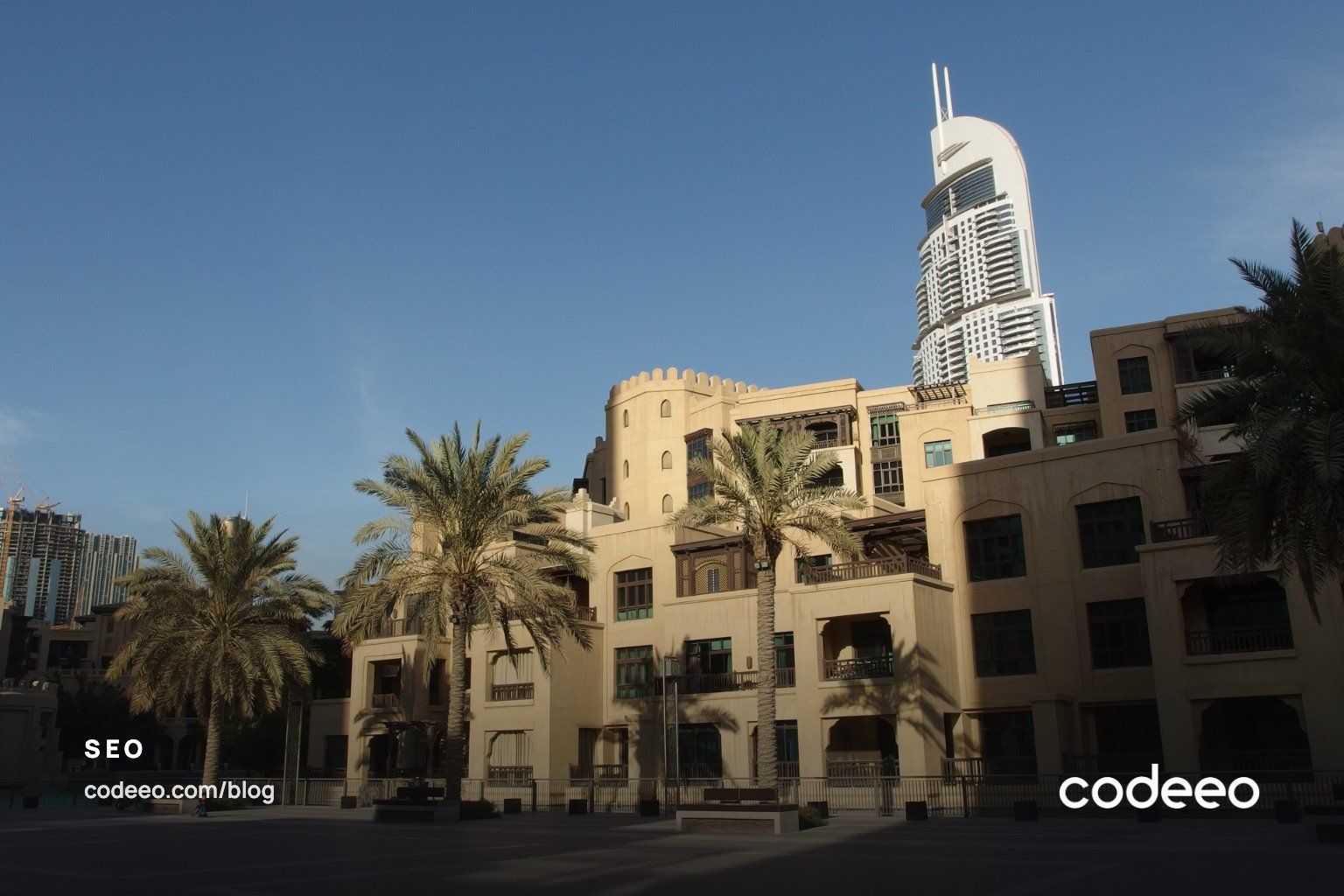
Rules described here were checked on 1 October 2026 against Cabinet Resolution No. 8 of 2025 on the executive regulations of Federal Decree-Law No. 34 of 2022, published by the UAE Ministry of Justice, the DIFC Courts’ registration of practitioners guidelines, ADGM’s description of its courts, and Google’s documentation on creating helpful content. This is general information about marketing and search, not legal advice on your own obligations; confirm your position with your regulator. Cover photo: Downtown Dubai (15853474986) by Guilhem Vellut from Annecy, France, via Wikimedia Commons (CC BY 2.0).
SEOTechnical SEO Audit: A Step by Step Guide for 2026A practical technical SEO audit in seven steps, using current Search Console reports and the Core Web Vitals thresholds Google publishes today. SEOSEO Packages in Dubai: What Each Tier Should IncludeWhat basic, mid level, comprehensive and custom SEO packages in Dubai should include, and how to spot a sound agency.
 SEOSEO for Clinics in Dubai: A Patient Acquisition Playbook for 2026DHA’s advertising standard bans the words SEO copy relies on, so clinic SEO in Dubai means doctor and service pages written to it, a Business Profile built to Google’s rules and phone-first booking.
Tell us what the business needs. We will tell you what to build first.
Schedule a free consultation and get a written recommendation, with costs, before you commit to anything.
Get in touchPROVEN RESULTS
4.7 / 5verified reviews on Google