 SEOHow to Optimize Your Website for Search EnginesA practical guide to optimizing a website for search engines: technical health, mobile first indexing, on page content, earning links and measuring results.
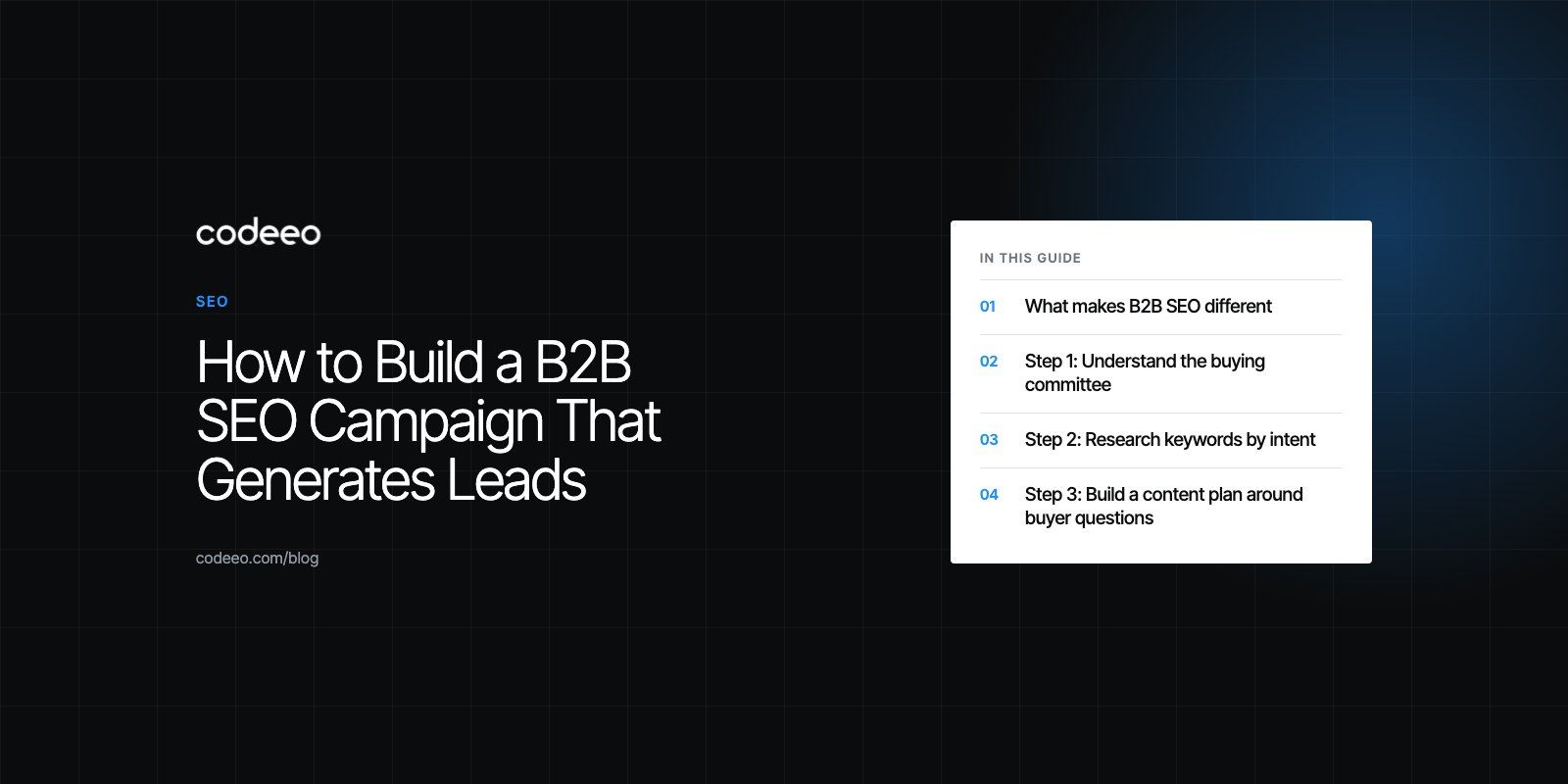
How to Build a B2B SEO Campaign That Generates Leads
A ten step B2B SEO campaign plan: buying committee research, intent keywords, expert content, technical fixes, backlinks, regions and lead tracking.
A winning B2B SEO campaign starts with the buying committee, not the keyword tool. Map the questions decision makers ask at each stage of a long sales cycle, target the specific, lower volume searches that signal real intent, answer them with expert content and proof, and make sure the site is technically sound so those pages can rank. Then measure leads and pipeline, not just traffic, and keep refining every quarter.
This guide breaks the campaign into ten practical steps, from audience research to reporting, with the mistakes that waste B2B SEO budgets along the way.
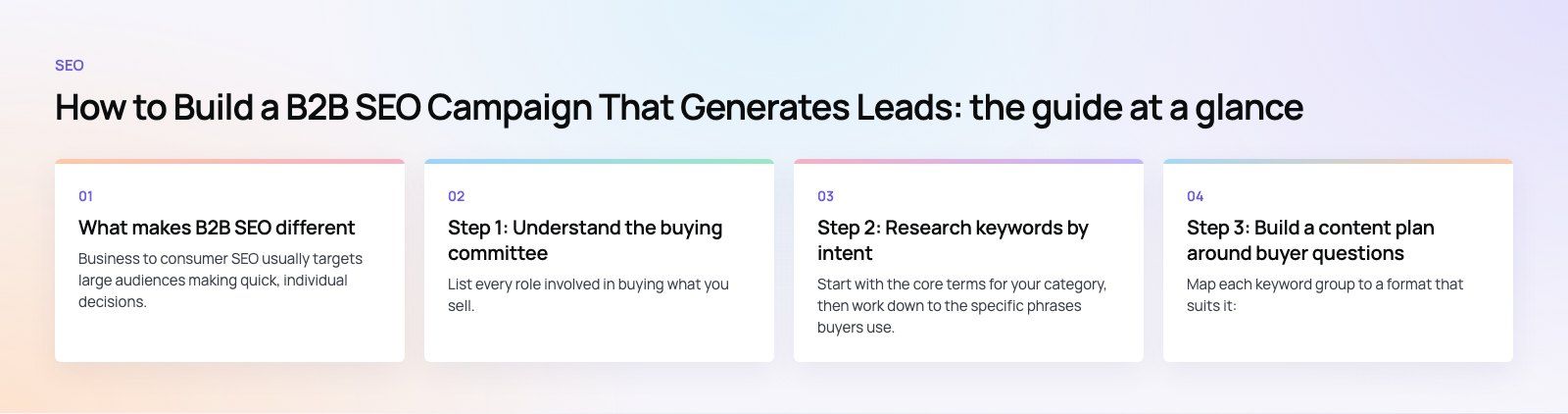
What makes B2B SEO different
Business to consumer SEO usually targets large audiences making quick, individual decisions. B2B SEO targets a small number of people inside companies who research for weeks or months, compare vendors, involve colleagues and need to justify the purchase internally. That changes almost everything:
| Factor | B2C SEO | B2B SEO |
|---|---|---|
| Audience | Individual consumers | Buying committees: users, managers, finance, IT, executives |
| Search volume | Often high | Often low, but each visitor can be worth a lot |
| Sales cycle | Minutes to days | Weeks to months |
| Content | Product pages, reviews, quick guides | Comparisons, case studies, technical documentation, buyer guides |
| Success metric | Sales and revenue | Qualified leads, pipeline and closed deals |
Because the audience is small and specific, a B2B campaign wins by being more useful and more credible than competitors, not by chasing the biggest keywords.
Step 1: Understand the buying committee
List every role involved in buying what you sell. A software purchase might involve the team that will use it, their manager, IT security, procurement and a finance approver. Each has different questions. Users ask how it works. IT asks about integrations and security. Finance asks about total cost and return.
Talk to your sales team and read call notes and lost deal reasons. The questions prospects ask on calls are the questions they type into search engines before they ever contact you.
Step 2: Research keywords by intent
Start with the core terms for your category, then work down to the specific phrases buyers use. Long, specific searches have lower volume but much higher intent. Someone searching for a category name is browsing; someone searching for how that product integrates with their ERP is close to buying.
Group keywords by stage:
- Problem aware: searches describing the pain, such as how to reduce a particular operational cost.
- Solution aware: searches for the type of product or service, and comparisons between approaches.
- Vendor aware: comparisons, alternatives, pricing models, reviews and integration questions.
Older advice talks about "LSI keywords". Search engines no longer work that way. What matters is covering the topic fully, with the related terms, entities and questions an expert would naturally include. Tools such as Semrush and Ahrefs help you find these and see which pages rank for them today.
Step 3: Build a content plan around buyer questions
Map each keyword group to a format that suits it:
| Stage | Formats that work |
|---|---|
| Problem aware | Explainers, checklists, industry guides, short videos |
| Solution aware | Approach comparisons, buyer guides, cost driver explainers, webinars |
| Vendor aware | Service pages, case studies, integration pages, alternative and comparison pages |
Write from real expertise. Google's guidance on creating helpful, reliable content rewards first hand experience, clear authorship and evidence. For B2B, that means named authors with relevant experience, real examples, specific processes and honest trade offs. Mix formats too: diagrams, short videos and downloadable checklists help busy decision makers absorb detail quickly.
Step 4: Get on page basics right
- Titles and meta descriptions that state clearly what the page covers and who it is for.
- One H1 per page, then logical H2 and H3 headings that mirror buyer questions.
- Short, descriptive URLs.
- Internal links from guides to related service pages and case studies, so authority and readers flow toward pages that convert.
- Descriptive alt text on images, written for people first.
- Readable layout: short paragraphs, lists, tables and a summary near the top.
- Structured data for organization, articles, FAQs and products where relevant, following Google's structured data guidelines.
Step 5: Fix technical SEO
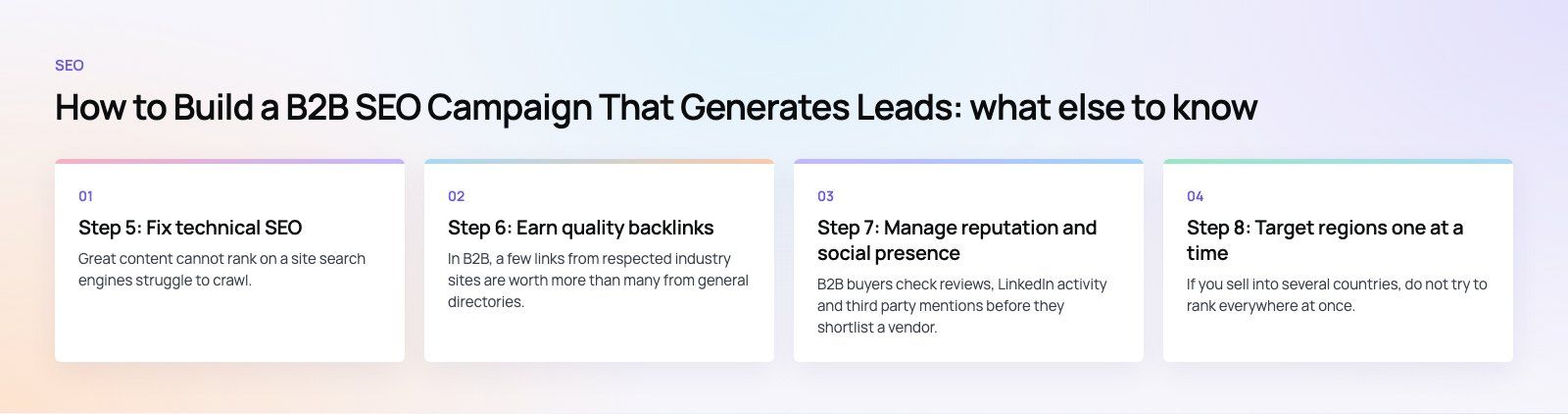
Great content cannot rank on a site search engines struggle to crawl. Check that important pages are indexable, that the site is fast and stable on mobile, that there are no redirect chains or broken links, and that duplicate pages have correct canonical tags. Many B2B sites carry years of old landing pages and thin blog posts that dilute quality. A technical SEO review finds these issues quickly, and our Core Web Vitals work fixes speed problems at the source.
Step 6: Earn quality backlinks
In B2B, a few links from respected industry sites are worth more than many from general directories. Practical ways to earn them:
- Publish original research or benchmarks from your own data that others will cite.
- Write guest articles for industry publications and association websites.
- Speak at events and webinars that link to speaker pages.
- Create genuinely useful tools, templates or calculators.
- Get listed by technology partners, clients and suppliers where a real relationship exists.
Avoid buying links or joining link schemes. They carry real risk and rarely help B2B rankings.
Step 7: Manage reputation and social presence
B2B buyers check reviews, LinkedIn activity and third party mentions before they shortlist a vendor. Ask satisfied clients for reviews on the platforms your buyers use, respond professionally to criticism, and keep company and leadership profiles active. Social signals are not a direct ranking factor, but sharing content on LinkedIn and industry communities gets it in front of the people who link to it and search for your brand later.
Step 8: Target regions one at a time
If you sell into several countries, do not try to rank everywhere at once. Pick one priority market, research how buyers there search, including language and local terms, and build pages that address local regulation, currency, delivery and examples. Then repeat for the next market. Google's guidance on managing multi regional sites explains how to structure URLs and hreflang tags so the right version shows in each country.
Step 9: Optimize your Google Business Profile
Even B2B companies get searched by name and location. Claim and complete your Google Business Profile with accurate name, address, phone, hours, categories and website. Add real photos of your office and team, post updates, and reply to reviews. Keep the same business details on your website and directory listings. For firms with several offices, our local SEO service manages each location.
Step 10: Measure what matters
Set goals that connect SEO to revenue:
- Organic sessions to service, comparison and case study pages.
- Rankings for your priority intent keywords, tracked by stage.
- Form fills, demo requests, calls and downloads from organic visitors.
- Qualified leads and pipeline value attributed to organic search in your CRM.
- Assisted conversions, since many buyers read several articles before they contact you.
Review monthly, report quarterly, and compare the value of organic pipeline with what you spend on content and SEO. When something does not work, change the approach rather than producing more of the same.
Common B2B SEO mistakes
- Targeting high volume keywords that attract students and job seekers instead of buyers.
- Publishing generic content with no expertise, data or examples behind it.
- Reporting traffic and rankings without connecting them to leads.
- Leaving service pages thin while the blog grows.
- Ignoring technical debt on old sites until rankings drop.
Keep the campaign moving
B2B SEO compounds over time when it is planned around real buyer questions and kept technically healthy. Search is also changing fast, with AI generated answers now appearing alongside traditional results, which rewards clear, well structured, expert content even more. Codeeo has delivered 200+ projects across the UAE and the US, including the Modon Holding website. Our digital marketing team can plan and run your B2B SEO campaign.
Frequently asked questions
B2B SEO is search engine optimization for companies that sell to other businesses.
It focuses on the decision makers inside target companies and the specific questions they research during a long buying process. Instead of chasing high traffic, it targets lower volume, high intent searches and measures success by qualified leads and sales pipeline.
SEOHow to Optimize Your Website for Search EnginesA practical guide to optimizing a website for search engines: technical health, mobile first indexing, on page content, earning links and measuring results. SEOTechnical SEO vs On-Page SEO: Differences and How They Work TogetherTechnical SEO gets your pages indexed; on-page SEO makes them rank. See what each covers, where they overlap and the order to fix problems in.
 SEOWordPress SEO Tips: A Practical Checklist to Improve RankingsA practical WordPress SEO checklist: plugin setup, site structure, keyword intent, titles, speed, mobile, schema, monitoring and the mistakes that hold sites back.
Tell us what the business needs. We will tell you what to build first.
Schedule a free consultation and get a written recommendation, with costs, before you commit to anything.
Get in touchPROVEN RESULTS
4.7 / 5verified reviews on Google