 InsightsHow Employee Engagement Drives Business PerformanceHow employee engagement affects profit, productivity, absence, retention, customers and innovation, what the evidence says, and how to link it to results.
Employee Engagement Activities That Build Team Cohesion
Eight employee engagement activities that strengthen team cohesion and morale, with a comparison table, tips for running them well and mistakes to avoid.
The employee engagement activities that build team cohesion and morale are the ones people choose to take part in and that connect to something real: solving actual problems together, helping a cause the team cares about, learning new skills, or simply getting to know colleagues they rarely work with. Good options include innovation challenges, volunteering, wellness programs, structured recognition, learning sessions, retreats, inclusion workshops and well run virtual activities for remote teams.
This article covers eight activity types, what each one is good for, how to choose and run them, and how to tell whether they are working.
Why engagement activities matter
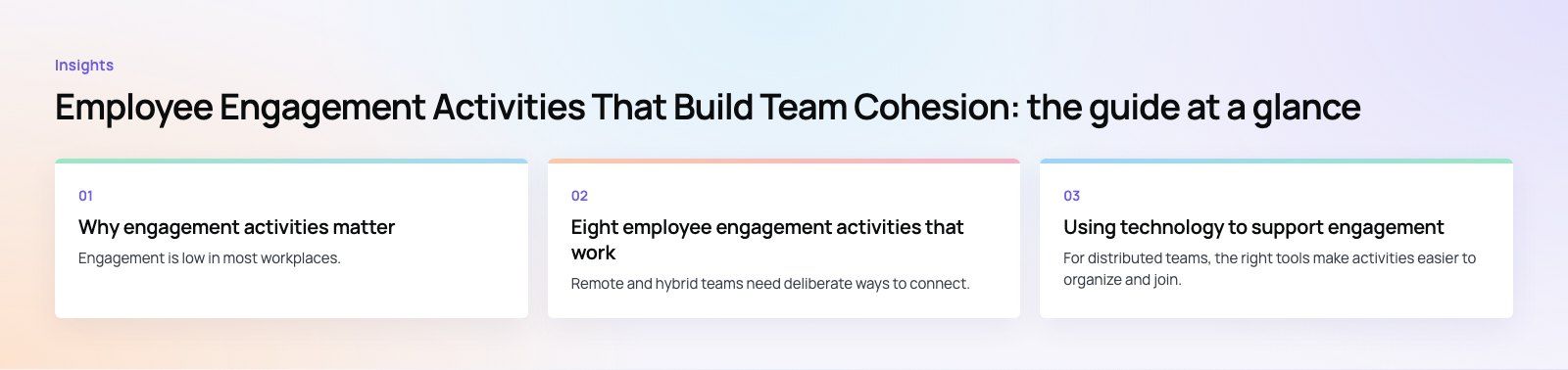
Engagement is low in most workplaces. Gallup's State of the Global Workplace 2026 report found that only 20% of employees worldwide were engaged in 2025. Activities alone will not fix that, because engagement depends heavily on managers, goals and daily work, but well chosen activities strengthen the relationships and trust that engagement grows from.
The benefits companies usually look for:
- Stronger relationships and collaboration across teams.
- Higher morale and job satisfaction.
- A shared sense of culture and values.
- More ideas and willingness to try new things.
- Better retention, because people stay where they feel connected.
Eight employee engagement activities that work
1. Virtual team building
Remote and hybrid teams need deliberate ways to connect. Online trivia, virtual escape rooms, show and tell sessions and informal video coffee breaks give people who rarely meet a chance to know each other. Keep them short, optional and during working hours. One simple approach is to let the team vote on which activities to run, so the program reflects what people actually enjoy.
2. Community service and volunteering
Volunteering together, such as mentoring young people, beach cleanups or tree planting, gives teams a shared sense of purpose outside their usual roles. It also exposes different strengths: the quiet analyst might turn out to be the best organizer. Let staff suggest causes so the activity feels genuine rather than staged.
3. Innovation challenges
Idea competitions, innovation workshops and internal hackathons invite people to solve real business problems. They build creativity and cross team collaboration, and the best ideas can become real projects. Two things make or break them: a clear problem statement, and a visible follow up on the winning ideas. Challenges where nothing happens afterward damage morale.
4. Wellness programs
Wellbeing and engagement are closely linked. Fitness challenges, yoga or meditation sessions, walking meetings and access to mental health support help people manage stress. Many wellness activities are inexpensive. Ask staff what they want before launching, because a program built on assumptions often goes unused.
5. Recognition programs
Recognition boosts morale and reinforces the behavior you want to see. Options range from regular shout outs in team meetings to peer nomination schemes and personal thank you notes from senior leaders. Recognition works best when it is specific, timely and fair, and when it covers quieter contributors as well as the most visible people.
6. Learning and development sessions
Lunch and learn sessions, internal workshops and support for courses or qualifications help people grow, and growth is a strong reason to stay. Sessions led by colleagues are especially good for cohesion, because they spread knowledge and give people a platform to share what they know.
7. Team retreats
Off site retreats, whether a day of outdoor activities or a structured planning session somewhere new, help teams build trust away from daily pressure. They do not have to be lavish. A clear agenda that balances work sessions with genuine downtime matters more than the venue.
8. Inclusion and diversity workshops
Workshops on inclusion, employee resource groups and cultural awareness sessions help everyone feel respected and heard. In teams that span several nationalities and locations, these sessions also improve communication and reduce misunderstandings. The most important rule is that every voice is heard, not just the loudest.
Comparing activity types
| Activity | Main benefit | Effort | Remote friendly |
|---|---|---|---|
| Virtual team building | Connection for distributed teams | Low | Yes |
| Volunteering | Shared purpose | Medium | Partly |
| Innovation challenges | Creativity and cross team work | Medium | Yes |
| Wellness programs | Lower stress, better wellbeing | Low to medium | Yes |
| Recognition programs | Morale and motivation | Low | Yes |
| Learning sessions | Growth and knowledge sharing | Low | Yes |
| Retreats | Trust and team bonds | High | No |
| Inclusion workshops | Respect and better communication | Medium | Yes |
How to choose and run activities well
- Start with a goal. Decide what you want to improve, such as cross team collaboration, morale after a hard quarter or connection between remote staff, and choose activities that fit.
- Ask people. A short survey or vote avoids activities nobody wants.
- Keep it optional and inclusive. Consider different schedules, abilities, cultures and family commitments. Forced fun backfires.
- Run activities in work time. Asking people to give up evenings or weekends sends the wrong signal.
- Get leaders involved. When senior people take part, it shows the activity matters.
- Follow up. Share photos, results and the ideas that came out of the activity, and act on feedback.
- Mix the program. Combine regular small activities with a few bigger moments through the year.
Mistakes that hurt morale
- Using activities to cover deeper problems. A team lunch will not fix unfair workloads or poor management.
- One size fits all. Activities that suit extroverts in one office can exclude everyone else.
- No follow through. Collecting ideas or feedback and then doing nothing breeds cynicism.
- Too much competition. Friendly rivalry helps; leaderboards that embarrass people do not.
Using technology to support engagement
For distributed teams, the right tools make activities easier to organize and join. Collaboration suites such as Microsoft 365 can host recognition channels, interest groups and virtual events. Event apps can manage agendas, polls and live questions, as the Meecon event app does. Internal community apps with groups, posts and chat, similar to what we built for My Places, can give a workforce its own social space.
To see whether activities are working, track participation, pulse survey results and retention over time. A Power BI dashboard can bring these together so leaders see trends instead of anecdotes.
If you want an engagement or internal community app built around how your teams actually work, Codeeo can help. Our team of 80+ across Dubai, Riyadh and Karachi builds mobile apps and custom software for companies of all sizes.
Frequently asked questions
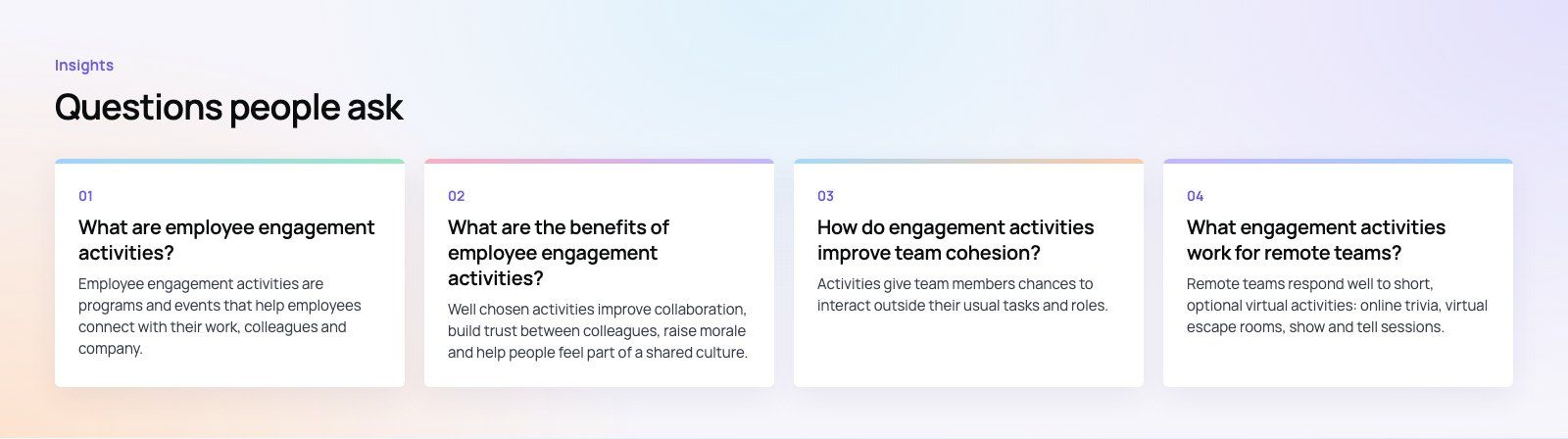
Employee engagement activities are programs and events that help employees connect with their work, colleagues and company.
They include team building, volunteering, innovation challenges, wellness programs, recognition schemes, learning sessions, retreats and inclusion workshops. The goal is to strengthen relationships, morale and commitment. They work best alongside good management and fair working conditions rather than as a replacement for them.
InsightsHow Employee Engagement Drives Business PerformanceHow employee engagement affects profit, productivity, absence, retention, customers and innovation, what the evidence says, and how to link it to results. InsightsThe Five Functions of Human Resource Management ExplainedThe five core functions of human resource management: recruitment, training, performance, compensation and employee relations, with practices and pitfalls.
 InsightsPerformance Management and Employee Engagement: A Practical GuideHow to run performance management that raises engagement: frequent check ins, specific recognition, growth plans, a strengths based approach and who owns what.
Tell us what the business needs. We will tell you what to build first.
Schedule a free consultation and get a written recommendation, with costs, before you commit to anything.
Get in touchPROVEN RESULTS
4.7 / 5verified reviews on Google