 InsightsHow Employee Engagement Drives Business PerformanceHow employee engagement affects profit, productivity, absence, retention, customers and innovation, what the evidence says, and how to link it to results.
Employee Engagement Training Activities That Deliver Real ROI
Ten interactive employee engagement training activities, a five step plan to maximize ROI, and the measures that show whether your training is paying off.
To get a real return from employee engagement training, start with a specific skill gap tied to a business result, use interactive formats such as role play, simulations and short quizzes instead of lectures, reinforce the learning after the session, and measure changes in performance and retention. Training that is relevant and active keeps people engaged while they learn, and engaged people stay longer and perform better, which is where the return comes from.
This guide covers why engagement focused training pays off, ten activity formats that work, a five step plan for maximizing ROI, and the measures that prove it.
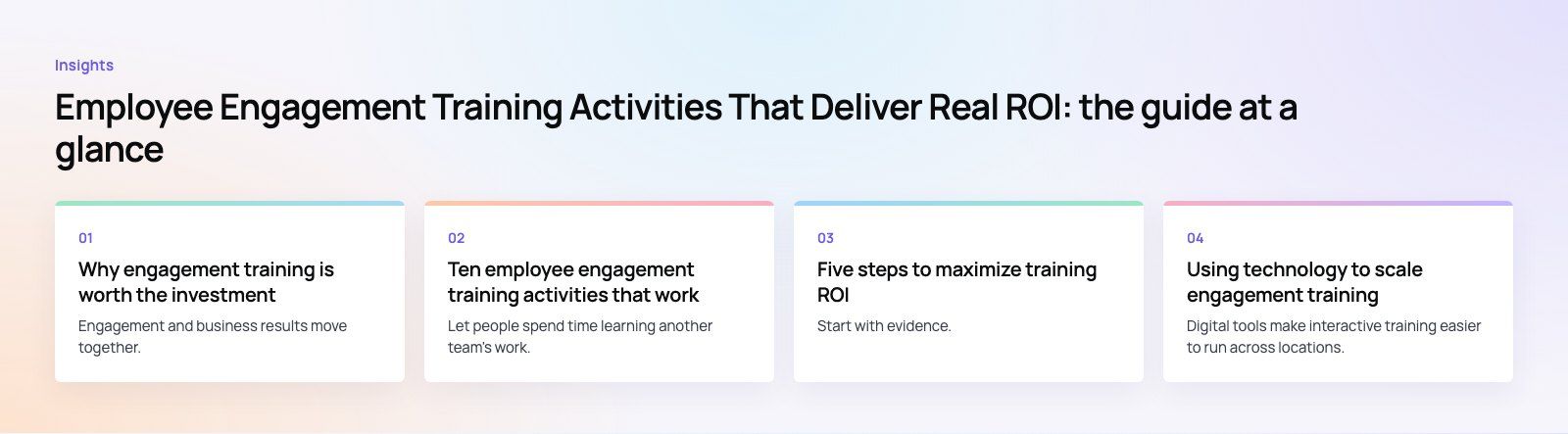
Why engagement training is worth the investment
Engagement and business results move together. Gallup's 2024 Q12 meta-analysis, covering more than 180,000 teams, found that compared with bottom quartile teams, top quartile teams for engagement showed median differences of 18% in sales productivity, 23% in profitability and 10% in customer loyalty. Development opportunities are one of the levers that move people from the bottom group toward the top.
Well designed training contributes in four ways:
- Productivity: people who know how to do their job well, and feel confident doing it, get more done.
- Retention: employees who see their employer investing in their skills have a reason to stay.
- Customer outcomes: staff trained in real scenarios handle customers better.
- Ideas: learning across teams and roles exposes people to new ways of working, which feeds improvement.
The catch is that training only produces these results if people pay attention and use what they learn. A slide deck read aloud does neither.
Ten employee engagement training activities that work
1. Cross training
Let people spend time learning another team's work. Pairing sales and marketing for a session on each other's roles, for example, improves handovers and reduces friction on shared goals.
2. Community and volunteering projects
Teams that volunteer together practice planning, communication and problem solving outside their usual roles, while doing something meaningful. Choose projects that match the skills you want to build.
3. Icebreakers
A few minutes of light activity at the start of a session, such as "two truths and a lie", lowers the barrier to speaking up later. This matters most in mixed groups who do not usually work together.
4. Team challenges
Problem solving challenges, such as an office scavenger hunt or a timed design task, build collaboration habits that carry back into daily work.
5. Role play
Role play lets people practice difficult conversations in a safe setting. Customer service teams, for example, can take turns as customer and agent to rehearse handling complaints and calming tense situations.
6. Simulations
Simulations recreate realistic situations so people can test decisions without real consequences. A sales simulation with scripted customer objections is a common example. Digital simulations can be reused across many cohorts.
7. Live polling
Polls at the start of a session show what people already know. Polls during it keep attention up and start discussion. After presenting a new approach, ask the group which option they would choose in a given scenario, then discuss the reasoning.
8. Webinars with experts
Webinars with internal or external experts reach remote and hybrid staff, and recordings become a reference library. Keep them short and leave real time for questions.
9. Quizzes and friendly competition
Short quizzes before, during and after a module reinforce memory. A light leaderboard between teams adds energy, as long as it stays friendly.
10. Microlearning tutorials
Breaking a topic into short videos or interactive steps lets people learn in small blocks and come back when they need a refresher. This suits software rollouts and process changes especially well.
Low cost options
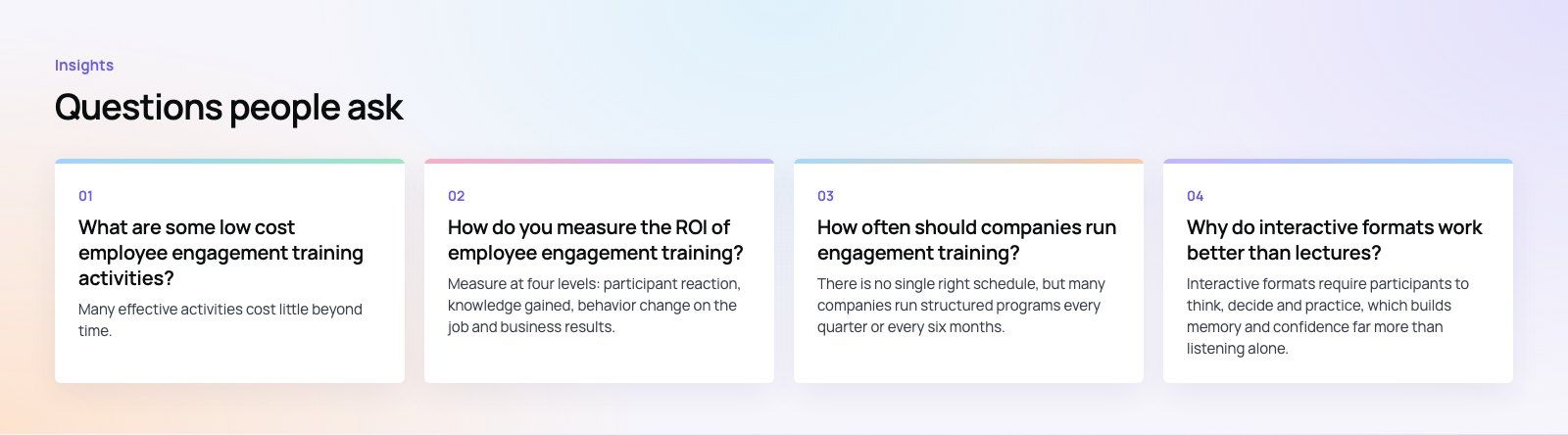
Engagement training does not need a large budget. Many activities above, such as icebreakers, role play, cross training and peer led sessions, cost little beyond time. Internal experts are often the best trainers because they know the business and its tools. Free templates and guides online can give structure, but adapt them to your context.
Comparing activity formats
| Format | Best for | Effort to run | Works remotely |
|---|---|---|---|
| Cross training | Collaboration between teams | Medium | Partly |
| Role play | Customer and people skills | Low | Yes, on video |
| Simulations | Decision making, sales | High to build, low to repeat | Yes |
| Live polling | Attention and discussion | Low | Yes |
| Webinars | Expert knowledge at scale | Low to medium | Yes |
| Quizzes | Knowledge retention | Low | Yes |
| Microlearning | Software and process changes | Medium to build | Yes |
| Team challenges | Trust and teamwork | Medium | Partly |
Five steps to maximize training ROI
1. Identify the real training need
Start with evidence. Use surveys, focus groups, performance reviews and operational data to find the skill gaps that are actually holding people back. Training aimed at a measured gap is far more likely to pay back than training chosen because it is popular.
2. Pick the right method
Match the format to the goal. Use role play for conversations, simulations for decisions, microlearning for software, and expert sessions for new knowledge. Mixing two or three formats in one program suits different learning styles.
3. Design for participation
Plan the session around what participants do, not what the trainer says. Build in discussion, group work and questions. Tie every exercise to a real situation from the business so people see how to apply it on Monday.
4. Reinforce after the session
Most of what people learn in a single session fades without practice. Support it with:
- Mentors who help people apply the new skill.
- Follow up conversations in regular one to ones.
- A shared space, such as a team channel in Microsoft 365, where people post questions and examples.
- Short refresher quizzes or videos a few weeks later.
5. Measure the impact
Decide before the program what success looks like, and measure it:
- Reaction: did participants find it useful? A short survey right after.
- Learning: did knowledge improve? Compare quiz scores before and after.
- Behavior: are people doing things differently? Ask managers and look at work samples.
- Results: did the target measure move? Productivity, quality, customer satisfaction or retention for the trained group.
Comparing a trained group against a similar group that has not yet been trained gives the clearest picture. A Power BI dashboard that joins training records with performance and HR data makes this comparison routine instead of a one off project.
Common mistakes that waste training budgets
- Training everyone in everything. Broad programs without a target rarely change behavior.
- No manager involvement. If managers do not know what their team learned, they cannot reinforce it.
- Measuring attendance only. Hours delivered say nothing about impact.
- One and done sessions. Without follow up, most of the learning disappears.
- Ignoring tools. If the systems people use do not support the new way of working, the training loses out to habit.
Using technology to scale engagement training
Digital tools make interactive training easier to run across locations. Event and session apps can handle agendas, live polls and audience questions, as the Meecon event app does for organizers. Education platforms can track tasks and give structured feedback, as in Edsidera. A dedicated mobile app puts microlearning in the pocket of staff who rarely sit at a desk.
If off the shelf learning tools do not fit how your teams work, Codeeo can help. Our team of 80+ across Dubai, Riyadh and Karachi builds custom software and apps for training, feedback and reporting.
Frequently asked questions
Many effective activities cost little beyond time.
Icebreakers, role play, cross training between teams, peer led sessions by internal experts, short quizzes and team problem solving challenges can all be run with existing staff and free tools. The key is choosing activities that target a real skill gap and connecting each exercise to situations people face in their daily work.
InsightsHow Employee Engagement Drives Business PerformanceHow employee engagement affects profit, productivity, absence, retention, customers and innovation, what the evidence says, and how to link it to results. InsightsThe Five Functions of Human Resource Management ExplainedThe five core functions of human resource management: recruitment, training, performance, compensation and employee relations, with practices and pitfalls.
 InsightsPerformance Management and Employee Engagement: A Practical GuideHow to run performance management that raises engagement: frequent check ins, specific recognition, growth plans, a strengths based approach and who owns what.
Tell us what the business needs. We will tell you what to build first.
Schedule a free consultation and get a written recommendation, with costs, before you commit to anything.
Get in touchPROVEN RESULTS
4.7 / 5verified reviews on Google