 Software DevelopmentSQL vs NoSQL Databases: Differences and How to ChooseHow SQL and NoSQL databases differ in data model, schema, scaling and consistency, where each one fits, and five questions to choose for your project.
CodeeoInsightsSoftware Development
Gas Station Point of Sale Systems: Features and How to Choose
What a modern gas station point of sale system should do, from pay at the pump and loyalty to inventory, PCI DSS and cloud, plus new versus used.
A gas station point of sale (POS) system is the software and hardware that handles fuel and store sales in one place: it controls the pumps, takes payment at the pump or the counter, tracks fuel and shop inventory, and runs loyalty programs. A modern system cuts queues with pay at the pump and contactless payments, stops stockouts with real time inventory, and gives owners data to set promotions. Older systems tend to fall short on all three.
This guide covers what a modern gas station POS should do, how to judge new against used systems, and what to check before you buy or build.
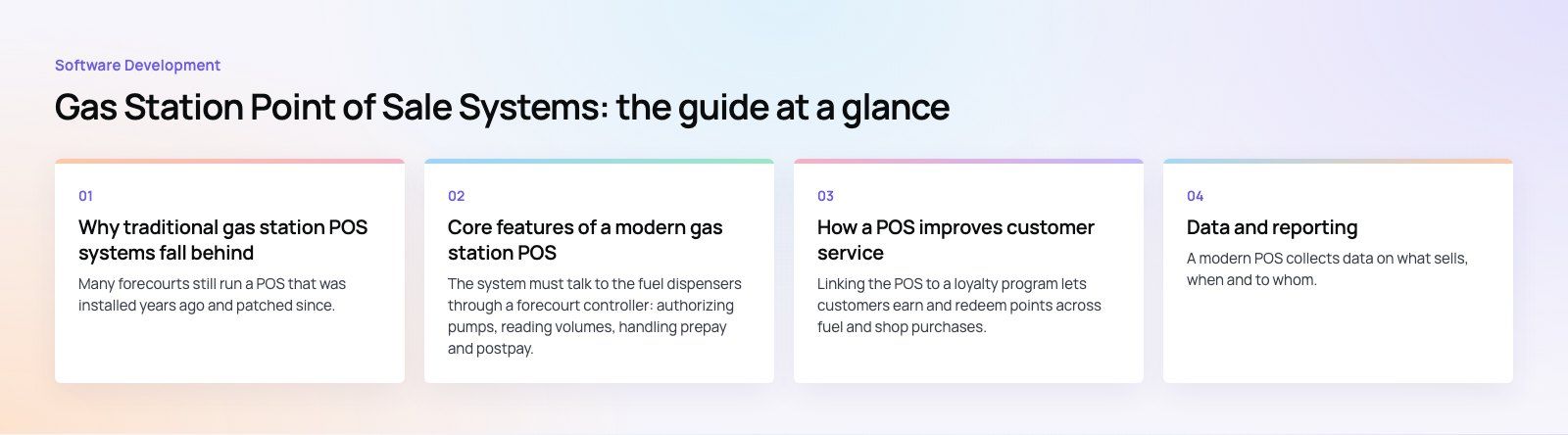
Why traditional gas station POS systems fall behind
Many forecourts still run a POS that was installed years ago and patched since. Customers expect to pay with a phone, earn points on every visit and get a receipt by email. Store teams expect stock levels to update on their own. Legacy systems usually struggle with these basics.
| Problem with older systems | Effect on the business |
|---|---|
| Limited payment options | Customers who want to tap a phone or watch walk away or wait |
| Slow transactions | Longer queues at the counter during peak hours |
| Manual inventory counts | Overstock on slow items, stockouts on popular ones, counting errors |
| Little customer data | No way to personalize offers or measure promotions |
| Clunky interface | Long training time and more cashier mistakes |
| Local server only | No remote view for owners with more than one site |
Fuel margins are thin, so the convenience store often carries more of the profit than the pumps. A POS that slows down shop sales or hides inventory problems costs more than it first appears.
Core features of a modern gas station POS
Forecourt and pump control
The system must talk to the fuel dispensers through a forecourt controller: authorizing pumps, reading volumes, handling prepay and postpay, and reconciling fuel dispensed against fuel sold. Compatibility with your existing dispensers and tank gauges is the first thing to confirm, because replacing pump hardware is far more expensive than replacing a POS.
Pay at the pump
Card readers on the dispenser let customers pay without walking inside. That shortens queues at the counter and keeps pumps turning over faster at busy times. Make sure the outdoor payment terminals accept chip, contactless and wallet payments, and that they are supported by your payment processor.
Contactless and mobile payments
Tap to pay with cards, phones and watches is now standard, built on the EMV contactless specifications maintained by EMVCo. Some fuel retailers also let customers activate a pump from their own mobile app, which ties payment directly into the loyalty account.
Real time inventory management
Every sale should update stock levels immediately, for both fuel tanks and shop shelves. Automatic reorder alerts when an item falls below a set level remove most manual counting and keep fast sellers in stock. Tank gauge integration adds fuel level alerts and helps spot leaks or delivery discrepancies.
Simple cashier interface
Staff turnover at gas stations is high, so the interface needs to be learned in a shift, not a week. Large buttons, clear pump status, fast product lookup by barcode and simple refunds all reduce errors and training time.
Task automation
Shift reports, end of day reconciliation, price changes pushed to every pump and shelf label, and age checks for restricted products should all be automated. Each manual step removed is one less place for errors.
How a POS improves customer service
Loyalty programs that cover fuel and the store
Linking the POS to a loyalty program lets customers earn and redeem points across fuel and shop purchases. The aim is to turn a fuel stop into a store visit. Points for buying coffee with fuel, or a discount per volume after a set number of shop purchases, give people a reason to come inside. The Gorgeous Flower Co store shows the same loyalty points idea in a different retail setting.
Personalized offers
With purchase history attached to a loyalty ID, the system can send targeted offers rather than blanket discounts. A customer who always buys an energy drink might get a bundle offer, while a weekend driver might get a car wash promotion.
Self checkout
Self checkout kiosks suit customers buying one or two items. They reduce counter queues during rush hours and free staff to restock or help others.
Digital receipts
Receipts sent by SMS or email are easier for business drivers who need records for expenses, and they cut paper use at the pump and the counter.
Data and reporting
A modern POS collects data on what sells, when and to whom. Owners can use that to adjust store layout, decide which products to stock near the counter, schedule staff to match busy hours and measure whether a promotion actually lifted sales. For owners with several sites, comparing locations side by side shows which practices are worth copying. Dashboards built with tools such as Power BI can combine POS, fuel and accounting data in one view.
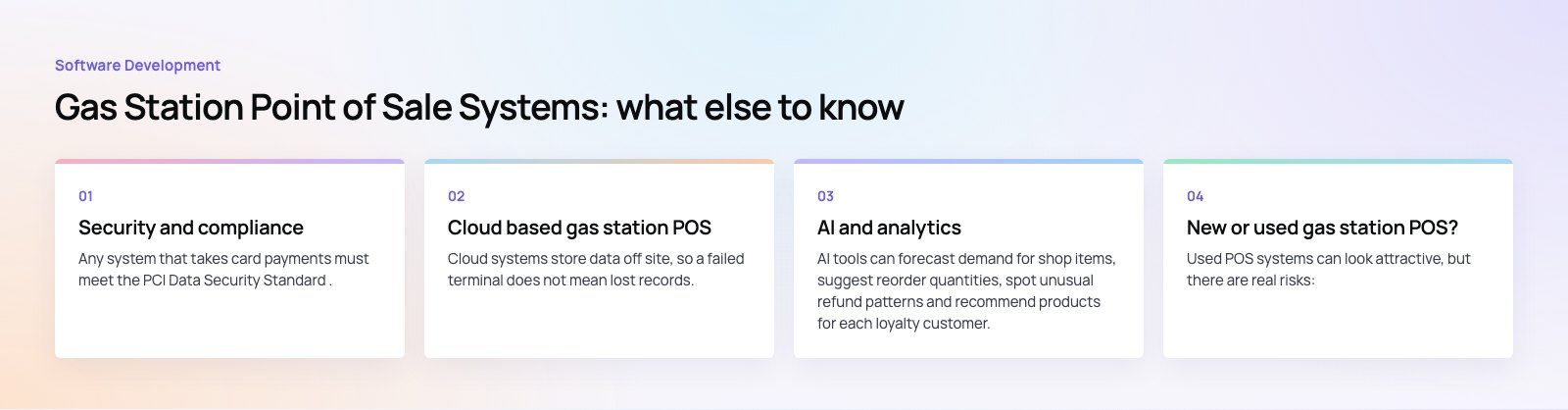
Security and compliance
PCI DSS
Any system that takes card payments must meet the PCI Data Security Standard. Outdoor payment terminals are a common target for skimming devices, so choose hardware with tamper detection, keep software patched and inspect pumps regularly. Point to point encryption and tokenization reduce how much card data your own systems ever touch.
Integration with security systems
Linking the POS to cameras lets managers match video to transactions when investigating disputes, drive offs or suspected staff fraud. Access controls on the POS itself, with individual logins for each cashier, matter just as much.
Cloud based gas station POS
Cloud systems store data off site, so a failed terminal does not mean lost records. Owners can see sales, stock and fuel levels from anywhere, push price changes to many sites at once and get software updates without a technician visit. The main trade off is connectivity: the system needs to keep selling during an internet outage and sync when the connection returns. Ask any vendor exactly how offline mode works.
AI and analytics
AI tools can forecast demand for shop items, suggest reorder quantities, spot unusual refund patterns and recommend products for each loyalty customer. These are only as good as the underlying data, so clean product catalogs and consistent loyalty sign up come first.
New or used gas station POS?
Used POS systems can look attractive, but there are real risks:
- Security: older payment terminals may no longer meet current card scheme rules or support contactless.
- Support: the vendor may have ended updates and security patches for that version.
- Compatibility: it may not work with your dispensers, tank gauges or payment processor.
- Licensing: software licences are not always transferable to a new owner.
A used system can make sense for a single site with simple needs, if the vendor confirms it is still supported. For a growing network, a current, supported system is usually the safer choice.
Off the shelf or custom POS?
Most single stations are best served by an established fuel POS product. Custom development makes sense when you run a chain with your own loyalty app, need to connect the POS to an ERP or fleet card system, or want features no vendor offers. In that case a product scoping exercise helps decide which parts to buy and which to build. Codeeo builds custom software and mobile apps for retail and service businesses, with 200+ projects delivered across the UAE and the US, and can help connect a fuel POS to the loyalty, payment and reporting tools around it.
Frequently asked questions
A gas station POS is the system that runs sales at the forecourt and in the store.
It authorizes fuel pumps, takes payments at the pump and the counter, tracks fuel and shop inventory, manages cashier shifts and connects to loyalty programs. It works like a modern cash register combined with pump control and stock management, usually with reporting for the owner.
Software DevelopmentSQL vs NoSQL Databases: Differences and How to ChooseHow SQL and NoSQL databases differ in data model, schema, scaling and consistency, where each one fits, and five questions to choose for your project. Software DevelopmentOpen Source Apps: Examples, Licenses and How to Build Your OwnWhat makes an app open source, well known examples, the steps to build your own, how to pick MIT, Apache or GPL, and when to customize instead.
 Software DevelopmentHow an Online HR Portal Improves Employee ExperienceWhat an online HR portal does, how self service improves employee experience, which features matter, and whether to buy, configure or build one.
Tell us what the business needs. We will tell you what to build first.
Schedule a free consultation and get a written recommendation, with costs, before you commit to anything.
Get in touchPROVEN RESULTS
4.7 / 5verified reviews on Google