 FreezoneCreative City Fujairah Freelance Licence: Costs, Activities and Visa OptionsCreative City Fujairah has no separate freelance permit: six company packages from sole-owner zero-visa to fifteen-visa, no published prices, remote setup, and how it compares with Shams and Ajman for a solo founder.
Dubai South Free Zone for E-Commerce and Logistics: Setup Guide 2026
Dubai South free zone suits firms moving goods through Al Maktoum airport and Jebel Ali Port. How the Logistics District, EZDubai and Business Hub licence differ, and the customs rule sellers miss.
Dubai South free zone is the right choice for an e-commerce or logistics company when the business will physically move goods through Al Maktoum International Airport or Jebel Ali Port, because the Logistics District sits inside a customs-bonded corridor that links the two. If you only need a licence, a visa and a desk, the same authority now sells that through the Dubai South Business Hub from AED 12,500 (price shown on its site on 8 October 2026), and the warehouse question can wait until you have orders to fill.
This article separates the two offers, explains what EZDubai and the new multiuser units are, and walks through the customs point that catches most online sellers: goods leaving any free zone for a Dubai customer are a mainland import, duty included.
Key takeaways
- Dubai South is regulated by Dubai Aviation City Corporation, and its Free Zone Management issues the licences, visas, NOCs and access cards.
- The Logistics District is an 18-kilometre district with a Freight Forwarding Zone on the airport cargo terminals, a Contract Logistics Zone tied to Jebel Ali Port, and EZDubai for e-commerce.
- The bonded corridor between the port and the airport covers 200 square kilometres, and Dubai South states cargo can move between them in as little as 20 minutes.
- The Dubai South Business Hub route is 100 percent digital, lists a licence from AED 12,500 with flexi-desk access, and allows up to five business groups on one licence at no extra cost.
- Dubai Customs charges 5 percent of CIF value when free zone goods are sold into the mainland, and a free zone company needs a Customs Business Code to file that declaration.
What Dubai South is, and who regulates it
Dubai South is the 145 square kilometre airport city around Al Maktoum International Airport, the figure EZDubai gives on its own site, and the Dubai Media Office calls it the largest single-urban master development focused on aviation, logistics and real estate. The regulator is Dubai Aviation City Corporation. Its Free Zone Management page lists the services it runs directly: visa issuance, NOC letters, access cards and work permits, plus an Employment Dispute Center that promises first feedback within three business days.
Company servicing runs through a customer portal that Dubai South says covers more than a hundred services, and a DWC LLC application starts there. Create the account before finalising the activity list, because the activity codes open to you are only visible once you are inside.
Logistics District or Business Hub, which licence do you actually need
The question that decides everything is whether you need a building. Dubai South’s own business setup page offers three registration routes: a DWC LLC company or branch, a freelancer professional licence, and the Dubai South Business Hub Free Zone, which bundles a business licence, a visa and flexi-desk access.
| Need | Route | What you get | What to check first |
|---|---|---|---|
| Warehouse, fulfilment or freight forwarding on site | DWC LLC in the Logistics District | Leased unit or built-to-suit plot inside the bonded corridor | Unit availability and the activity codes the lease supports |
| Trading or online selling with third-party fulfilment | Dubai South Business Hub | Licence, flexi-desk, visa package, from AED 12,500 (8 Oct 2026) | That your five business groups cover import, export and online retail |
| Solo consultant or service provider | Freelancer licence | Professional permit for an individual | Whether your activity is on the freelancer list |
The Business Hub launched in September 2025 as a digital-first platform, reported by Gulf News on 8 September 2025 with same-day licensing as the headline promise. Its own site on 8 October 2026 states a licence from AED 12,500 including flexi-desk access, shows a limited-time price of AED 11,375, allows up to five business groups on one licence at no extra cost, claims more than 3,500 approved activities, and issues eligible licences with an instant IBAN, subject to terms. A Gulf News feature updated in October 2025 added that no paid-up capital is required. Those figures change, so get the itemised quote in writing.
One issue we often see is a founder paying for a Logistics District unit before a single order exists, on the theory that a warehouse makes the business look serious to banks. The lease then becomes the largest fixed cost in a company with no revenue. Start on the Business Hub licence, use a fulfilment provider in the district, and take your own unit when volume justifies the rent.
What the Logistics District gives you that a desk licence cannot
The Logistics District page describes an 18-kilometre district with three zones. The Freight Forwarding Zone has direct access to the Al Maktoum International Airport cargo terminals. The Contract Logistics Zone connects to Jebel Ali Port through a bonded logistics corridor. EZDubai is the dedicated e-commerce zone. Dubai South puts the corridor at 200 square kilometres, customs-bonded, with seaport-to-airport movement in as little as 20 minutes, and lists the port as ten minutes away.
Jafza’s own guide to the corridor, dated 29 September 2021, describes a single customs bonded area connecting port, free zone and airport and claims sea-air transfer time fell to under one hour from four. Those are the authorities’ figures, not independent measurements, but the mechanism is real: cargo under bond does not clear and re-clear at each handover. For a seller importing by sea and flying parcels out to GCC customers, that is the reason to be here rather than in a cheaper mainland warehouse. The trade-off is commitment: built-to-suit plots mean a long lease and a fit-out budget, and the standard warehouses were sized for established operators rather than a start-up with three pallets.
EZDubai, the e-commerce zone inside the district
EZDubai was launched in January 2019, according to a Dubai Media Office release of 27 September 2021, which gives its total size as 9,902,700 square feet, states 1,300,000 square feet had been developed and handed over by then, and lists a further 270,000 square feet under construction with two last-mile centres being built for market leaders. A Gulf News report from 28 September 2020 named DHL Express, Aramex, Amazon, Fetchr, Yunda, FirstCry and Triboo among the tenants, with a first phase of 340,000 square metres.
The EZDubai site lists what the zone is built around: single-tenant warehouses, duty-paid and duty-unpaid storage, what it calls Dubai’s first hybrid bonded facility, dedicated free zone gates, and on-site licensing and visa authority. The duty-unpaid storage is the feature that matters for a cross-border seller. Stock can sit under bond, ship to Saudi Arabia or Africa without ever paying UAE duty, and only the units sold to UAE addresses pay the 5 percent on exit.
The named tenants are carriers and marketplaces. A brand doing 300 orders a month does not need its own EZDubai unit; it needs a fulfilment partner that already has one.
The new multiuser units, and the size question
The gap between a flexi-desk and a built-to-suit warehouse is the one Dubai South tried to close in 2025. On 17 July 2025 the Dubai Media Office announced multiuser facilities in the freight forwarding zone with about 215,278 square feet of built-up area, in two unit sizes of 2,152 and 3,767 square feet, temperature-controlled, air-conditioned, with ground-level access and the option to combine units. Handover to tenants was scheduled for the first quarter of 2026. Mohsen Ahmad, CEO of the Logistics District, framed it as a facility for SMEs, e-commerce operators and traders.
We found no public confirmation on 8 October 2026 that handover has completed or that units remain available, so ask the leasing team before planning around them. If a 2,152 square foot unit is on offer, it is the first Dubai South product sized for a growing brand with its own stock, and it should be compared against a fulfilment contract on total cost per order, not on rent alone.
The airport timeline and your lease
Dubai South’s long-term value rests on the airport. On 28 April 2024 the Dubai Media Office announced approval of a new passenger terminal at AED 128 billion, with capacity of 260 million passengers and 12 million tonnes of cargo a year, five parallel runways, a 70 square kilometre footprint and a first phase of 150 million passengers within ten years. An update on 15 June 2026 put first-phase operations in 2032, with packages worth over AED 13 billion under execution, more than AED 55 billion expected to be awarded by the end of 2026, the second runway complete, and an on-site workforce of around 9,000 that is expected to reach about 120,000 at peak.
For a tenant that means judging the district on today’s airport and the Jebel Ali link, since the headline cargo capacity arrives after 2032, and confirming gate access and truck routes in writing, because a site heading for 120,000 construction workers will reroute traffic for years.
Selling into the UAE mainland from a free zone
This is the point online sellers get wrong most often. A free zone licence lets you import, store and re-export without duty, but a parcel delivered to a customer in Jumeirah is a sale into the mainland. The Dubai Customs FAQ states the duty rate as 5 percent of CIF value, with 50 percent on alcohol and 100 percent on cigarettes, and says a free zone company must process an appropriate customs declaration for sale of goods to the mainland and hold a Customs Business Code to do so. The federal Ministry of Economy and Tourism page, last updated 8 October 2026, puts the general tariff at 0 to 5 percent and confirms up to 100 percent foreign ownership in free zones.
Three practical consequences follow. Price the UAE catalogue with the 5 percent built in, because paying it per shipment at the courier’s gate is where margins leak. Decide early whether you file declarations under your own Customs Business Code or your fulfilment provider files under theirs. And keep UAE-bound and export-bound stock separable in the inventory system so a mixed pick never compromises the duty-unpaid status of export stock.
VAT depends on turnover and where supplies are made, which the licence does not change. Corporate tax follows the same logic: the 0 percent free zone rate applies only to a Qualifying Free Zone Person, and a company selling mainly to UAE consumers can fail that test. Our post on corporate tax relief for small businesses covers the thresholds. Figures here are indicative, not tax or legal advice; confirm your position with a registered tax agent.
Visas, office and the day-to-day administration
The Free Zone Management issues visas, work permits, NOCs and access cards, and Dubai South does not publish a public table of visa quotas per office type the way some zones do. When you request a quote, ask for the quota attached to the flexi-desk and to each unit size in writing, because a two-visa desk package that later needs five sales staff forces an upgrade to a larger premises. The Employment Dispute Center, with its three business day response target, is the authority’s own mediation route for staff disputes before anything reaches the courts.
For a logistics operator, gate passes, driver access cards and the Customs Business Code sit alongside the trade licence, each with its own renewal. A missed access card renewal does not stop the licence, but it stops the truck.
Dubai South against Jafza and Dubai CommerCity
Three Dubai zones court online sellers. Jafza sits at the port and is the natural choice when sea freight dominates and the company already trades through Jebel Ali; our DMCC versus Jafza comparison covers the trading-company view, and the Jafza setup page covers the process. Dubai CommerCity, which describes itself on its site as a joint venture between Dubai Integrated Economic Zones Authority and Wasl Properties, sits near Dubai International Airport and markets office, retail and fulfilment space to digital commerce companies. Dubai South is the airport-side option with the bonded corridor to the port.
Sea-in, air-out GCC distribution favours Dubai South. Pure domestic fulfilment with stock from the port favours Jafza or a mainland warehouse. A brand with an office-first team and outsourced fulfilment can pick on licence cost and visa terms alone, and the Dubai South setup page is a sensible place to start that comparison.
A setup sequence that avoids the usual mistakes
- Write down the physical flow of goods first, including the origin port, the share going to UAE addresses, and the share re-exported. That single page decides the route.
- Reserve the trade name and check that your activities fit within five business groups if you are using the Business Hub, so you are not paying for additions later.
- Take the licence and flexi-desk before any lease. Open the corporate bank account on that licence, using the instant IBAN if your licence is eligible, and then negotiate space.
- Apply for the Customs Business Code as soon as the licence is issued if you will import under your own name.
- Sign a fulfilment agreement with a Logistics District or EZDubai operator for the first year and record the per-order cost. Compare it against a multiuser unit at month nine, not month one.
- Register for VAT when the threshold requires it and set up the duty-paid and duty-unpaid stock split in your inventory system before the first container lands.
From a development perspective, the storefront should reflect the same split. A Shopify or WooCommerce store serving both UAE and export customers needs separate shipping and tax rules per market, and that is far easier to build in before launch than to retrofit. Codeeo builds those storefronts as part of its Shopify development and WooCommerce development services, and handles the licence side through its business setup service.
If you are weighing Dubai South against another zone for an online or logistics business, Codeeo’s business setup team can map the goods flow, confirm current fees with the authority and set up the storefront to match. Figures in this article are indicative, were checked on 8 October 2026, and do not constitute legal, tax or customs advice.
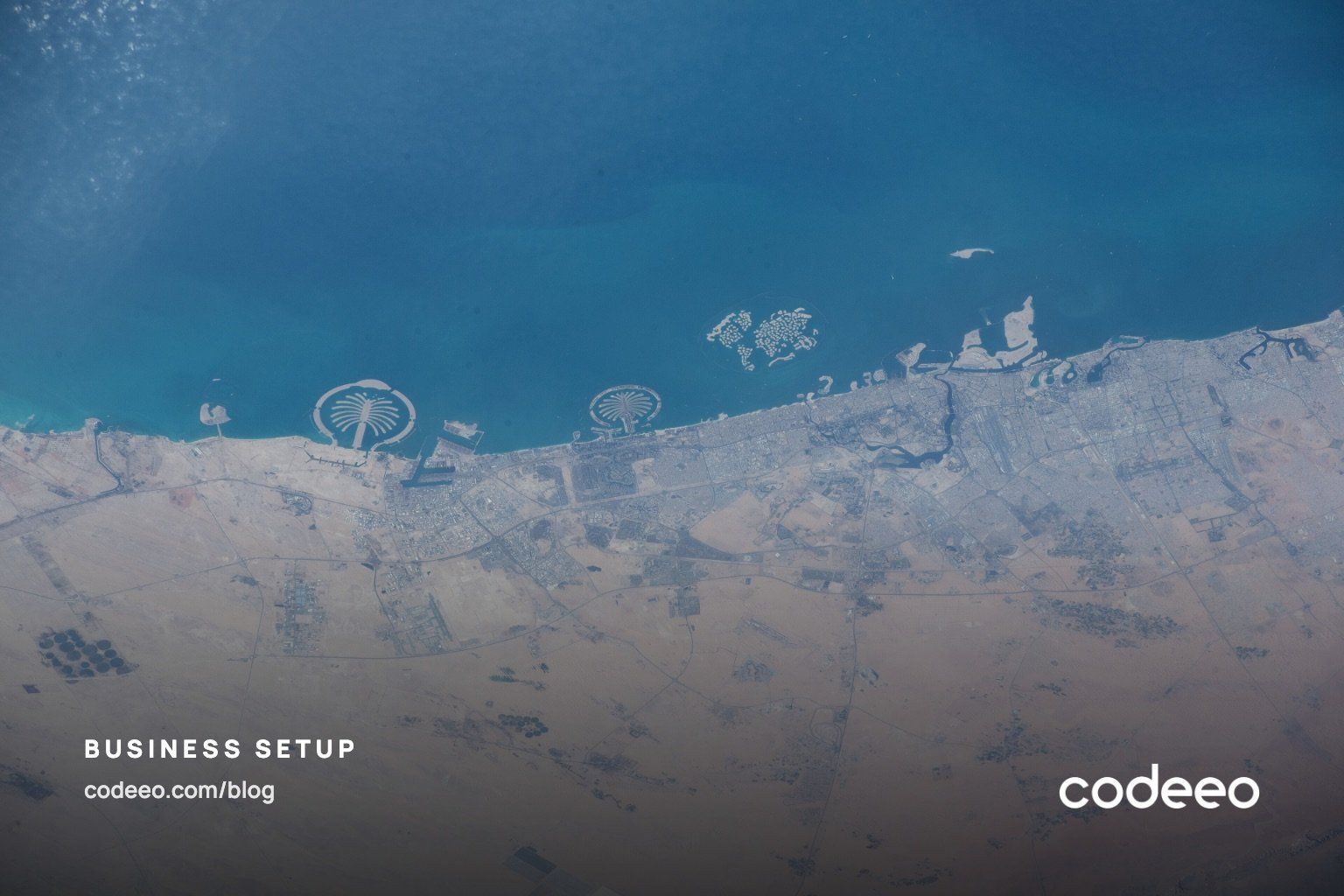
Cover photo: Dubai from space (iss066e126122), via Wikimedia Commons (Public domain).
FreezoneCreative City Fujairah Freelance Licence: Costs, Activities and Visa OptionsCreative City Fujairah has no separate freelance permit: six company packages from sole-owner zero-visa to fifteen-visa, no published prices, remote setup, and how it compares with Shams and Ajman for a solo founder. FreezoneDMCC vs JAFZA: Which Dubai Free Zone Is Right for a Trading Company?DMCC vs JAFZA decided on what your goods actually do. The published 2026 package prices, the warehouse sizes, the visa-to-desk link, the licence structures, and the questions neither free zone answers on its website.
 FreezoneShams Free Zone Licence: What Sharjah Media City PublishesSharjah Media City publishes no licence fee. Here is what Shams does publish in 2026: the five-activity rule, the Red Licence, the 50 visa ceiling, the LLC suffix, and the corporate tax condition behind the 0% rate.
Tell us what the business needs. We will tell you what to build first.
Schedule a free consultation and get a written recommendation, with costs, before you commit to anything.
Get in touchPROVEN RESULTS
4.7 / 5verified reviews on Google