 Web DevelopmentBusiness Website Design DubaiWhat a business website in Dubai should do, template vs custom builds, what drives cost and time, platforms, SEO and conversion, and choosing an agency in Business Bay.
Logistics Website Dubai: What Freight Companies Need
How to structure a logistics website in Dubai around the six Dubai Trade customer roles, a quote form that qualifies, tracking you can realistically integrate, and trade lane pages that stay the right side of Google’s scaled content abuse policy.
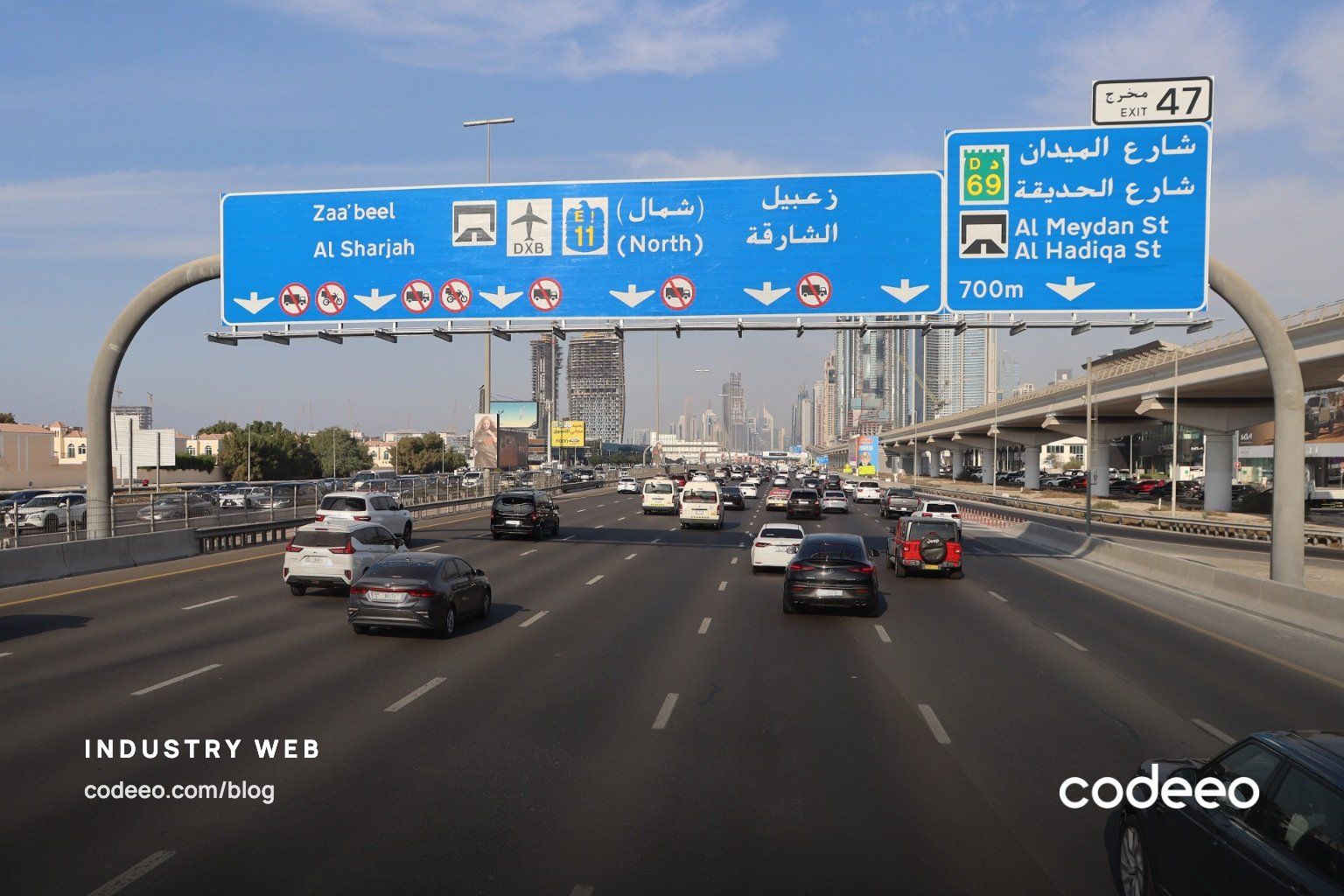
A logistics website in Dubai has one job that matters more than the rest: turning a shipper who has never heard of you into a qualified quote request. Freight is bought on trust and on specifics, so the pages that win are the ones that name the trade lanes you actually run, the licences and memberships you actually hold, and the cargo you will not handle. Everything else, including a live tracking widget, is secondary to that.
Key takeaways
- Dubai Trade lists six distinct customer roles, from freight forwarder to clearing agent to free zone company, and a site written for all of them at once reads as written for none of them.
- A quote form that asks for incoterm, commodity, weight, dimensions and ready date qualifies better than one that asks for a name and a message.
- Google’s structured data gallery, updated 15 June 2026, contains no shipment or logistics rich result, so tracking markup earns nothing in search.
- Trade lane pages work, but Google’s July 2026 guidance says generating a page per query variation to manipulate rankings violates the scaled content abuse policy.
- Core Web Vitals targets are LCP under 2.5 seconds, INP under 200 milliseconds and CLS under 0.1, measured at the 75th percentile of real page loads.
- AI Mode has supported Modern Standard Arabic since 8 October 2025, and early AI Mode users ask questions two or three times longer than ordinary searches.
Decide which of the six trade roles you are selling to
The Dubai Trade portal, which offers over 700 e-services under a single window, segments its own users into importers and exporters, shipping agents, airline agents, clearing agents, freight forwarders and free zone companies operating from JAFZA, NIP, DAZ or Textile City. That segmentation is not marketing. It reflects genuinely different buying situations, and it is the most useful starting point for a site structure.
A clearing agent handling customs on behalf of an importer wants to know your declaration turnaround and whether you work inside their free zone. An e-commerce seller in Dubai South shipping 400 parcels a week wants last-mile coverage and returns handling. A trading company moving two containers a month from Jebel Ali to East Africa wants a rate and a sailing schedule. One homepage cannot answer all three, and the usual compromise, a page of generic capability statements, answers none of them.
From a development perspective, the cleanest structure is a short homepage that states what you move and where, then one page per service line, then one page per major lane. Segment pages written in the buyer’s own language, such as “customs clearance for free zone traders”, outperform service pages named after internal departments.
The quote request is the product
Most logistics enquiries that arrive through a website are unusable, because the form asked for a name, an email and a message. The sales team then spends two emails collecting what should have been captured in the first place, and in that gap the shipper has already had a reply from someone else.
A quote form that works asks for the things a rate depends on: origin and destination, mode, commodity, incoterm, gross weight, dimensions or volume, number of pieces, whether the cargo is hazardous or temperature controlled, and the ready date. That is nine fields, which sounds like a lot until you consider that a shipper who will not answer them was never going to become a customer.
Two design decisions matter more than the field list. The first is progressive disclosure: ask for the lane and the mode on screen one, the cargo details on screen two, and the contact details last, after the visitor has already invested effort. The second is honest routing. If you do not handle project cargo or live animals, say so on the form itself rather than letting the enquiry arrive and die.
One issue we often see is a quote form that posts into a generic inbox with no reference number and no acknowledgement. The shipper has no proof the request landed, and the enquiry competes with invoices and newsletters. Sending an immediate acknowledgement with a reference, and pushing the record into whatever system the operations team already lives in, costs little and changes the conversion rate more than a redesign does.
Tracking: what is realistic to integrate
Shipment tracking is the feature most requested and least understood. The honest position is that a mid-sized Dubai forwarder rarely owns the tracking data. Container movements sit with the carrier and the terminal, customs status sits with Dubai Customs, and the Dubai Trade app already lets customers request and track delivery orders and make payments directly. Rebuilding that badly on your own site adds a layer that can be wrong.
There are three workable approaches, in increasing order of cost:
- Link out. A tracking page that explains which reference to use where, and links to the carrier and portal, is genuinely useful and takes a day to build.
- Status mirroring. Your operations system already records milestones such as booked, loaded, sailed, arrived and cleared. Exposing those to the customer behind a login, updated by your own staff, is honest about its source and is usually enough.
- Carrier integration. Pulling live events from carrier APIs or a tracking aggregator gives the best experience and brings real cost, because every carrier models events differently and the mapping needs maintenance. Our note on integrating UAE business systems through APIs covers the groundwork.
What tracking will not do is help you rank. Google’s structured data gallery, last updated 15 June 2026, lists the rich result types Google actually supports, and there is no shipment, consignment or logistics type among them. Organization, local business, breadcrumb, review snippet and job posting are there and are worth implementing. Our piece on schema markup for UAE local businesses explains which of those pay off.
Trade lane pages, and the line you should not cross
Lane pages are the strongest organic play in freight, because the searches are specific and commercial. Someone searching for sea freight from Jebel Ali to Mombasa is close to buying. Jebel Ali alone supports over 80 weekly services connecting more than 150 ports, according to DP World, so the list of plausible lane pages runs into the hundreds.
That is exactly where it goes wrong. Google’s guide to optimizing for generative AI search, updated 10 July 2026, is explicit that while covering related questions is fine, doing it “primarily to manipulate rankings or generative AI responses in Google Search violates Google’s scaled content abuse spam policy”. It adds that a high quantity of pages does not make a site higher quality or more relevant. A forwarder who generates 300 near-identical lane pages by swapping two place names has built the thing the policy describes.
The workable version is a smaller set of lanes you genuinely serve, each carrying information only an operator would have. Our rule of thumb is that a lane page needs at least four of these before it earns a URL:
- Typical transit time and the frequency of sailings or flights you actually book.
- The ports or airports you route through, and why that routing rather than the obvious one.
- Documentation particular to the destination, such as certificates of origin or pre-shipment inspection.
- Commodities you move on that lane and ones you decline.
- Seasonal reality, such as peak-season space on that trade or the effect of local holidays.
Twelve lane pages with that substance will beat 300 thin ones, and they will not put the rest of the site at risk. The same guide notes that unique content people find useful will influence visibility in generative AI search more than any other suggestion in it.
Credibility signals a shipper checks before replying
Freight buyers carry out a short, consistent check before they send cargo details to a stranger. Make that check easy to pass and put the evidence where it is seen, not on a page called “About”.
A real street address with the emirate named, because “Dubai, UAE” on its own tells a shipper nothing. The trade licence number and the issuing authority, because a shipper can verify it. Membership numbers for bodies you actually belong to, and nothing you do not. The names and photographs of the operations people a customer will deal with. A landline as well as a mobile number. Working hours stated with the weekend convention, since Friday and Saturday still differ across the region.
Two things damage credibility quickly. Stock photography of container ports that are visibly not Jebel Ali, and claims that cannot be checked. Describing yourself as a leading provider says nothing; stating that you clear 40 declarations a week and run weekly consolidations to two named destinations says a great deal. If you cannot evidence a number, leave it out rather than rounding it upward.
Speed, because the audience is on a phone in a yard
A large part of this traffic arrives on mobile data from people who are not at a desk. Google’s Core Web Vitals thresholds, set out on web.dev and last updated 31 October 2024, are Largest Contentful Paint within 2.5 seconds, Interaction to Next Paint of 200 milliseconds or less, and Cumulative Layout Shift of 0.1 or less, assessed at the 75th percentile of page loads and segmented across mobile and desktop. The 75th percentile matters: a site that feels quick on office wifi can still fail, because the measurement is taken from real users on worse connections.
In practice the usual offenders on logistics sites are an uncompressed hero image of a port, a tracking widget loading a third-party script on every page rather than only on the tracking page, and a chat widget that shifts the layout as it appears. Hosting location plays a part as well, which we covered in when a UAE local server is worth it.
Arabic is a second audience, not a translation task
Google brought AI Overviews to the Middle East and North Africa, and to Arabic globally, on 20 May 2025. AI Mode followed in English in the region in August 2025, and added Modern Standard Arabic on 8 October 2025. The same announcement notes that early AI Mode users ask questions two or three times the length of traditional search queries.
For a Dubai forwarder this has a practical consequence. Longer, more conversational questions in Arabic, asking about documents for a specific destination or the cost of clearing a particular commodity, are searches your English-only site cannot be retrieved for. A loose machine translation does not fix it either, because the result is the commodity content Google’s guidance describes. An Arabic page that carries the same lanes, documents and conditions as the English one, written by someone who works in the language, with its own URL and hreflang annotations, is the version worth paying for. Start with the three pages that generate enquiries rather than translating the whole site at once.
What to build first
For a forwarder with no usable website, we would usually recommend this order, because each stage earns something before the next is paid for:
- Homepage, two or three service pages and a contact page with verifiable company details. This is the minimum that lets a shipper trust you.
- The quote flow, with the field set above, acknowledgement emails and delivery into your operations inbox or system.
- Four to six lane pages covering the trades you are strongest on, each meeting the substance test.
- A tracking page that links out honestly, deferring any carrier integration until enquiry volume justifies it.
- Arabic versions of the highest-performing pages, then the customer login if operations can keep it current.
What can go wrong is predictable. A customer portal nobody updates is worse than no portal. Lane pages written by someone who has never booked that trade read as filler and will be treated as such. Published transit times become a complaint when they slip, so phrase them as typical rather than guaranteed and review them each quarter. If you are weighing the build itself, our web design and web application development pages set out how the two halves differ.
If you are planning a website for a Dubai freight, customs clearance or last-mile business and want the quote flow and lane structure worked out before anything is designed, our Dubai team can review what you have and map it against the enquiries you want.
Indicative figures only; this article is general information about website planning and not legal, customs or trade advice. Sources checked on 1 October 2026: Dubai Trade portal (dubaitrade.ae), DP World Jebel Ali terminal facts, Google Search Central (optimizing for generative AI features, updated 10 July 2026; structured data gallery, updated 15 June 2026; documentation changelog entry of 8 May 2026), web.dev Web Vitals (updated 31 October 2024) and the Google MENA Blog post of 8 October 2025. Cover photo: E11 Sheikh Zayed Road Northeast Near Exit 47 by Coolcaesar, via Wikimedia Commons (CC BY 4.0).
Web DevelopmentBusiness Website Design DubaiWhat a business website in Dubai should do, template vs custom builds, what drives cost and time, platforms, SEO and conversion, and choosing an agency in Business Bay. Web DevelopmentBest Website Designing Company in DubaiHow to choose a website designing company in Dubai: business goals, the right platform, SEO and conversion, costs and timelines, and support after launch.
 Web DevelopmentInclusive Web Design: Principles, WCAG 2.2 Checks and Tools for 2026What inclusive web design means in 2026, the seven principles behind it, the WCAG 2.2 checks that matter most, useful accessibility tools and the laws to know.
Tell us what the business needs. We will tell you what to build first.
Schedule a free consultation and get a written recommendation, with costs, before you commit to anything.
Get in touchPROVEN RESULTS
4.7 / 5verified reviews on Google