 Web DevelopmentBusiness Website Design DubaiWhat a business website in Dubai should do, template vs custom builds, what drives cost and time, platforms, SEO and conversion, and choosing an agency in Business Bay.
School Website Dubai: Building Around KHDA Rules
A school website in Dubai is regulated advertising. What KHDA allows you to claim, how the AED 500 application fee changes the admissions form, the 31 December age cut-off, fees pages after the 2026-27 freeze, and the narrower rules for training institutes.
A school website in Dubai has one commercial job: turning a parent’s search into a booked tour or a submitted application. What makes it different from any other business site is that KHDA treats almost everything on it as regulated. Claims, fees, admission forms, testimonials, even the age calculator on the admissions page all sit under published KHDA rules. Build the site around those rules and the website gets simpler, because most of the design decisions have already been made for you.
This covers private schools, nurseries and KHDA-permitted training institutes, using KHDA documents opened in September 2026.
Key takeaways
- KHDA’s advertising guidelines list the institution’s own website as material it checks, alongside newspaper ads, social posts and emails.
- Any award, ranking or collaboration on the site needs evidence and a date. Testimonials need proof of permission.
- A school may charge up to AED 500 to process an application, but only after confirming a place is available. An online form that takes payment first gets this backwards.
- The age cut-off moved to 31 December for September-start schools from 2026-27. Any age calculator built on 31 August is now giving parents the wrong year group.
KHDA counts the school website as advertising
The starting point is KHDA’s Guidelines for Advertising and Marketing. They cite Article 27 of KHDA’s Resolution No. 1, under which educational providers must get KHDA approval for advertisements and marketing material before publishing it. The list of material KHDA checks names “the website of the educational institution and other websites”, along with online banner and pop-up ads, emails, text messages and press releases.
One caution about that document. The PDF KHDA still serves carries a creation date of October 2011. It is still hosted on KHDA’s website, but a 15-year-old guidance note is exactly the kind of source that gets replaced quietly. On 17 September 2026 KHDA announced four compliance handbooks for early childhood centres, private schools, higher education and training institutes. Before signing off a new site, ask your KHDA contact whether the handbook for your segment changes anything below.
From a development perspective this changes the build plan. On most business websites the client writes copy the week before launch. For a school, the pages that make claims need to be finished early enough for KHDA review, and the guidelines give two working days per submission when no changes are requested. Ten claim-heavy pages submitted the week before a September intake is the timeline that goes wrong.
What you can and cannot claim on the page
The claims section of the guidelines maps almost line by line onto pages every school site has.
The “Why choose us” page is where most problems sit. The guidelines require evidence for any direct or implied claim about awards, rankings, acknowledgements and collaborations, and they require those claims to carry dates and timelines. “Award-winning school” with no award named fails both tests. A line that names the award, the body that gave it and the year, with the certificate on file, passes. A partnership logo strip needs the same treatment: the guidelines say an institution must not claim it or any entity in its advertisements has been approved or endorsed by a public or private body unless properly authorised, and must not display a trust mark or quality mark without permission.
Parent testimonials need proof that the parent gave permission, and the guidelines say testimonials alone cannot be presented as absolute truth. One issue we often see on education sites is a rotating carousel of first-name quotes with no record of who agreed to what. Keep the signed permission next to each quote in the CMS.
Inspection ratings have their own rule. Schools may share their final Dubai School Inspection Bureau reports on their website. They may use the final overall rating in enrolment advertising only after all school inspection reports have been published on the KHDA website. In practice that means a new rating should go on the homepage banner after KHDA publishes the full set, not the day the school hears its own result.
Two other rules affect new schools and campaigns. A school advertising enrolment for premises still under construction must say so, give a likely opening date, and state what provision exists for enrolled students if the building is late. And competitions, raffles or draws that encourage students to register are not permitted, although scholarships and financial aid are excluded from that ban. A social campaign landing page offering an iPad to the first 50 registrations is exactly what this clause prohibits.
Fees pages after the 2026-27 freeze
On 22 May 2026 KHDA confirmed there will be no increase in school fees for private schools in Dubai for the 2026-27 academic year. Any fees page that still carries a “2026-27 fees to be confirmed” note, or a table showing an increase, now contradicts a public government decision.
The simplest honest fees page links to the school’s School Fees Fact Sheet. KHDA describes it as a one-page reference covering all fees a school may charge during an academic year, including transport, extracurricular activities, trips and books, plus any discounts and scholarships, and it publishes one for every private school in Dubai through its directory. A fees page whose numbers differ from the Fact Sheet costs trust at exactly the moment the parent is deciding.
The payment schedule on the site should also match KHDA’s Registration and Refund Policy (the PDF we opened was last modified in May 2026). Tuition is collected in three instalments at the start of each term, with the first no more than 40% of annual tuition and the second and third no more than 30% each, or as 10 equal monthly instalments. If an online payment portal offers some other split, the software is out of line with the policy, however convenient it looks.
Online applications and the AED 500 question
This is where a standard form plugin gets KHDA policy wrong.
The same Registration and Refund Policy says a school may charge up to AED 500 to process a new student’s application, covering standard assessment and administrative costs. Before accepting an application or collecting any fee, the school must confirm to the parent whether a place is available in the relevant grade or year group. The fee becomes refundable if the child is not offered a place after assessment, or if the school collected it without first saying there was no place or that the child would go on a wait list.
A typical online application form asks for the child’s details, takes the AED 500 by card, and emails a confirmation. That sequence collects the fee before availability has been confirmed. The flow that fits the policy has an extra step:
- The parent submits an enquiry with the child’s date of birth and the year group applied for.
- The admissions team, or a live seat count from the school’s information system, confirms whether a place exists or the child joins a wait list.
- Only then does the parent receive a payment link for the application fee.
- After assessment and a formal offer that the parent accepts, a separate payment request covers the registration deposit.
The deposit has its own limits. It may only be requested after a formal offer has been made and accepted, and it cannot exceed 10% of annual tuition. It is refundable if the parent cancels at least 60 calendar days before the school’s start date, and non-refundable after that. The re-registration deposit for existing students is capped at 5% of annual tuition or AED 500, whichever is higher. Those numbers belong in the admissions FAQ exactly as KHDA states them, because a parent who later disputes a refund will compare the two.
For a small school we would usually recommend keeping payment off the website: a link sent by admissions after the availability check is simpler to audit.
Age calculators and the new cut-off
Many Dubai school sites have a “Which year group?” tool on the admissions page. Most of them were built around 31 August, and that date no longer applies.
KHDA’s Student Placement Guidelines FAQ for parents, last modified June 2026, sets the age cut-off at 31 December for schools starting in September and 31 March for schools starting in April. It describes 2026-27 as a transitional year. For children born between 1 September and 31 December 2022 who are not enrolled anywhere, the parents and the school may choose FS1 or FS2 as the starting point during 2026-27. From 2027-28, all new registrations follow the revised cut-off with no cohort flexibility. The change affects only children registering in the KHDA system for the first time, not children already enrolled or transferring within Dubai.
So the calculator needs three behaviours, not one: the standard 31 December rule, a flag for the 2022 September to December birth window that says “FS1 or FS2, speak to admissions”, and a date-based switch that removes that flag for 2027-28 entry. Schools that start in April need the 31 March version instead. A calculator that gives a confident wrong answer does more damage than no calculator, because the parent books a tour for the wrong year group.
Training institutes play by narrower rules
A training institute site looks like a course catalogue, and that is where its main constraint sits. KHDA’s advertising guidelines say material should publicise courses and programmes offered in Dubai and approved by KHDA, with anything unapproved dealt with case by case. For higher education providers, programmes that are not approved must say so clearly, and programmes delivered outside Dubai need a disclaimer to that effect.
In practice this means the course catalogue should be driven by the institute’s permit scope, not by whatever the marketing team wants to rank for. A Business Bay institute permitted for IT certifications that adds a “Project Management Masterclass” page to target a keyword has published advertising for an activity outside its permit. KHDA runs a dedicated service for approving training institute advertisements through its e-services portal, and its training institute service manual (dated 2017) lists the steps as uploading the material, paying the fee and printing the approval, within two working days.
The guidelines add one rule that catches marketing automation: email and mobile marketing must carry the institution’s full name and a valid address for opt-out requests.
Parent portals and student data
Parent portals are where a school website stops being a marketing site and starts holding children’s personal data. The UAE’s Federal Decree-Law No. 45 of 2021 on the Protection of Personal Data was issued on 20 September 2021, took effect on 2 January 2022 and is listed as active on the federal legislation portal. Its articles cover consent, security, breach reporting and the rights to information, correction and erasure.
From a development perspective the safer design keeps the public website and the portal apart. Most Dubai schools already run a school information system that ships its own parent app with grades, fees and attendance. A second portal on the marketing site duplicates that data, and every copy of a child’s record is one more thing to secure and delete when a family leaves. The website’s job is usually a clear login link to the existing system, a readable privacy notice, and admission forms that collect only what the admissions stage needs. A passport scan is not needed to book a tour.
Where a school’s systems are hosted outside the UAE, the law’s cross-border transfer articles apply, and that is a question for a data protection lawyer rather than the web team.
Multilingual prospectuses and the PDF habit
Most Dubai schools publish the prospectus as a designed PDF, often in English and Arabic. As a download that is fine. As the main source of admissions information it is poor: on a phone a parent has to zoom around an A4 page, and the PDF is the document most often left out of date when fees change.
The better pattern is to put the substance of the prospectus on real pages, one per section, in each language, with the PDF offered as a printable copy. KHDA’s own language rules help here. The guidelines ask for language that is clear and unambiguous, allow KHDA to challenge text that is excessively long or complex, and require all communication channels in the material to be clearly specified. That reads as a brief for good web copy. For the Arabic and English versions, the technical setup matters as much as the translation; our guide to hreflang for Arabic and English UAE sites covers how to stop the two versions competing with each other in search.
If your admissions page still runs a 31 August age calculator, or your online form takes the application fee before anyone checks for a seat, those are the two fixes worth making before the next intake. We build education sites through our web design team and on CMS platforms that let admissions staff update fees and dates without waiting for a developer.
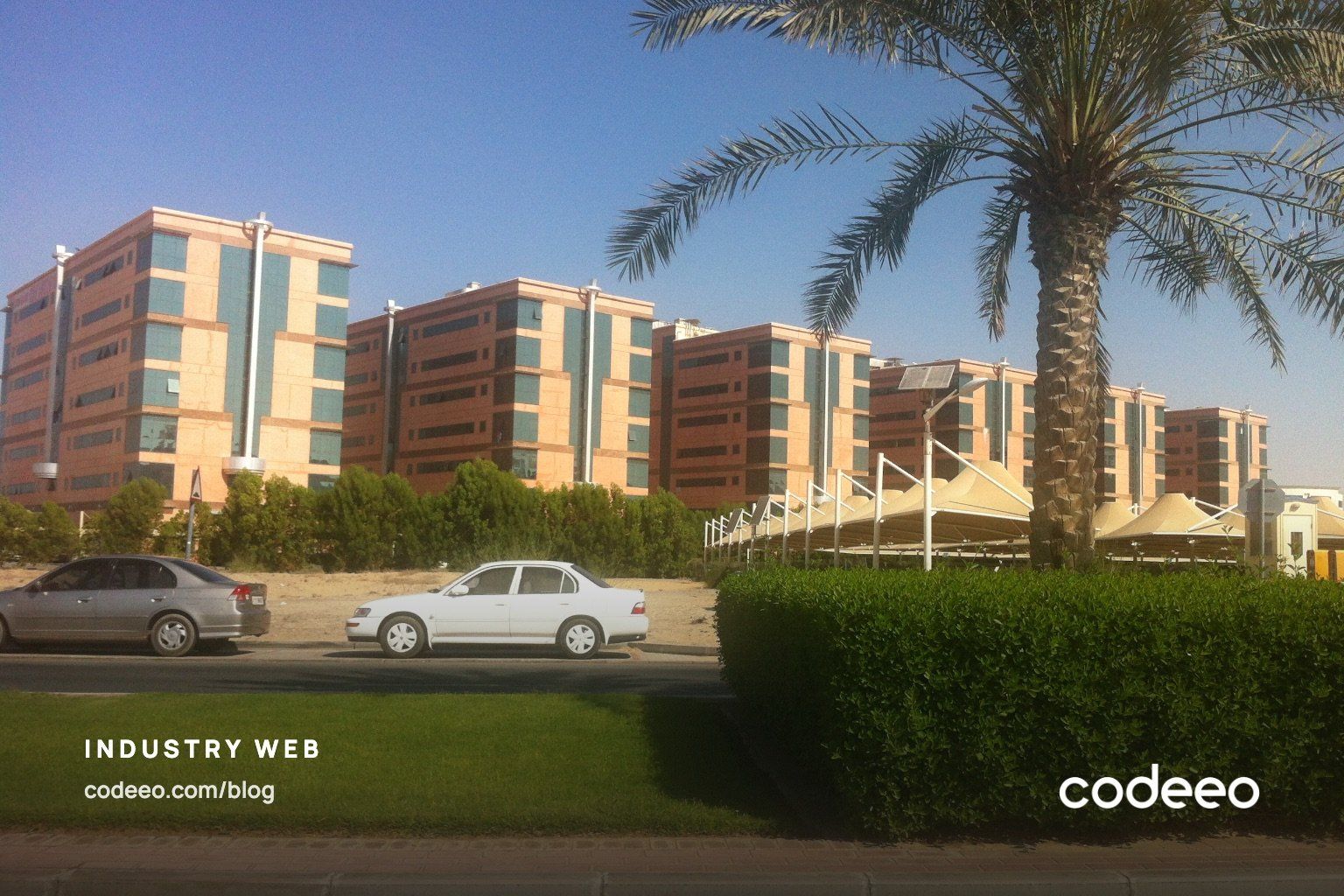
KHDA rules were checked against KHDA’s Guidelines for Advertising and Marketing, the Registration and Refund Policy for all Dubai Private Schools, the Student Placement Guidelines FAQ for parents, the training institute service manual and KHDA news releases on 27 September 2026, and they change over time. This is general information rather than legal or regulatory advice; confirm your own obligations with KHDA. Cover photo: Academic City – Dubai – United Arab Emirates – panoramio by Mahmoud Farrag, via Wikimedia Commons (CC BY 3.0).
Web DevelopmentBusiness Website Design DubaiWhat a business website in Dubai should do, template vs custom builds, what drives cost and time, platforms, SEO and conversion, and choosing an agency in Business Bay. Web DevelopmentBest Website Designing Company in DubaiHow to choose a website designing company in Dubai: business goals, the right platform, SEO and conversion, costs and timelines, and support after launch.
 Web DevelopmentInclusive Web Design: Principles, WCAG 2.2 Checks and Tools for 2026What inclusive web design means in 2026, the seven principles behind it, the WCAG 2.2 checks that matter most, useful accessibility tools and the laws to know.
Tell us what the business needs. We will tell you what to build first.
Schedule a free consultation and get a written recommendation, with costs, before you commit to anything.
Get in touchPROVEN RESULTS
4.7 / 5verified reviews on Google