 UAEQualifying Free Zone Person: How the 0% Corporate Tax Rate WorksThe 0% rate applies to Qualifying Income only. The four doors in Cabinet Decision 100, the 2025 activity lists, the 5% or AED 5m de minimis test and the five-year loss rule, with Dubai examples.
UAE VAT Registration Threshold: When a New Business Must Register
The AED 375,000 and AED 187,500 VAT thresholds explained: how the rolling 12-month and 30-day tests work, what counts, free zone rules, and the cost of registering late.
The UAE VAT registration threshold is AED 375,000 of taxable supplies and imports. A UAE resident business must register once it has passed that figure over the previous 12 months, or once it expects to pass it within the next 30 days. Below that, a business may choose to register voluntarily once its taxable supplies or its standard-rated expenses pass AED 187,500. Both figures are set in Articles 7 and 8 of the VAT Executive Regulation and repeated on the Federal Tax Authority’s registration service page (last updated 19 August 2026), and the application is due within 30 days of the obligation arising.
Key takeaways
- Mandatory registration applies above AED 375,000 of taxable supplies and imports, tested on a rolling 12 months and on the next 30 days.
- Voluntary registration opens at AED 187,500, and for a new company it can be based on standard-rated expenses rather than sales.
- Zero-rated sales such as exports count toward the threshold, exempt sales such as residential rent do not, and selling a capital asset is ignored.
- The FTA can backdate registration to the date you first became liable, and the late registration penalty is AED 10,000.
- A free zone licence does not take a company outside VAT. Only a short list of designated zones gets special treatment, and mostly for goods.
The two thresholds in one table
Most confusion comes from mixing up the two figures and the two tests. This is how the law sets them out, using the consolidated VAT Decree-Law published by the Ministry of Finance on 28 November 2025 and the Executive Regulation as amended up to Cabinet Decision No. 149 of 2026. That last decision takes effect on 1 October 2026 and does not touch the registration articles.
| Question | Mandatory registration | Voluntary registration |
|---|---|---|
| Threshold | AED 375,000 | AED 187,500 |
| What is counted | Taxable supplies plus imports | Taxable supplies plus imports, or standard-rated expenses |
| Backward test | Previous 12 months | Previous 12 months, checked at the end of any month |
| Forward test | Next 30 days | Next 30 days, with evidence of intention |
| Legal basis | Decree-Law Art. 13, Executive Regulation Art. 7 | Decree-Law Art. 17, Executive Regulation Art. 8 |
| Choice | None once the test is met | Optional |
The VAT rate itself is 5% under Article 3 of the Decree-Law. Non-resident businesses are handled separately and are covered further down.
How the 12-month and 30-day tests actually work
The backward test is a rolling window, not a calendar year and not your financial year. At the end of each month you add up the last 12 months of taxable supplies and imports. If the total is above AED 375,000, you have crossed the threshold, even if the business is only a few months old and even if January to June was quiet.
Take a hypothetical Deira trading company that starts invoicing in February at around AED 30,000 a month. By the end of December, eleven months in, it has billed roughly AED 330,000 and is still under. One larger order of AED 50,000 in January pushes the rolling total past AED 375,000, and the obligation starts there. Nobody at the company decided anything. The arithmetic did.
The forward test catches businesses that are about to cross the line in one step. A Business Bay fit-out contractor that signs a single AED 400,000 contract due to be invoiced in the next 30 days has to register now, before the invoice is issued. Waiting for the 12-month total to catch up is not an option, because Article 13(1)(b) is triggered by the expectation alone.
Executive Regulation Article 7 fixes the dates. The application is due within 30 days of becoming required to register. Under the backward test, registration normally takes effect from the first day of the month after the month you crossed the threshold. Under the forward test, it runs from the date there were reasonable grounds to believe you would cross it.
What counts toward the VAT registration threshold in the UAE
Article 19 of the Decree-Law lists what goes into the total, and Article 20 lists one thing that stays out. The practical version looks like this.
- Standard-rated sales at 5% count, which covers most trading, consultancy, retail and service revenue.
- Zero-rated sales count too, including qualifying exports of goods and services outside the GCC under Article 45, so an exporter can pass the threshold without charging any VAT to its customers.
- Imported goods and services received by the business count, which matters for a company buying software, marketing or consultancy from suppliers abroad.
- Exempt supplies do not count, since the Decree-Law’s definition of a taxable supply excludes them. Article 46 lists residential property sold or leased (outside the zero-rated cases), bare land, local passenger transport and specified financial services.
- The sale of the company’s own capital assets, such as a used delivery van or office equipment, is ignored for both thresholds under Article 20.
- Supplies of a business you have bought from someone else count, as do related-party supplies in the cases the Executive Regulation sets out.
One issue we often see is a founder counting only local sales and leaving out imported services. A Dubai e-commerce seller paying overseas platforms, ad networks and freelancers can find that those imports push the total past AED 375,000 months before local revenue would have.
Voluntary registration for a new business
A company with little or no revenue yet can still register voluntarily, and for some businesses that is the better route. Article 17 allows it when taxable supplies or standard-rated expenses exceed AED 187,500 over the previous 12 months, or are expected to within the next 30 days.
The expense route is the one new companies use. Executive Regulation Article 8(5) defines these taxable expenses as standard-rated costs incurred in the UAE by a UAE resident. A new restaurant in JLT spending on fit-out, kitchen equipment and a deposit on rent can pass AED 187,500 in expenses before it serves a single customer.
The reason to do it is input tax. Once registered, a business can recover the 5% VAT on its costs. Article 56 also allows VAT paid before registration to be recovered on the first return, provided the goods and services go on to be used for taxable supplies, although it excludes some cases such as the depreciated part of capital assets. A fit-out budget of AED 600,000 plus VAT carries AED 30,000 of VAT, which is a real number for a company that has not opened yet.
Since 15 November 2024, when Cabinet Decision No. 100 of 2024 took effect, the voluntary route also requires evidence that you are carrying on a business in the UAE and that you intend to make supplies that give a right to recover input tax. The FTA’s registration page asks expense-based applicants for at least five VAT invoices with amounts exceeding the threshold. In practice that means contracts, invoices and a plausible business plan, not a trade licence alone.
When voluntary registration is the wrong call
A registered business files returns every tax period, keeps records for five years under the Tax Procedures Executive Regulation, and faces penalties for late filing. A freelancer selling mainly to consumers, who cannot pass the 5% on without raising prices, may gain little and take on a filing obligation. Register voluntarily when the input tax you recover, or the credibility with VAT-registered clients, is worth that ongoing admin.
Free zones and designated zones
A free zone licence changes where your company is licensed. It does not remove VAT. A software firm in Dubai Internet City, a consultancy in DMCC or an IFZA trading company registers on exactly the same thresholds as a mainland LLC.
The special treatment belongs to designated zones, which are a separate and much shorter list set by Cabinet decision. The FTA’s published list, dated 21 September 2021, includes Jebel Ali Free Zone, Dubai Airport Free Zone, Dubai CommerCity and several others across the emirates, and it does not include DMCC, DIFC, Dubai Internet City, IFZA or Meydan. We could not find a newer version on the FTA site, so check the current list before relying on it.
Even inside a designated zone, the relief is narrow. Article 51 of the Decree-Law lets goods move between designated zones without VAT in qualifying cases, and Executive Regulation Article 51(6) treats services supplied in a designated zone as supplied inside the UAE. A JAFZA company selling consultancy therefore charges VAT like anyone else, and it counts toward the threshold in the normal way.
Related companies and splitting the business
Some owners try to keep each company under AED 375,000 by spreading sales across two or three licences. Executive Regulation Article 13 was written for exactly that. Where companies are linked economically, financially and by regulation and have artificially split one business, the FTA treats their taxable supplies as one total for both thresholds, and each company must register if that total is over the line.
The FTA can aggregate even where the split was not artificial if it sees a loss of tax revenue. Article 9 of the Executive Regulation describes the links it looks at: a shared commercial objective or the same customers, financial dependence, and common management, staff or shareholders. Two salons under the same owner, same brand and same manager are an easy case for aggregation.
The legitimate version of grouping is a tax group under Article 14, where related persons established in the UAE register together under one tax registration number. That suits holding structures with several operating companies, and it is a planning decision rather than a way round the threshold.
Late registration, the penalty and the back tax
The penalty for failing to apply on time is AED 10,000. That figure appears in Cabinet Decision No. 49 of 2021 and was kept in the revised penalty table introduced by Cabinet Decision No. 129 of 2025, which took effect on 14 April 2026.
The penalty is usually the smaller cost. Under Executive Regulation Article 7, a business that fails to apply is registered from the date it first became liable, and it must pay the VAT due on all taxable supplies and imports made before registering. If those sales were invoiced without VAT, the 5% comes out of the company’s own margin, because the customers have already paid.
Take the hypothetical Deira trader again. If it crosses the threshold in January and only notices in October, nine months of sales at around AED 30,000 a month carry roughly AED 13,500 of VAT it never collected, on top of the AED 10,000 penalty. That is why we suggest setting a monthly check on the rolling 12-month total from the first month of trading.
Non-residents and zero-rated only businesses
A business with no place of residence in the UAE has no threshold at all. Article 13(2) requires it to register as soon as it makes supplies in the UAE where no other person is obligated to account for the VAT. In many business-to-business cases the UAE customer accounts for the tax under the reverse charge, which is why the rule bites mainly on non-residents selling to consumers or to unregistered buyers.
At the other end, a resident business whose supplies are all zero-rated can ask the FTA for an exception from registration under Article 15. It must tell the FTA within 10 business days if it starts making standard-rated supplies. An exporter may prefer to register anyway so it can recover VAT on its UAE costs, so the exception is a choice, not a default.
If you are close to AED 187,500 or AED 375,000, or you are setting up and want to know whether voluntary registration pays for itself, our team handles corporate tax and VAT registration in Dubai, including the invoicing and record setup that has to exist before the first return. Free zone founders may also find our guide to corporate tax registration for free zone companies useful alongside this one.
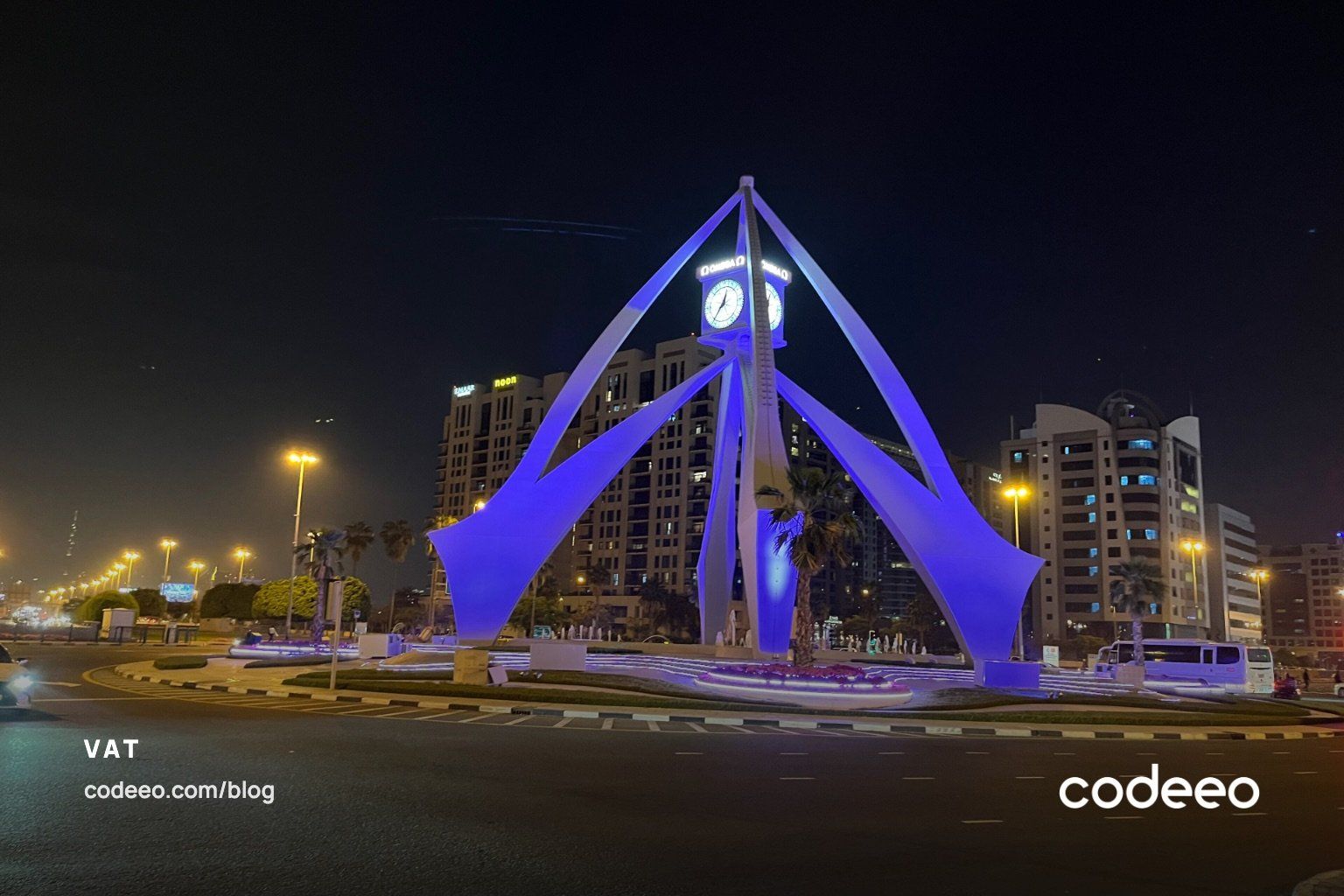
Figures and rules were checked on 28 and 29 September 2026 against the FTA VAT registration service page, Federal Decree-Law No. 8 of 2017 as amended (consolidated text published 28 November 2025), its Executive Regulation as amended up to Cabinet Decision No. 149 of 2026, Cabinet Decision No. 40 of 2017 as amended by Cabinet Decision No. 129 of 2025, and the FTA designated zones list of 21 September 2021. The English texts are unofficial translations published by the Ministry of Finance, figures are indicative, and this is general information rather than tax advice. Cover photo: Deira Clock Tower, Dubai, United Arab Emirates by CivArmy, via Wikimedia Commons (CC BY 4.0).
UAEQualifying Free Zone Person: How the 0% Corporate Tax Rate WorksThe 0% rate applies to Qualifying Income only. The four doors in Cabinet Decision 100, the 2025 activity lists, the 5% or AED 5m de minimis test and the five-year loss rule, with Dubai examples. UAEBookkeeping Requirements for a UAE Free Zone Company: What to Keep and for How LongCorporate tax records run seven years, VAT real estate records fifteen, and an open audit adds four more. A Qualifying Free Zone Person also needs audited accounts at any revenue level, which rules out Small Business Relief entirely.
 UAESmall Business Relief and UAE Corporate TaxSmall Business Relief lets a UAE resident business with revenue up to AED 3 million elect to pay no corporate tax until 2029, but it still has to register, file and keep records.
Tell us what the business needs. We will tell you what to build first.
Schedule a free consultation and get a written recommendation, with costs, before you commit to anything.
Get in touchPROVEN RESULTS
4.7 / 5verified reviews on Google